
1.4.4 Building And Analysing Concept Maps—A Short Tutorial
Each year I ask groups of students in a postgraduate class I teach to produce a concept map of a topical problem. Such a problem is the subject of this short tutorial. Students start by creating an account of the problem. They break this down into constituent elements, which they state as individual concepts. These concepts are usually stated as distinct phrases of typically 8-12 words, each taking the form as a call for action (Eden and Ackermann, 1998a), where such a statement is possible. These statements are written on Post-it® Notes, small sticky labels. Using a white board or flip charts, these concepts are first clustered with like concepts and amalgamated as necessary, then progressively connected, using the three types of link described above. The map thus produced is built as a graphical representation of the group’s account of the problem situation. These group activities reveal the richness and pattern of reasoning about a problem in a way that is unique to mapping. In this exercise, the start point is the bland statement:
‘Smoking leads to heart disease’.
Students are generally quick to point out that it is more appropriate to use the words leads to rather than to make the statement, which appears on packs of cigarettes in Australia:
‘Smoking causes heart disease’.
A statement using the verb causes suggests smoking always produces heart disease. The verb causes suggests immutable autonomic causality that is only found in the physical world. Consider the following example from Newtonian Physics:
Increasing the force applied to a moving body will cause its acceleration to increase proportionally to the increase in force.
(Newton’s Second Law: ∑ Force = mass x ∑ accelerations).
Logic from our physical-world example does not fit well with what we know about the relationship between smoking and heart disease. It is not clearly established that a smoker who increases the number of cigarettes smoked per day from, say, ten to twenty will double the likelihood of developing heart disease. A person may develop heart disease by continuing to smoke as few as five cigarettes per day, or despite quitting smoking totally after being a smoker for some years. Further, we may choose to differentiate between active and passive smoking. This may be depicted using the terminology rather than, to indicate a bi-polar concept, signified by the use of an ellipsis (…), as used by Eden (1988). Some non-smokers in Australia, for example, have argued successfully and won in litigation against employers who have not provided a smoke-free workplace. Their legal arguments were built around the following:
‘Passive smoking … (rather than) active smoking, leads to heart disease’
An alternative way of depicting this rather than (…) relationship is shown at Figure 1-2. Concepts are normally numbered, simply for identification. As this map is quite small, a scheme for numbering the concepts has not been used.
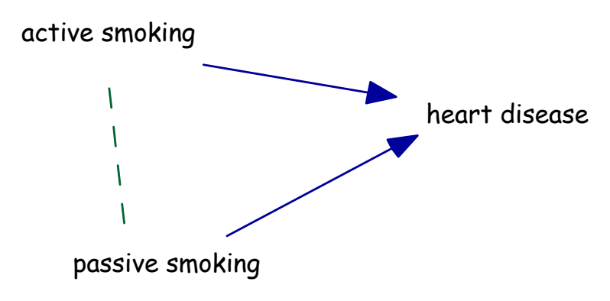
The solid arrows depict fuzzy leads to causality. The dotted line depicts a connotative relationship between active smoking and passive smoking. It suggests that passive smoking and active smoking may be similar to some extent. They may be different but the nature of these similarities or differences for now remains unclear. Further investigation of the two forms of smoking is needed before we fully understand them.
Note that this map can also be read in the reverse way that ‘active smoking …(rather than) passive smoking alone leads to heart disease’. Each of the concepts has been shortened for convenience. However, a note of caution is needed. Each mapped concept is normally and deliberately coded with an active verb so that each of the ideas, notions, personal constructs or concepts contained in them constitutes a call for action. This is both an aid to minimising ambiguity and to guide manage and control processes, which is meant to flow through pairs of linked concepts. A call for action at the tail (source) of a causal link is intended to result in some form of management or control action at the head (sink) of that link. More fully expressed, concepts in this figure are ‘partaking in the practice of active smoking of cigarettes’, ‘being exposed to passive smoking of cigarette smoke’, and ‘the onset of heart disease later in life’.
It is quite feasible that passive smoking by a bartender who worked for years in a smoke-filled bar might have the same effect on the individual’s health as a comparable period of active smoking. Characteristically, connotative relationships are difficult to describe with precision.
In our tutorial example, students argue that there could be a myriad of factors affecting the onset of heart disease, including:
- stress;
- a genetic predisposition to the disease;
- lack of exercise;
- exposure to environmental pollution;
- having elevated blood pressure (hypertension), noting individuals may have a predisposition to hypertension, whilst others may also suffer from hypertension aggravated by a lack of exercise or stress;
- lifestyle factors such as levels and types of fatty food intake are likely to contribute to heart disease via an intermediate mechanism, increased cholesterol; and
- the proportion of cholesterol that is low-density lipids, the form that builds up and is likely to form blockages in blood vessels.
References
- Eden, C and Ackermann, F., 1998a, Making Strategy: The Journey of Strategic Management, Sage, London.
- Eden, C., 1988, “Cognitive mapping.”, European J. Operational Research, vol. 36, no. 1, pp 1-13.