
1.1 A PARADOX AND A POLAR BEAR
In risk management, today’s situations and problems are very frequently created in the days, months, or years before anything untoward is noticed. This is because causes and their observed effects are frequently not proximate in space and time. The source of today’s problems may be elsewhere and therefore not immediately obvious. Significant delays may also be involved between the cause and the effect. Since the causes may not be within our immediate view and outside our normal domain of action, when the effects present they can come as a surprise.
This book starts with the hypothesis that effective risk management stems from being acutely aware of what is happening. Situation awareness verges on being a nervous state of heightened sensitivity to what is going on, and what might happen at some stage in the future.
Situation awareness might be introduced with the aid of a metaphor. A family with a number of small children might attend a poolside barbeque. The father is keen to catch up with friends and relatives. He also has the responsibility to help cook the food and distribute drinks. He will do this once the introductions have been made and the children have gone off to play. The mother quickly scans the pool area, the pool fence and gate and the games being played by the other children, before sending them off to play. She also issues instructions that the two-year old toddler is not to be allowed to go near the pool. Unlike the father who is already busily engaged in socialising, the mother positions herself on a deck chair where she is able to view the children’s play as well as the comings and goings of the elder children through the pool gate. Unlike the father, the mother has situation awareness as far as the activities of the children is concerned. This awareness is heightened by the existence of the pool: the mother has already assessed that the pool, and unobserved entry to the pool area by the toddler, represent threats to the toddler’s safety. Whilst able to relax somewhat and enjoy a drink with friends, she has chosen to position herself so that she is able to monitor what the children are doing. She pays little attention to the games of the older children, but retains certain nervousness and continues to monitor where the toddler is and what he is doing.
A state of heightened sensitivity or acute situation awareness, particularly to slowly developing situations, is not natural. Human evolutionary development leaves us far better equipped to react to clear and present danger, invoking a ‘fight-or-flight’ response, than making carefully calculated responses to insidiously developing circumstances and choosing the precise time to act. To be able to choose the right time to act, we must be able to imagine those scenarios that might lead to possible future outcomes, well in advance of events occurring. This demands we think about many things, not just one or two we believe right now to be critically important.
There is a growing body of evidence which suggests that as managers we often seek simple but highly effective solutions, that is, ‘gold nuggets’ to solve problems we face. That we might expect to uncover ‘gold nuggets’ is both naïve and problematic; few real-life problems are simple. More frequently than not, real-life problems are systemic and dynamic. Further, it is safer to start from a premise that our problems are complex. Such a premise is closest to reality. Subsequently, when we find that a problem is truly simple, we will be pleasantly surprised. If we start from a premise that the world and our problems are simple, invariably we will be disappointed; we find to our chagrin that we are unable to resolve what confronts us. Although there is strong evidence that single ‘gold nuggets’ do not exist and that panaceas for all ills are a myth, managers specifically and people generally bet on them in the same way as one might bet on a horse race or take a ticket in a lottery. Imagine every lottery ticket carrying a health warning like a pack of cigarettes … “your chance of winning first prize is only marginally higher than being struck by lightning”. This is as likely to deter a player buying a lottery ticket as a health warning on a pack of cigarettes is likely to persuade a long-term smoker to re-think the purchase of the next pack.
Examples of contemporary society’s search for ‘gold nuggets’ include expecting to find a single effective cure for HIV/AIDS, or expecting that mapping the human genome will reveal everything the medical fraternity needs to know to determine how to correct human frailties and obviate our predisposition to life-threatening diseases. Too frequently, risk management is taught from a mathematical viewpoint with virtually no explanation of how to deal with risks that are coupled together. Real-life risk management is about much more than singling out a specific event of concern and estimating its likelihood or probability of its occurrence, and contemplating its consequences. To most managers, a likelihood of 1 in 10,000,000 that a specific event could occur means little. However, it should be clear that an event with a probability of 1 in 10,000 is much more likely to occur. But, what does it really mean when we restate this by saying that the latter event is 1,000 times more likely to occur than the former? Unfortunately, even this restatement has little practical significance for most managers. In recognition of this, we focus here on qualitative risk-management techniques and consider how to use those techniques to greatest effect.
What is of greater value to managers is to have a highly developed appreciation of real-life risks. Real-life risks are typically coupled to one another and operate in combinations. Real-life risks are systemic and dynamic in nature. We need to understand how several causal influences can come together, frequently after an indeterminate period of delay, at a point in space and time, and that the consequences of this coming together might be undesirable or even disastrous.
Before the Concorde crash on the outskirts of Paris in 2000 it was well known that the fuel tanks in the wings of every Concorde aircraft were vulnerable to being punctured by sharp objects or projectiles. It was also well known that tyres sometimes burst. However, the circumstances leading to puncturing of the fuel tanks following a tyre bursting were hard to imagine. In this case, it was almost inconceivable that debris, parts of another aircraft, could actually fall off and could remain strewn on the runway and would remain there undetected for some time. It is now history that a lack of action to look for and clear that debris could subsequently cause the Concorde’s tyre to burst with the result that a fuel tank would be punctured causing a horrific fuel fire and fatal crash.
Accident investigators frequently talk about chains, or sequences, of events. The veracity of such an approach for determining what went wrong in accident cases is not questioned. There will always be a need for a forensic view of accidents. However, in an attempt to enhance the risk-management skills of managers, this book looks more widely. It seeks out the systemic failures that create the precursor situations, or environments, conducive to manifestations of highly undesirable consequences. It must be stressed that few risky situations we may be involved in, or are called upon to manage, will ever culminate in catastrophic consequences. However, much of what we see in our domains of action, or are required to manage, are benign instances of potentially catastrophic situations.
The first step on our journey of enhancing our situation awareness is to appreciate the meaning of systemic risk. A non-smoker working in blue asbestos processing plant may do so with comparatively little risk, whereas a smoker in the same workplace will almost certainly be sentenced to a painful choking death, though the onset of the symptoms of terminal disease will not appear for many years. This is an example of systemic risk: smoking and blue asbestos are a lethal combination, effects of which do not appear for many years.
How we should perceive the combination of systemic risks derives from evidence found through empirical analysis of real cases. A cynic might argue that ‘after-the-event’ analysis is of little real value; academics might draw lessons and publish journal articles based on the analysis, but that is of little real value to managers generally. That is true enough. This book aims to correct that situation by sharing the knowledge gained from empirical research and the techniques used to provide powerful insights into systemic risk situations so that they may be applied routinely ‘before-the-fact’, not in a predictive sense, but to facilitate highly effective risk mitigation. It would be foolhardy to expect we could ever predict with any precision both when and where risks will manifest themselves. A variant of Heisenberg’s Uncertainty Principle applies to systemic, dynamic real-life risks.
Great utility derives from an understanding of the risks we might draw from case study analysis and characterisations of the nature of risks. The utility can only be fully realised when we deliberately transport these characterisations to contextual situations we might encounter in the future. As a result of this deliberate action, we should be able to develop heightened situation awareness of what may be, or what is actually developing around us within our domains of action. Through this process, managers develop much more relevant ways of thinking about risks, particularly systemic risks. They are more likely to learn. This planned and deliberate process is necessary because opportunities to learn from experience in risky situations generally come at a high cost, and few managers actually (thankfully) have the opportunity to learn from bitter experience.
Armed with new ways of thinking, that is, systems thinking about risky situations, we can develop enhanced situation awareness and heightened sensitivity. We are then much better placed to manage risks before they arise or before they play out to their final, undesirable, potentially catastrophic consequences.
Deliberately building awareness of risks might be explained by a metaphor. We face a problem of searching for a polar bear thought to be lying on the snow a couple of hundred metres away near our intended route. Identification and subsequent recognition of the polar bear can only occur once the vast expanse of background can be effectively scanned and focus brought to bear (no pun intended) on the subject of our search. Using visible light, we are not well equipped to identify the superbly camouflaged bear.
In our metaphor, however, we might use a thermal imager to great effect. A thermal imager is an electro-optic device that converts heat, emitted as infrared radiation, into visible light. This device enables us to readily detect heat-emitting bodies. Armed with this device, we can quickly find any sources of heat contrasting against a colder background. We will quickly find and recognise our otherwise invisible polar bear. This is possible through the act of changing the context. In the first context, the polar bear could easily hide in the white of the snow and attack us as we draw near. In the second context, the polar bear as a warm body against a cold background shines like a beacon. We can now avoid the danger, or if we are unable to vary our route, we can know when we must be prepared to defend ourselves against possible attack. It is no coincidence that the first stage of the risk-management process described in the Australian /New Zealand Standard (AS/NZS) 4360 Risk Management is to establish the context within which risks may occur. To extend the metaphor, we need analytical tools and techniques that permit effective identification and recognition of that which should really be our centre of attention, at the effective exclusion of the distracting background. Many of the things we do we manage as projects. In the simplest terms a project is a purposeful endeavour having a clearly defined beginning and end. Much of the discussion that follows is made easier when we consider a particular timeframe, say, corresponding to the beginning and end of a project of interest. What is written here about risks is generally applicable whether we are talking about projects, or talking about operational or strategic-level management.
Thinking about risks, particularly in projects, must start very early. Careful thought should be applied even before the existence of a project is acknowledged. From that earliest point, thinking about and managing risks proceeds as a series of iterations. It becomes an endless cycle of thinking, observing, doing, making adjustments and reflecting on how things have gone so far and how they might play out in the future.
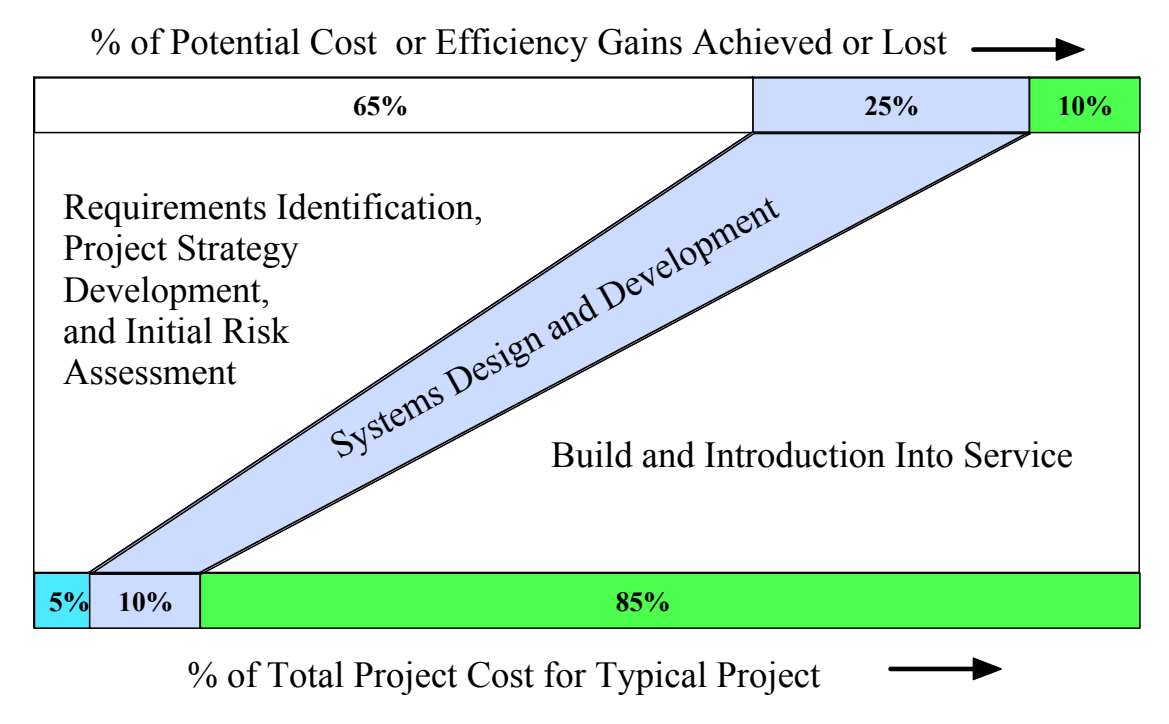
In the early part of any project we spend time thinking about how we are going to manage the project. This is when we develop our project strategy. This is known as the conception phase. As a general principle, the cost and efficiency gains in projects accruing from effective conduct of the project’s conception phase are depicted below in Figure 1-1. This diagram suggests that despite consuming as little as 5% of the funds of the project, conceptualisation activities can impact on some 65% of the overall costs. Thus, developing the project strategy and conducting an initial assessment of the risks that we might encounter in the project are critically important and formative activities. The better we are at these activities, the greater the rewards, noting of course that risk management is an activity that continues through every phase of a project. The cost savings that might accrue from being an effective risk manager are sufficient justification for wanting to improve our risk-management skills.
Footnotes
- [1] Adapted from Australian Joint Parliamentary Committee on Public Accounts, Report 243, 1986. back