
12.9.3 Helical Antenna
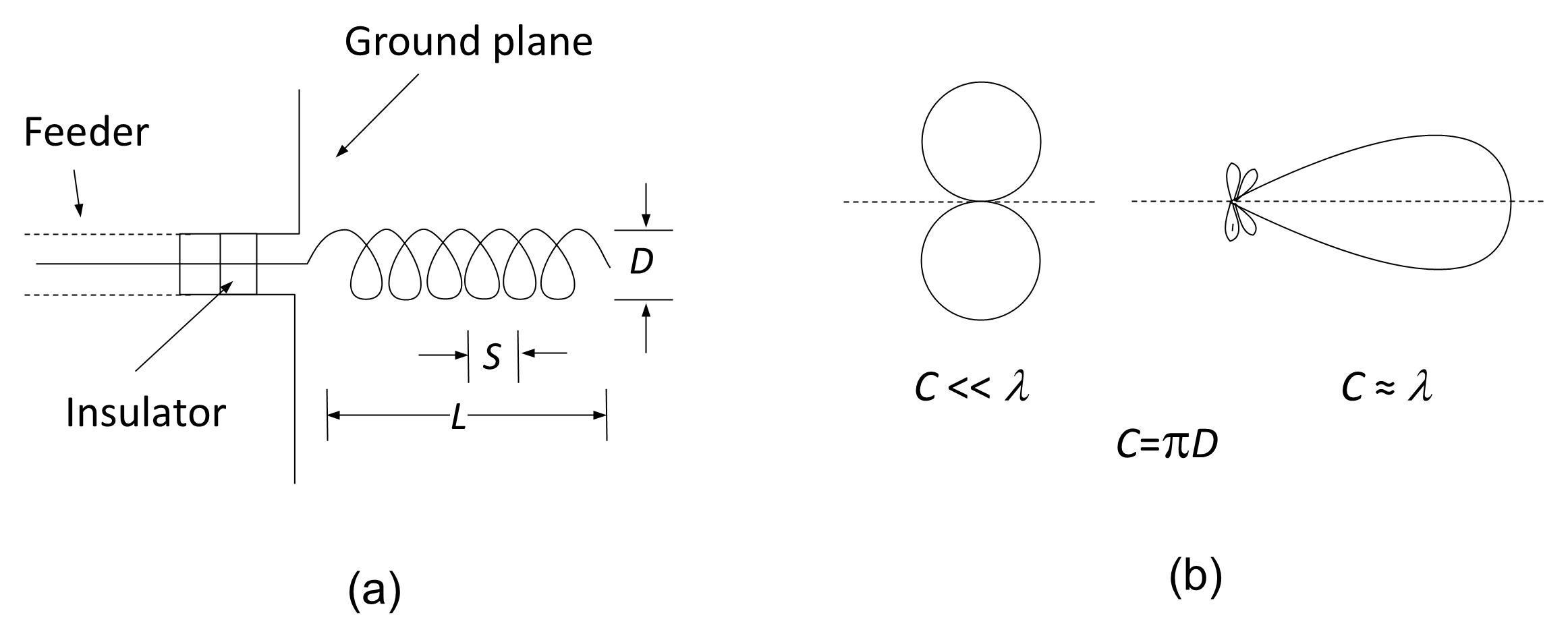
The helical antenna is valued for its mechanical simplicity, moderate gain, and ability to produce circular polarization without complex feed networks. As illustrated in Figure 12.43, the radiating element is a conductor wound in the form of a helix, connected to the center conductor of a coaxial cable, and a metal ground plane connected to the braid. The helix is typically fed at its base by a coaxial line, with the center conductor connected to the helix and the outer conductor bonded to the ground plane.
As illustrated in Figure 12.43, the antenna may operate in two distinct modes depending on its electrical dimensions:
- Normal mode. When the circumference of the helix is small compared with the wavelength (C ≪ λ, typically C < 0.3λ) and the overall length is short relative to λ, the antenna operates in the normal mode. In this case, the current distribution is approximately uniform along each turn, and the helix behaves electrically like a short dipole combined with a small loop. The radiation pattern resembles that of a short dipole with maximum radiation perpendicular to the helix axis. Polarization is predominantly linear (often vertical if mounted vertically) and gain is low (typically 1–3 dBi). Normal-mode helices are compact and commonly used at VHF and UHF in handheld and mobile equipment where size is constrained.
- Axial mode. When the helix circumference approaches one wavelength (C ≈ λ), the turn spacing is approximately 0.2–0.3λ, and several turns are used (typically 3–15), the antenna operates in the axial mode. Radiation from successive turns adds constructively along the helix axis such that the main beam is directed along the axis of the helix (end-fire radiation). Radiation is naturally circularly polarized, with the sense (right-hand or left-hand) determined by the winding direction. The beam is moderately narrow with reasonable front-to-back ratio with typical gain ranges from 10 to 15 dBi, depending on the number of turns and geometry. Axial-mode helices are widely used in satellite communications, telemetry, space probes, and GNSS applications, where circular polarization reduces polarization mismatch losses due to rotation or Faraday effects.
Helical antennas have reasonable directivity, but have higher side lobes than parabolic reflectors. The gain of a helical antenna is approximated by:
where n is the number of turns in the helix, S is the turn spacing, and D is the diameter of the helix. Gain increases approximately linearly with the number of turns and with helix aperture area. Increasing the number of turns also narrows the beamwidth.
One of the principal advantages of the axial-mode helical antenna is its relatively broad impedance and axial-ratio bandwidth compared with many resonant antennas. This bandwidth is considerably wider than that of high-Q resonant structures such as small loops, though narrower than that of log-periodic or spiral antennas.
Helical antennas offer a compromise between simple dipoles and high-gain reflectors. While their gain and side-lobe performance do not match those of parabolic reflectors, they are mechanically simpler, lighter, and easier to construct. Their ability to generate circular polarization directly makes them especially suitable for space and satellite systems, where polarization alignment cannot be guaranteed.
In summary, the helical antenna is a versatile radiator whose operating mode is determined primarily by its electrical circumference. In normal mode it behaves as a compact linearly polarized antenna radiating broadside to its axis, whereas in axial mode it becomes a moderately high-gain, circularly polarized end-fire antenna with useful bandwidth and stable performance characteristics.
Back to reading