12.8.1 Rod/Whip Antennas
Vertical rod antennas have the obvious advantages of being self-supporting and robust and can be quickly erected. They are therefore more suited to mobile applications than the wire monopole. Whips are robust and self-supporting and can be erected quickly (although a ground plane must be elevated with them if they are elevated on a mast). The radiation pattern produced is omnidirectional, although the position of the whip on a radio or vehicle will distort the pattern. For example, when mounted on a vehicle, the radiation pattern is modified so that the maximum radiation is oriented across the bulk of the vehicle’s surface (the effective ground plane).
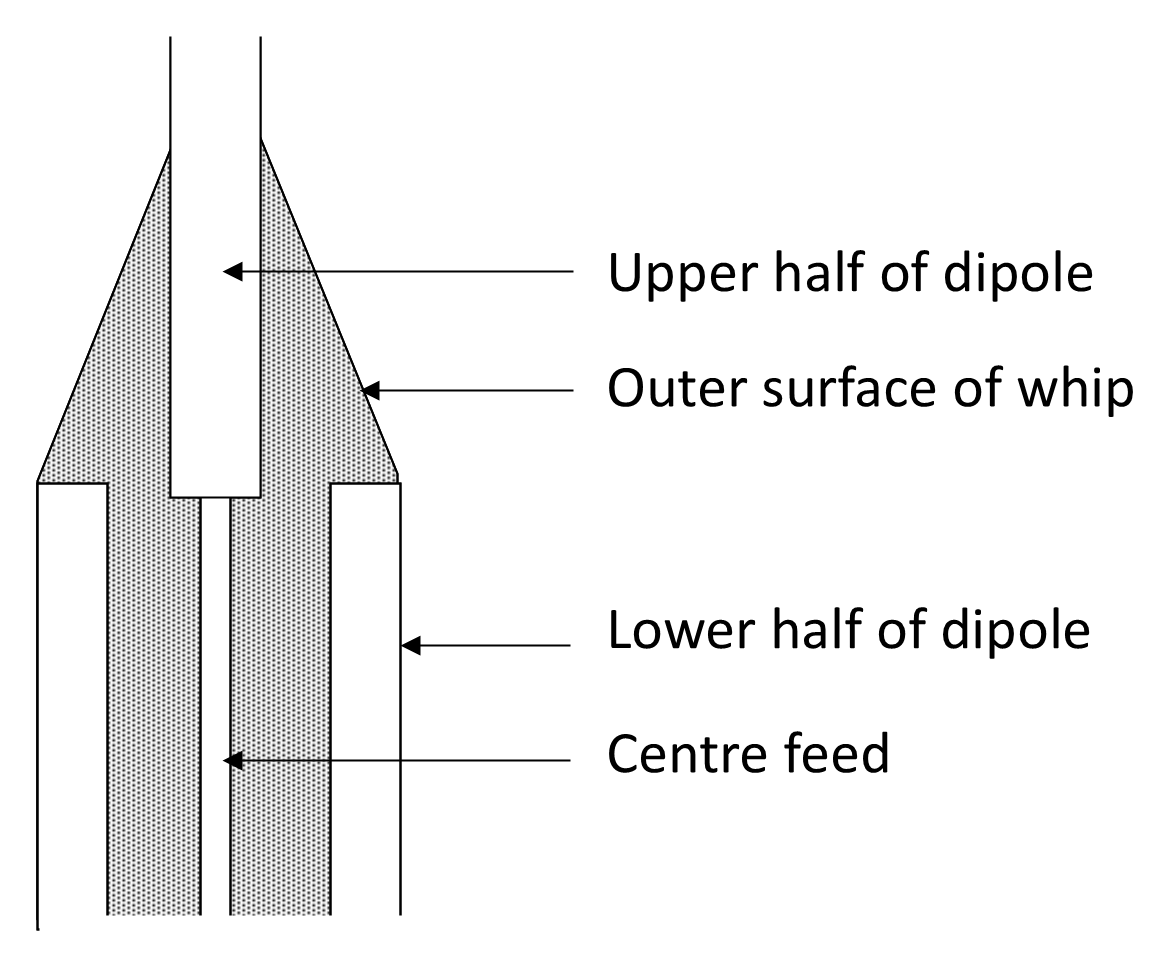
One whip antenna that looks like a monopole, but is in fact a dipole, is the center-fed whip—Figure 12.24 illustrates its construction. The center-fed whip is commonly used in place of a monopole because it has similar robustness for elevated applications but does not require a ground plane. It is common for such antennas to be mounted on the front bumper bar of off-road vehicles.