12.4.5 Narrowband Vs Broadband
A half-wave dipole is a resonant antenna and is most efficient near its design frequency. Although it radiates over a range of frequencies, its radiation resistance and impedance match degrade as frequency departs from resonance. Because practical signals occupy finite bandwidth due to modulation sidebands, insufficient antenna bandwidth can introduce mismatch loss or distortion.
Antenna bandwidth is typically defined as the frequency range over which the input VSWR remains below a specified value (e.g., 2:1). Resonant antennas have relatively high quality factor Q (see Section 9.2.1 for a description of Q), and for such antennas the fractional bandwidth is approximately 1/Q. Thus, since thin dipoles have a relatively high Q they generally exhibit narrow fractional bandwidth—often only a few percent.
Bandwidth may be increased by:
- Employing multiple resonances (trap dipoles).
- Increasing conductor diameter (reducing Q).
- Using tapered or flared geometries.
- Adopting inherently broadband structures (biconical, discone, log-periodic, spiral).
We will briefly examine the multiple resonances approach here. As we examine the antenna designs that follow, we will identify which are inherently broadband and what structural modifications may extend operational bandwidth.
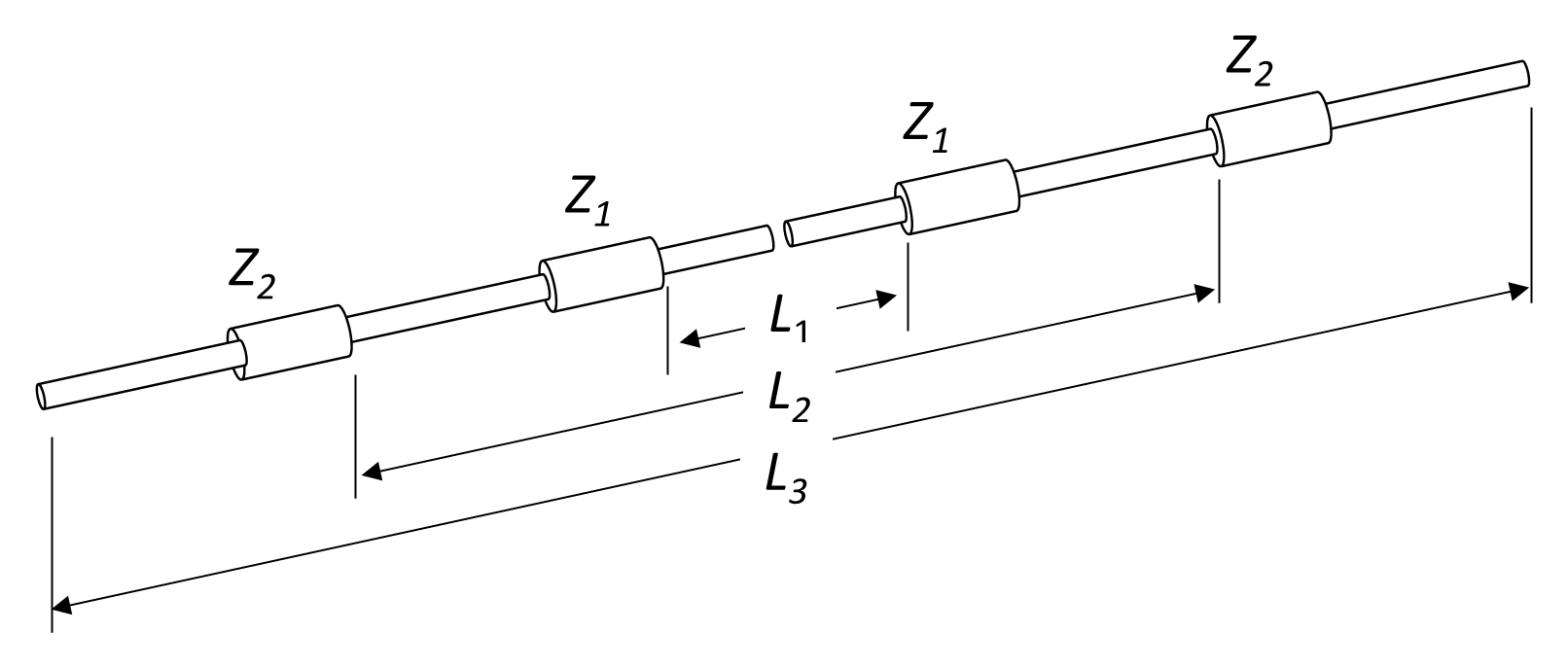
Figure 12.18 illustrates a simple multiband dipole in which parallel-resonant trap circuits are inserted along each leg of the conductor. At the lowest operating frequency, the entire length L3 is resonant at the lowest operating frequency, with traps Z1 and Z2 presenting relatively low reactance at that frequency. At the next higher frequency, trap Z2 is designed to be at or near parallel resonance and therefore presents a high impedance, electrically shortening the antenna to length L2, which is resonant in the second band. At the highest operating frequency, trap Z1 likewise presents a high impedance, isolating the outer sections and leaving only the shortest section L1 active. In this way, the effective electrical length decreases as frequency increases, enabling operation on multiple discrete bands.