
12.4.2 Tuning Of Dipoles And Monopoles
When forming a dipole from an opened transmission line, the optimal resonant length corresponds to approximately half a wavelength. If the element is shorter than resonance, it behaves capacitively; if longer, inductively. The resonant condition occurs when reactive components cancel, leaving a purely resistive input impedance.
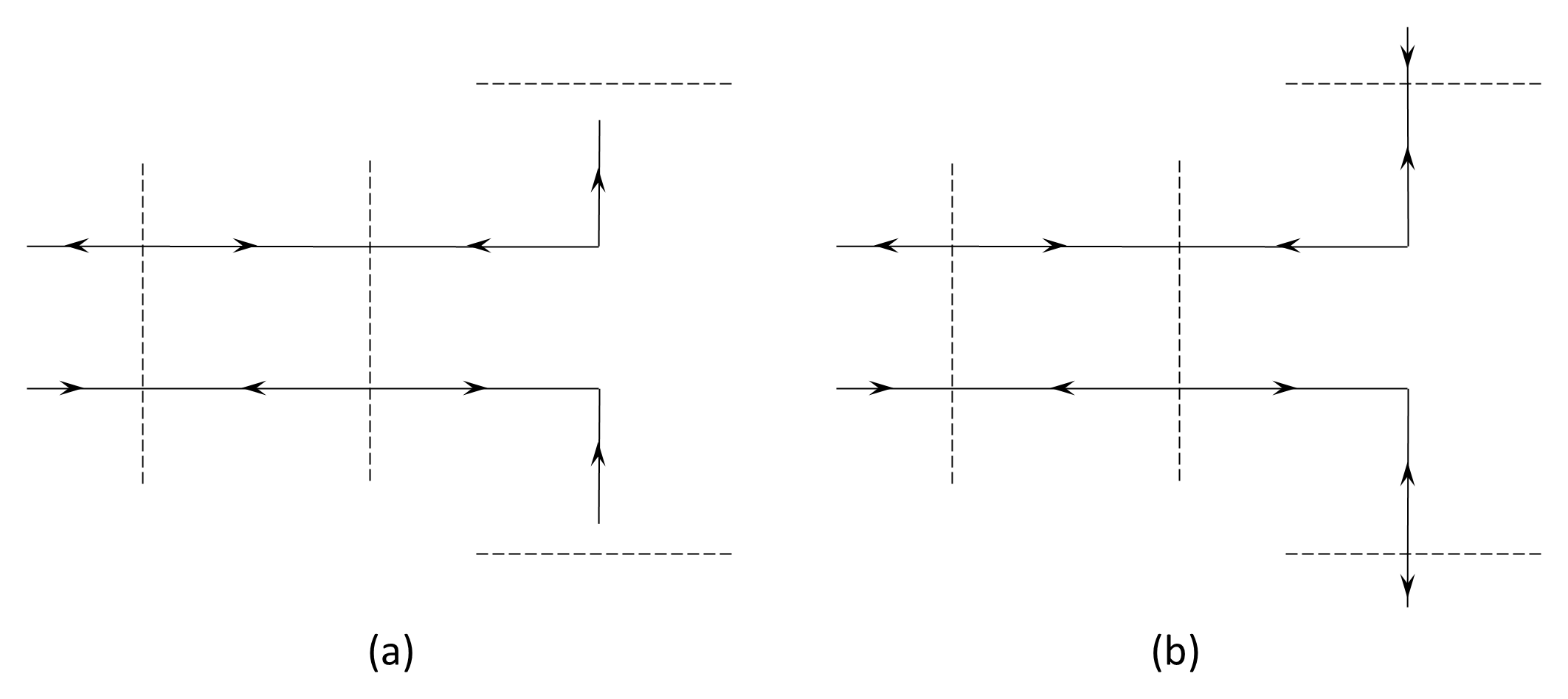
The next question to ask is how much of the transmission line opened out. What would happen if we opened up legs that were longer or shorter? As illustrated in Figure 12.14(a), if we fold the legs back to be less than half a wavelength long, then the currents in each leg will still be in phase, but there is less current so less energy is radiated. Similarly, Figure 12.14(b) shows that, if we fold back more than half a wavelength in each leg, we allow some current in each leg that is in the opposite direction to the main current. The overall current is therefore lower, leading once again to lower radiated energy. Consequently, the optimal length of a dipole antenna is a half wavelength, that is, each of the legs is a quarter of a wavelength long.
At resonance, a thin half-wave dipole in free space presents an input impedance that is approximately purely resistive, with a radiation resistance of about 72–73 Ω at its center feedpoint. A quarter-wave monopole mounted over a perfect ground plane exhibits approximately half this value, about 36–37 Ω. In these resonant cases, the reactive component of the input impedance is zero, although the antenna still possesses distributed inductance and capacitance along its length.
As discussed in Section 12.3.6, antenna tuning involves cancelling the reactive component of the impedance by introducing an appropriate series reactance. A physically short antenna, which is capacitively reactive, may be brought to resonance by inserting a series inductance. Base loading is common, in which an inductor is placed at the base of a short monopole, often forming part of the mechanical structure. For antennas that are electrically long and therefore inductively reactive, a series capacitance may be used to restore resonance at the feedpoint.
A related technique is top loading, in which additional capacitance to ground is introduced at the top of a shortened vertical element—for example by means of a capacity hat or radial wires. Top loading increases the effective electrical length and improves current distribution compared with simple base loading. However, although loading restores electrical resonance, it does not recreate the ideal sinusoidal current distribution of a full-length element, and therefore radiation efficiency cannot be fully recovered.
Historically, some transmitters and receivers were designed to match directly to the approximately 73 Ω impedance of a half-wave dipole. Modern RF systems—including contemporary military tactical radios—almost universally standardize on 50 Ω transmission lines and terminations. Accordingly, antennas that do not naturally present this impedance must either be transformed to 50 Ω through a matching network or be accommodated within the transmitter’s allowable VSWR limits.
In practical military systems, the radio typically provides a 50 Ω coaxial interface—commonly via a TNC connector—with balanced antennas such as dipoles fed through a balun or antenna coupler to ensure that the impedance presented to the transmitter is acceptable. The widespread adoption of 50 Ω in military RF systems reflects an engineering compromise: approximately 30 Ω maximizes power-handling capability, while approximately 77 Ω minimizes attenuation in coaxial lines. An impedance near 50 Ω provides a practical balance between these competing requirements, offering robustness, efficiency, and compatibility across a wide range of tactical equipment.
Back to reading