
12.3.1 Antenna Gain
While it is not possible to build a practical antenna that can radiate power equally in all directions, the isotropic radiator is a useful reference against which to compare real antennas. The gain, G, of an antenna is defined as the ratio of the maximum power density to that for an isotropic radiator at the same distance:
The gain G is called the isotropic power gain, because it represents the gain of the antenna relative to an isotropic radiator. In decibels, the isotropic power gain is written as dBi. While the isotropic power gain is useful in a mathematical sense, we may define the gain of an antenna relative to any other standard antenna (especially a real antenna, rather than the fictitious isotropic radiator). For example, it is common to refer gain to a standard dipole, particularly where a dipole is used to illuminate a reflector, so that the antenna is said to have a certain gain over the dipole on its own. When gain is referred to any antenna other than an isotropic radiator, the units are normal decibels, dB. Care must be taken therefore to ensure that it is clear to which reference antenna a stated antenna gain is referred.
The isotropic radiator is also assumed to be perfect in that it radiates all of the power fed into it. Again, practical antennas are not 100% efficient and we need to distinguish directivity, D (pattern-only), from gain G (pattern plus losses):
where η is the antenna efficiency. Note that η only relates to the efficiency with which the antenna radiates all of the energy that is fed into it; other losses such as feeder losses must also be accounted for.
As illustrated in Figure 12.4, an antenna is described by its gain pattern g(θ,φ), which describes the gain of the antenna in three dimensions. Because the patterns are normally symmetrical about an axis (the z-axis in Figure 12.4), the gain function is often written in terms of θ only—g(θ).
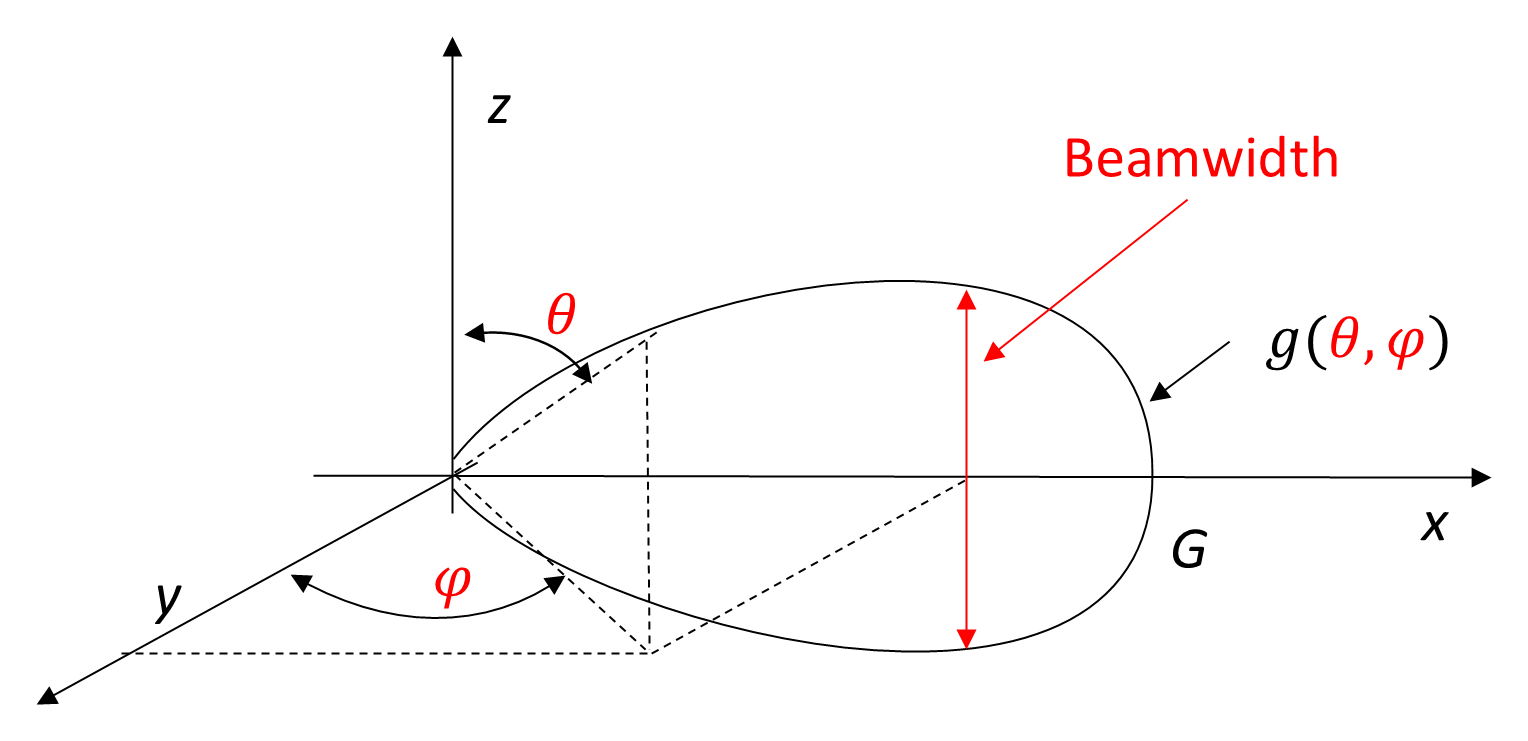
Figure 12.4 illustrates an important feature of a gain function: the maximum value of gain, G, as we discussed earlier. For all antennas, the maximum gain, G, can be approximated by:
where A is the cross-sectional area of the antenna aperture, and η is the antenna efficiency factor. We call the product ηA the effective aperture, Ae.
Back to reading