
12.9.1 Horn Antennas
The horn antenna is an aperture antenna which is useful for microwave frequencies since the antenna is a physical extension of the waveguide structure allowing the antenna to be matched closely to the waveguide. As the waveguide is flared at the ends, the impedance of the waveguide is gradually matched to that of free space. Horns therefore provide a smooth coupling of the fields inside the waveguide to the fields in free space. Like the dipole, the horn antenna can be used to radiate directly or can be used as a primary feed for a reflector antenna.
Horns are widely used as direct radiators of energy because they are small and robust. They have high gain and a good impedance match over a reasonably wide bandwidth. While horns offer relatively low sidelobes compared with many other antenna types, their sidelobe levels are higher than those achievable with large parabolic reflectors. The three most commonly used types of horn antenna (pyramidal, conical, and corrugated conical) are illustrated in Figure 12.36.
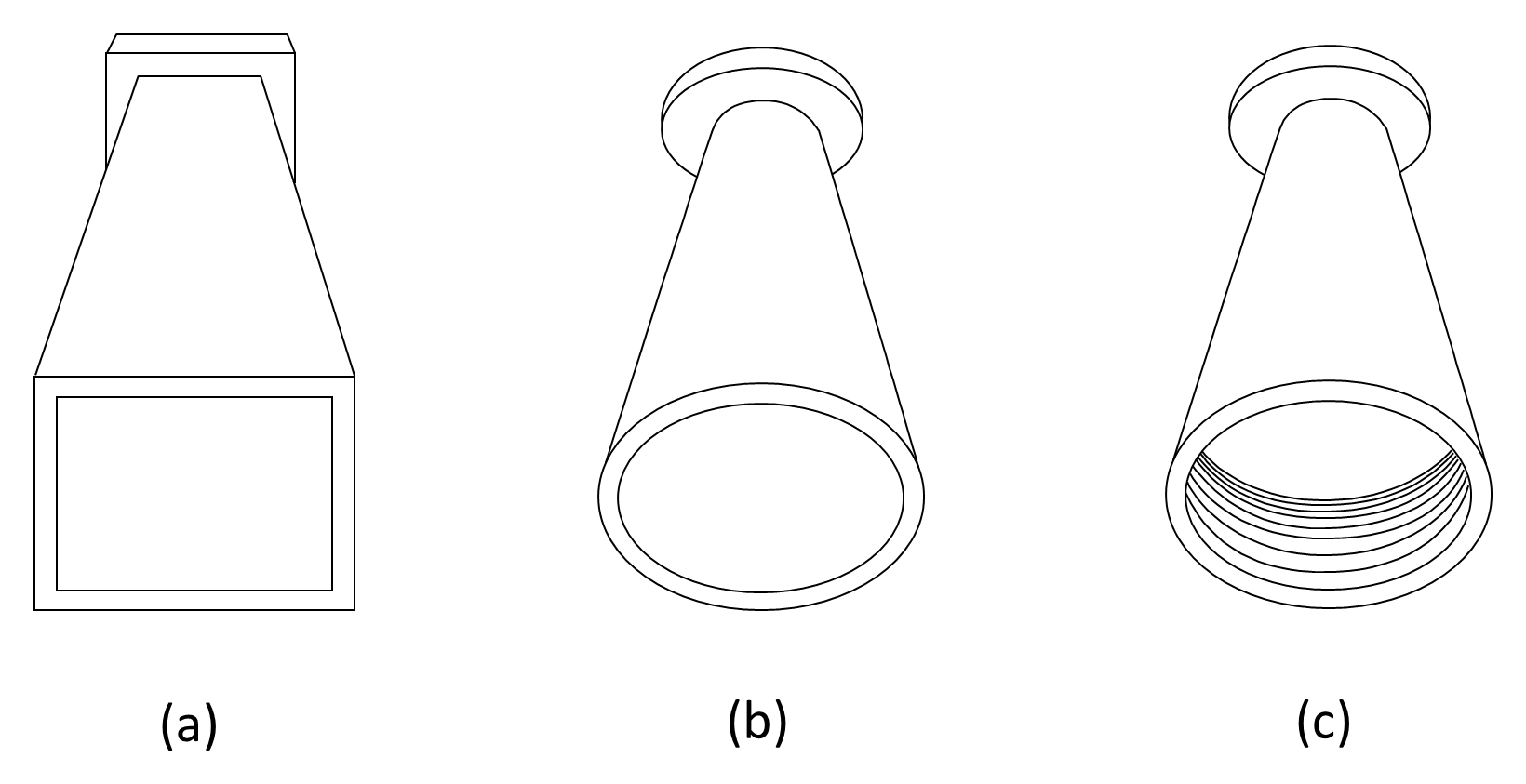
Pyramidal horn antennas. The pyramidal horn antenna has a rectangular cross-section with different beamwidths in the E and H planes, although appropriate aperture dimensions can be chosen to ensure equal beamwidths. One of the advantages of the pyramidal horn is that it can radiate horizontal and vertical polarization simultaneously without significant cross-polarization. Again, the radiation pattern of a practical horn is difficult to evaluate because of the amplitude and phase variation across the aperture.
Conical horn antennas. The conical horn antenna is ideally suited to terminating a circular waveguide, although it can be used with a rectangular waveguide by using a suitable junction. Both linear and circular polarization can be radiated. Although the horn is symmetrical, the radiation patterns are not, which causes some difficulty in covering large areas. The inside of the antenna can have a smooth wall, or the wall can be corrugated, which allows the designers to attain symmetrical beams in the principal planes. Although geometrically symmetrical, the radiation pattern of a conical horn is not fully symmetric, which can complicate uniform coverage of large areas. Symmetry can also be improved by including a dielectric rod to load the antenna or using a multi-mode horn which also assists in reducing sidelobes. Conical horns are useful for Earth-coverage antennas because their 20° beamwidth matches well with the 17.4° angle subtended by the Earth from geostationary altitude making them well-suited for Earth-coverage applications from geostationary orbit. The horn produces maximum power at boresight, tapering down to become 3 dB below maximum at the edge of the Earth.
The gain of a horn antenna can be found by using the aperture area and wavelength in Equation (12.6). For a square pyramidal horn of dimension d, for example, the gain is:
For a square horn antenna, the efficiency, η, varies from 35 to 80%, and the half-power beamwidth of is: