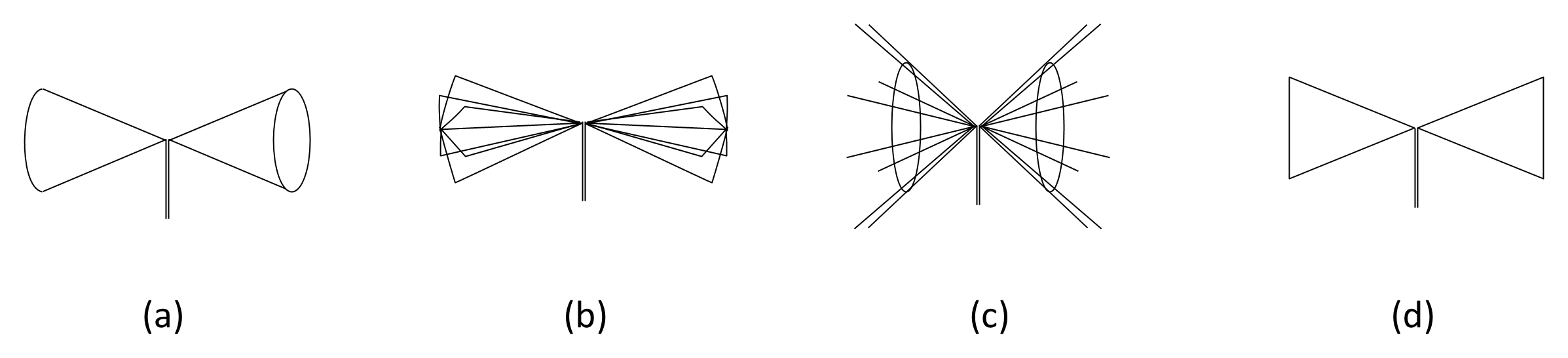
12.8.4 Biconical Antennas
A conical, or bi-conical, antenna is a broadband, omnidirectional antenna formed by replacing the thin elements of a conventional dipole with flared, cone-shaped conductors. In its most common configuration—the biconical antenna—two identical metal cones are mounted apex-to-apex, with the feed applied across the small gap at the centre. Each cone acts as a continuously tapered conductor whose diameter increases smoothly away from the feed point. This gradual geometric transition provides a distributed impedance transformation along the length of the structure, rather than the sharp current distribution found in a thin half-wave dipole. As a result, the antenna exhibits inherently wide bandwidth and relatively stable input impedance over a broad frequency range.
Electrically, the conical antenna behaves as a travelling-wave structure rather than a strongly resonant element. Because the flare angle and cone dimensions determine the characteristic impedance, the antenna can be designed to approximate a constant impedance (commonly 50 Ω) across a wide band. The radiation pattern is similar to that of a dipole—maximum radiation broadside to the axis and nulls along the axis—but remains comparatively stable with frequency. Mechanically, the rigid conical surfaces provide structural strength and consistent electrical geometry. For these reasons, biconical antennas are widely used in electromagnetic compatibility (EMC) testing, spectrum monitoring, wideband communications, and measurement applications where predictable performance over an octave or more is required.
A closely related structure is the bow-tie (or butterfly) antenna, which may be regarded as the planar approximation of the biconical antenna. Instead of three-dimensional cones, two triangular conducting plates are arranged in a flared dipole configuration and fed at the narrow gap between them. Electrically, the flared geometry produces the same distributed impedance transformation as the biconical form, yielding wide bandwidth and relatively stable input impedance, but in a flat, lightweight structure that is easily fabricated using sheet metal or printed-circuit techniques. While the bow-tie does not achieve the same ideal impedance uniformity as a true biconical antenna, it offers comparable broadband performance and is widely used in television reception, UHF communications, and planar array applications where mechanical simplicity and low profile are advantageous.