12.7.2 Medium Range (300–1,500 Km)
For these ranges, we need radiation angles between 60˚ and 20˚. Depending on the exact angle required, there are several possibilities. Horizontal half-wave dipoles between 0.25λ and 0.6λ above the ground can give angles of radiation between 60˚ and 25˚. The vertical monopole can also be useful for medium ranges producing a radiation pattern with most of the radiation below 40˚, which would give a minimum range of about 250 km using an appropriate frequency for the E layer.
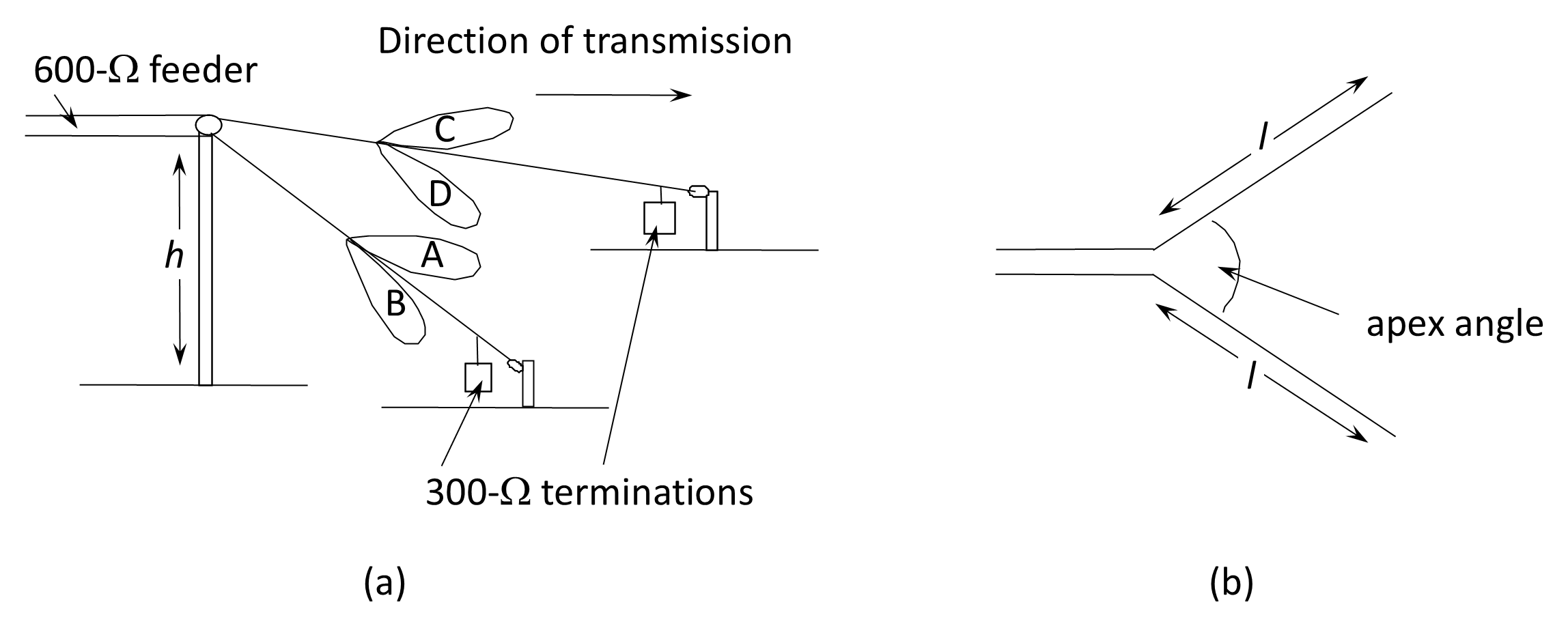
The most useful antenna for medium ranges is the sloping-V antenna, which covers ranges from about 1,200–2,000 km efficiently, and up to 3,200 km less efficiently. The design of the sloping-V antenna is illustrated in Figure 12.22. The antenna is constructed with two wires, several wavelengths in length, arranged in a horizontal V with the apex elevated. The legs of the V are travelling-wave antennas and are terminated in 300-Ω resistors. The antenna is fed at its apex with 600-Ω open-wire line, which is matched to the 72-Ω coaxial cable from the radio by means of a transformer. Lobes A and C add and B and D cancel if the dimensions are correct. The sloping-V is reasonably suitable to field use as it is small and requires only one mast and is reasonably broad-band.