12.2 AN ISOTROPIC RADIATOR
When considering radio-wave propagation we are interested in the far-field of the antenna (that is, at a distance that is many wavelengths away). In this region the radiated electric and magnetic fields are at right angles to each other (and to the direction of propagation) in the form of the transverse electromagnetic (TEM) wave we saw at the start of Chapter 11. Consequently, in the far field (see Section 12.3.8), we can consider that the electromagnetic wave that was generated by the antenna is equivalent to a spherically propagating wavefront generated from an isotropic radiator which radiates power equally in all directions. Because the far field is also a significant distance from the antenna, we can ignore the size of the antenna—we therefore consider the isotropic antenna to be a point source (that is, have no length, width or height).
As we saw in Section 11.3.2, since the power is radiated equally in all directions, we can characterize the isotropic power density, Pden(iso), of the propagating wavefront of an isotropic radiator because the transmitter power, Pt, is spread out over the surface area of a sphere (4πd2), where d is the distance away from the isotropic radiator:
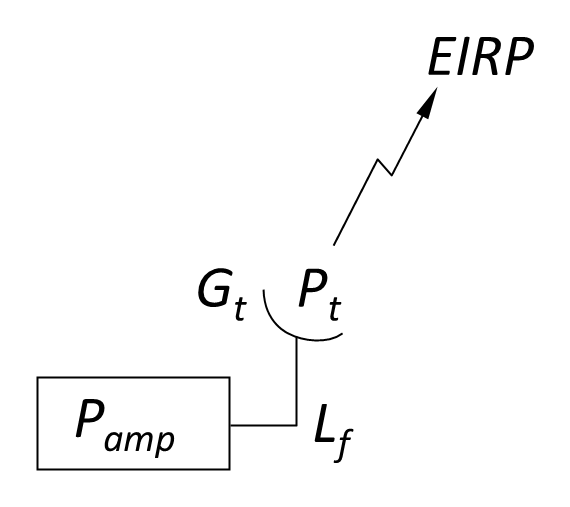
In practice, an isotropic radiator is not possible and the radiation pattern of a real antenna will have some other (not perfectly spherical) shape that depends on the construction of the antenna—the radiation pattern of real antennas must be therefore be known so that they can be used effectively (we discuss this in the next section). However, as we saw in Chapter 11, for any given antenna radiation pattern, we can consider the radiation in the far field to be effectively isotropic—the effective isotropic radiated power (EIRP), which is the product of the radiated power of the real antenna and its gain (that is, EIRP= PtGt). As illustrated in Figure 12.3, we also have to recognize that not all of the transmitter’s amplifier power, Pamp, is available for transmission since a proportion is lost in propagating down the feeder to the antenna due to the feeder loss, Lf, so that the power at the end of the feeder is Pt = Pamp Lf. so that:
The EIRP is a very useful property since it translates the antenna pattern of a given antenna into that of an isotropic radiator with unity gain, but with a commensurately higher transmitted power.
The following sections provide an understanding of a number of other basic properties of antennas and describe examples of several important types.