A THE RETENTION MODEL
There is a theory of warfare which is spreading unchallenged throughout the military establishments of the western powers like a rumor that relentlessly passes back and forth within the body of a crowd. Its name is Network Centric Warfare and its main thesis is that recently developed information technology compellingly points the way towards a revolution in military affairs.
As the reader may recall, our attempt to account for the proficiency of the average member of a military community required the development of a retention model that would generate the distribution of that community over the seniority of its members. This Appendix drives and explains the distribution we used in the main text of Section 8.4.
Let be the constant retention rate for the individual at hand, and let us assume that each arrival or departure event occurs quite independently of all others. Then, the probability that there are individuals remaining in the service out of those that joined it together years ago is given by:
where the summation is over all values of , subject to the condition that:
and where the “starred” symbols represent the random variables whose values are to be equal to the corresponding symbols without a star. This equation reflects the simple observation that in order to have individuals of seniority , one must have started with recruits entering service years ago, an event of probability , and then lost of them the first year, the second year, and so on until the sum of all loses amounts to .
We shall now assume that the accession probability is Poisson with parameter and that the yearly departure process is binomial with parameter . One can then show that the desired probability is also Poisson, but with parameter :
The probability that an operator drawn at random from the community has seniority is given by the fraction of operators in today’s population that have seniority ,
averaged over the Poisson distribution above. If the sum in the denominator, which runs up to the maximum seniority , fluctuates little over the distribution, we can take it out from under the averaging operation at its average value and have:
so that the probability distribution over seniority is independent of the accession rate γ in this simple model.
Since the proficiency formula we derived in the main text has taken time to be a continuous variable, it shall prove convenient to replace discrete time with a continuous variable here as well. Then the denominator becomes:
in which case the probability distribution over seniority s is given by:
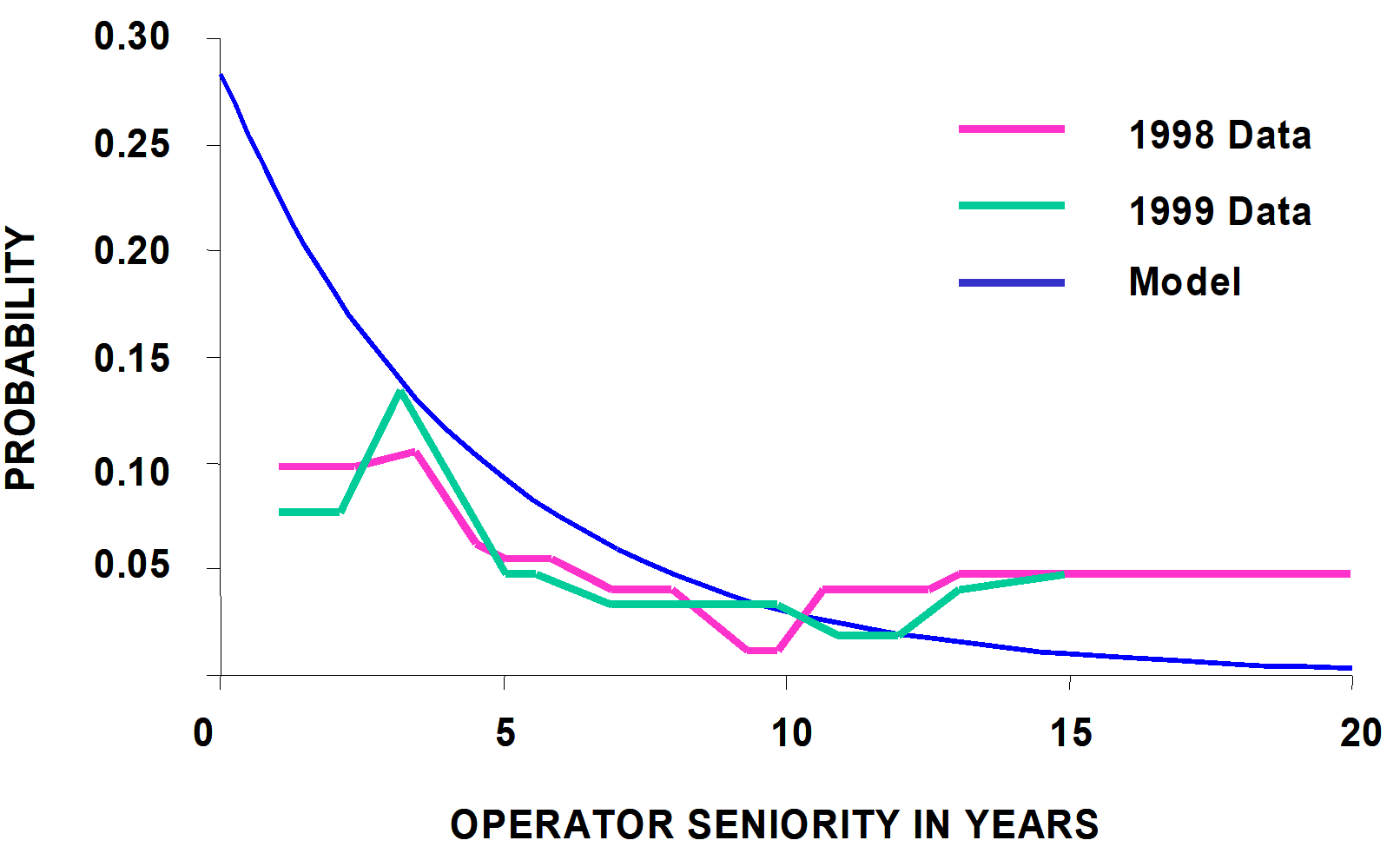
This model representation of the seniority distribution, although quite simple, is not totally unrealistic. As shown in Figure A.1, the model curve with fits rather well the 1998 and 1999 data for sonar operators in the midrange, overestimates for low seniority and underestimates somewhat for high seniority.
This latter is undoubtedly the result of the natural tendency enlisted personnel have of staying in for the 20 years retirement package, a fact not included in our model.