
3.3.2 How Many Weapon Systems To Buy?
The decision between alternative technologies described above was made possible by the fact that the set of different technologies is generally discrete and that therefore different choices lead to distinctly different operational outcomes. However, operational outcomes are generally continuous functions of the number of weapon systems incorporating the chosen technology: the more systems one buys the larger the resulting operational outcome until a diminishing returns regime eventually sets in. Under the circumstances, one can not use the resulting military effectiveness to decide how many weapon systems to buy because there is no way in which one can credibly say that the additional effectiveness obtained from buying one more system is not really necessary. Trying to use funding level instead is not a solution either because one can not know whether the next dollar invested will buy insufficient effectiveness to be worth its value. Therefore, comparing the military effectiveness and the costs corresponding to different numbers of weapon system bought, can not lead to a decision about how many of them to buy. A different analytical technique is required to decide how many weapon systems incorporating a given technology one ought to purchase.
The key to this dilemma is to realize that deciding how much risk one is willing to accept is a far easier thing to do for a human being than deciding how much effectiveness one is willing to forgo. Perhaps the fundamental nature of our instinct for self-preservation is responsible for having developed this uncanny capability to tell when things are getting too risky for comfort. In any event, this capability suggests that we base our decision process upon risk rather than benefit.
To do that, we need to first define in some practicable manner what we mean by risk. Clearly, given the military character of the problem at hand, risk ought to mean risk of losing the battle. That means, within the context of our current discussion, the risk that, because of insufficient numbers of weapons, we shall not be able to deal in a timely manner with all the challenges that the enemy is likely to put in front of us. This kind of risk is not to be confused with technological risk, or with the risk that our operational plans were ill-conceived and executed, or again with the risk that uncertainties inherent in war might work in our enemy’s favor. The risk we have in mind here is a special kind of risk intended to quantify the danger of going to war with insufficient wherewithal to deal with all reasonable contingencies.
With this definition of risk, the more weapon systems we buy, the likelier that we shall have sufficient forces to deal with the enemy’s next moves, and, therefore, the smaller the risk of failure on the battlefield. Conversely, the fewer the number of weapon systems, the larger the risk. The desired number of weapon system will then be the one corresponding to the maximum level of risk that the decision maker is willing to undertake. This analytic process will therefore put a floor beneath the number of weapon systems that we ought to buy.
To make this method work, all we need is a practicable way of quantifying the risk of going to war with insufficient numbers of weapon systems as a function of the number of weapon systems available. Since we are measuring risk in terms of the fraction of contingencies that our forces may not be able to cover for want of adequate numbers of weapons, the focus falls upon the set of reasonable contingencies we might have to confront within the planning scenario, not upon the military campaign we expect to fight in it. That makes life considerably easier. Indeed, imagine first that we have constructed a reasonable list of such set-piece contingencies, and that we have evaluated the number of weapon systems under consideration that would be needed to deal with each of those contingencies. Imagine further that we have also determined the number of set-piece contingencies that we could simultaneously handle with a given number of forces by adding-up the weapon systems needed to handle successive contingencies until the total number used matches the given number. In determining this latter number, the likelihood order in which the contingencies could be expected to occur becomes relevant because different contingencies would require different numbers of weapons systems; indeed, with limited forces, one would naturally want to cover the more-likely contingencies first and fall short, if need be, on the less-likely contingencies. As a fall-back position, absent any a priori knowledge about the ranking of contingencies, one could assume that all set-piece contingencies are equally likely to occur. In either case, one can thus display the fraction of set-piece contingencies one will fail to handle with a given number of forces as a function of that number. The result would have to look something like the illustrative curve shown in Figure 3.3.
For small numbers of weapon systems, the number of set-piece contingencies we can cover is bound to be quite small and therefore the fraction of contingencies that would remain uncovered is bound to be close to one hundred percent. By our definition, the risk of failure due to insufficient weapons would correspondingly be near one. As we acquire more weapons, the number of contingencies we cover increases and the fraction of contingencies that would remain uncovered decreases, and with it, the risk.
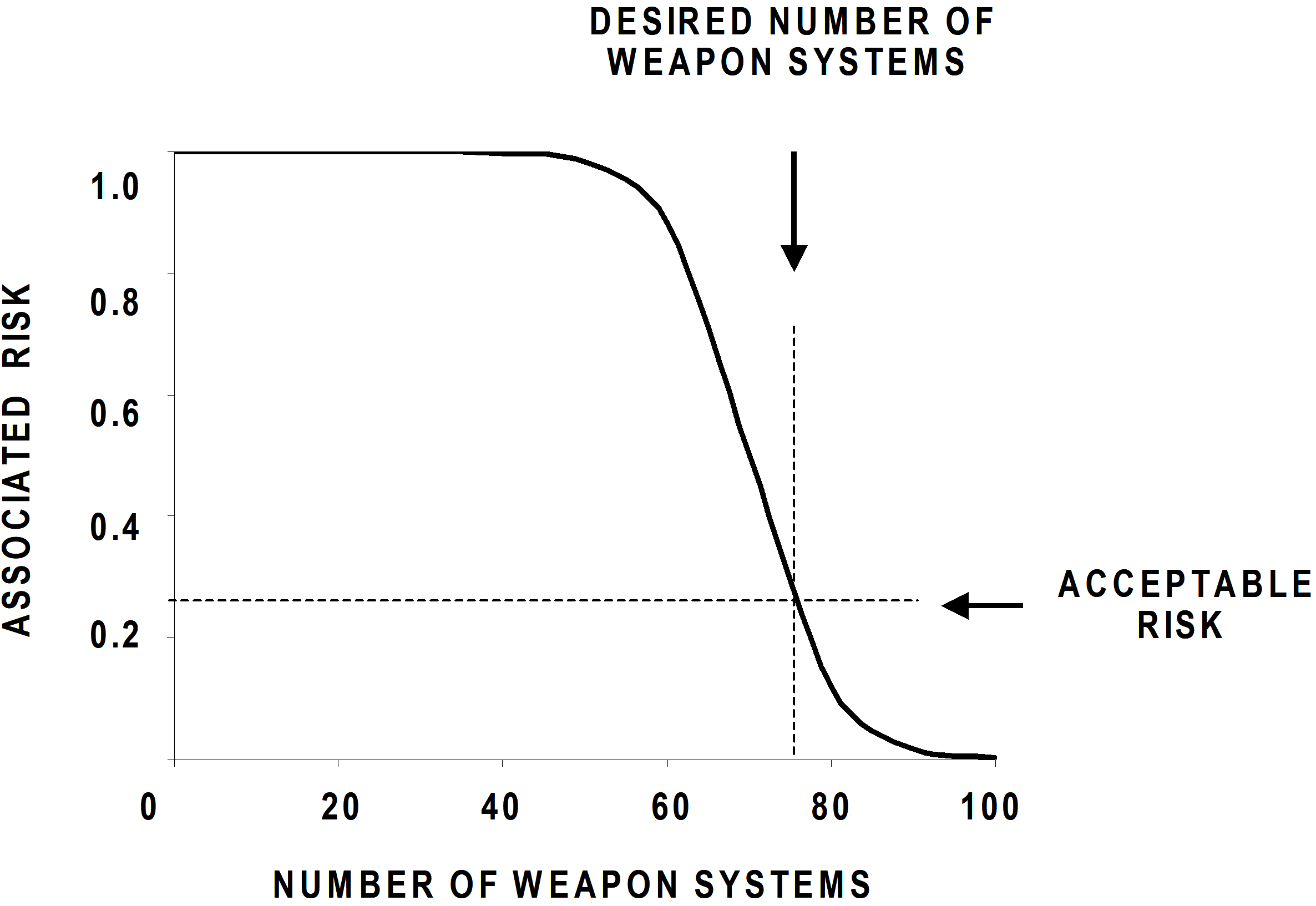
The rate of decrease in risk is naturally expected to be quite small at the beginning, while many of the key contingencies still remain beyond our capability to handle, but will get increasingly larger as we add more and more weapon systems to our force. At some point, the decrease in risk becomes precipitous indicating that the most crucial set-piece contingencies have now been covered. The number of weapon systems where this happens is dependent upon the specifics of the planning scenario through the particular rank-ordering that the scenario imprints upon the sequence of contingencies. Thereafter, the risk continues to decrease at an increasingly smaller rate until the contingencies have all been mopped up one by one.
The attentive reader may have begun to wonder by now whether determining the number of weapons systems needed to handle a set-piece contingency does not beg the question we were about to answer in the first place. Lest he find the previous discussion somewhat tautological, let us point out that the task of determining the number of weapon systems needed to cover a contingency is not the same as the original task of deciding how many systems to buy for the nation. In the latter, we would have to make judgments about the number and likely sequence of enemy actions confronting us during the planning scenario; in the former, we would have to merely evaluate the number of systems needed in one specified contingency at a time.
The main virtue of the decision technique described above is that, in the true spirit of systems analysis, it allows full reign for the decision maker’s judgment to operate as he weighs the number of forces he should acquire against the risk that his military will be caught short-handed on the battlefield.