
8.4 BUYING INDIVIDUAL HUMAN PROFICIENCY
When an individual has been assigned to perform a given operational function, he brings with him a certain level of proficiency concerning the tasks he is expected to perform. That level is the result of two competing processes that are constantly at work in his professional life: the process of learning the relevant skills while undergoing training, re-training, and while employing those skills in actual combat, and the process of forgetting them while otherwise occupied with activities that are totally unrelated to the maintenance of those skills.
To model this competitive process, let us assume that the individual emerges from whatever training school he has attended with proficiency , where measures the operator’s service seniority at graduation time, and consider the change in proficiency that occurs in the interval of time between and . The rate of change can be written as follows:
where the first term represents the increase in proficiency resulting from the amount of exercising done in ds and is proportional to the probability f that the individual was employing his skills during that time interval, and the second term represents the decrease in proficiency that obtains in ds when the operator is not exercising his skills, and is therefore proportional to the probability that the operator is otherwise occupied during ds.
The first term, representing the rate at which humans learn, naturally depends on the amount of time they spend practicing; the more they practice, the faster they pick up any additional skill yet un-mastered until, of course, they have learned all they need to know, in which case any additional practice would return diminishing advantages. Given this diminishing returns effect, it would be quite reasonable to assume that the learning rate is inverse proportional to the time during which one is effectively engaged in performing one’s skills and directly proportional to the product of the current state of proficiency and the current shortfall in that proficiency. The time spent in using one’s skill, is given by:
where the first term represents the time he spends in training school and the second terms represents the fraction of all the subsequent time that he spends on using his skills. Since f is the probability that at any given time the individual is actually employing his skills, it is only a fraction f of the total time spent in the service since graduation that contributes toward his learning. The corresponding fraction of time spent on learning while in training school is naturally equal to one and the first term is therefore equal to that time itself.
The rate of learning is therefore given by:
where is an unknown constant measuring the strength of the learning process.
The rate at which humans forget, on the other hand, naturally depends upon the amount of time an individual has been away from the exercise of his skills. Given the well documented exponential decay of knowledge with time, it would be quite reasonable to assume that the rate of forgetting is proportional to the time the individual has been away from his work and to his current state of proficiency. The time spent away from the exercise of his skill is naturally given by:
Hence, the rate of forgetting becomes:
where is another unknown constant measuring the strength of the forgetting process. Both and would, of course, have to be determined experimentally.
The total rate at which human knowledge changes with time is then the sum of these two rate, the rate of learning and the rate of forgetting, and therefore:
From this differential equation, one can evaluate individual proficiency as a function of time for an individual with a specified history of military service, a history characterized by the total amount of time he spends in the service before retiring and by a specified training program. One gets:
where:
The manner in which the resulting proficiency depends upon operator seniority is shown in Figure 8.9 for , and a number of different values for , , , .
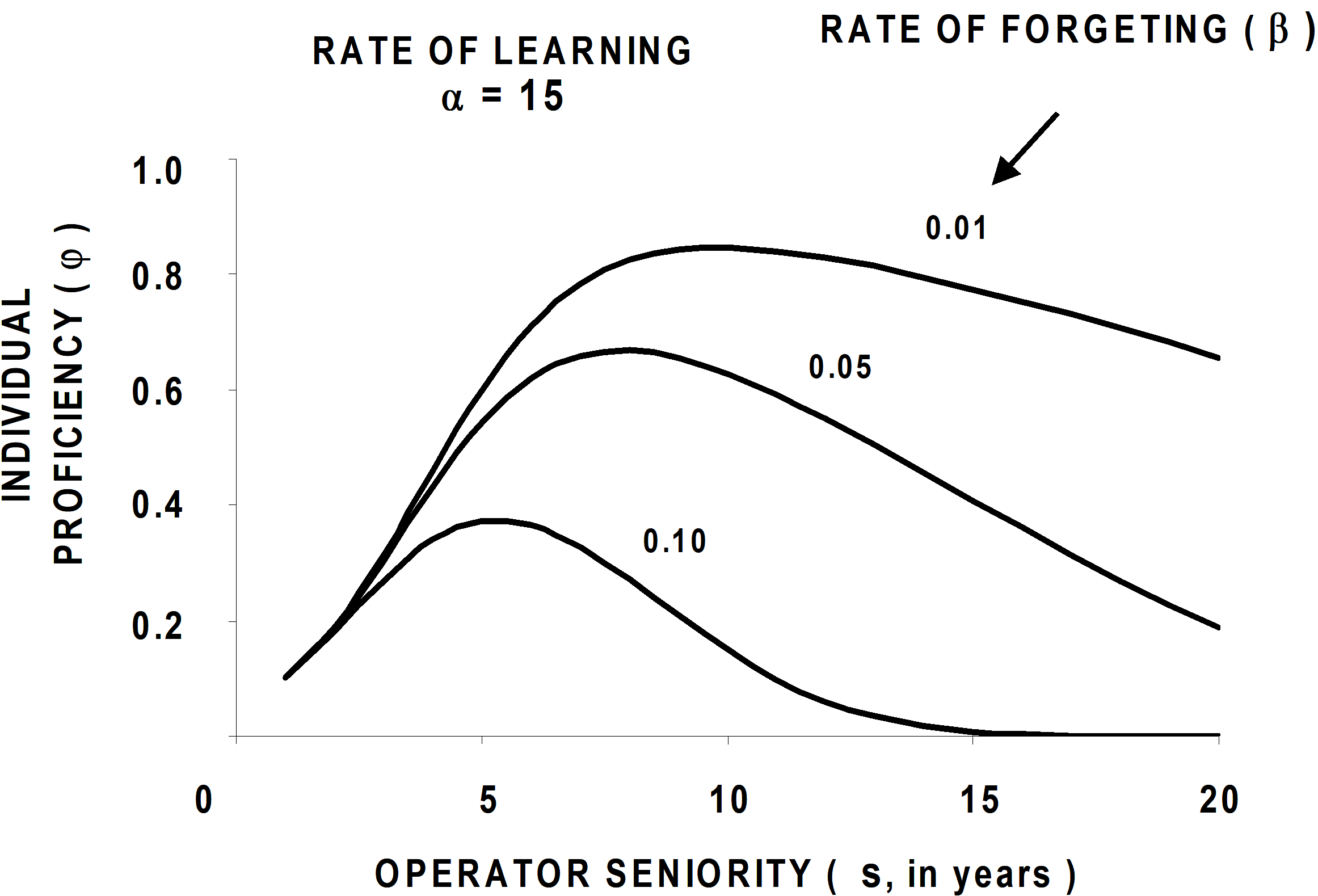
As expected in this simplified model, where we have lumped all periods of learning together into one continuous interval of time and all periods of forgetting into another, each curve begins by rising, an indication that the operator is increasing his proficiency early in his career despite the occasional forgetting, but eventually begins to decrease due to the effect of all the cumulated forgetting that took place during his professional life. A more detailed model would of course have to recognize that periods of learning are always followed by periods of forgetting and would lead to a proficiency that varied with time during each year in a manner similar to that shown in the figure.
In the previous discussion, we have derived operator proficiency as a function of his seniority. Since we can not control the seniority of any individual that we assign to a given job, it would make sense to average this proficiency over the seniority distribution of operators performing the function at hand. This distribution could be obtained from empirical data. However, because the data tends to be year-specific in a way that is not truly relevant to our point, we have derived instead a simple model of that distribution which follows quite closely the typical service data. The details of that derivation are contained in Appendix A, and the resulting distribution is given by:
where represents the constant retention rate. We can now finally calculate the proficiency of individuals performing a given function by averaging the expression we derived for that proficiency over this model seniority distribution:
This average proficiency is what we were after when we started this rather long incursion into the modeling of human proficiency. Its value depends explicitly on a number of parameters that reflect the infrastructure programs involved in creating the skilled individual which concerns us. Thus, the recruiting program is reflected in the proficiency attained at the time of graduation from initial training, , as well as in the empirical parameters and ; the subsequent training program is reflected in the fraction f of each year spent in exercising his skills; and the various quality of life programs are reflected in the retention rate to which they contribute. Figure 8.10 shows how the average proficiency varies with the fraction of time spent in training for various values of the intensity of learning measured by , when the probability of retention is 0.8.
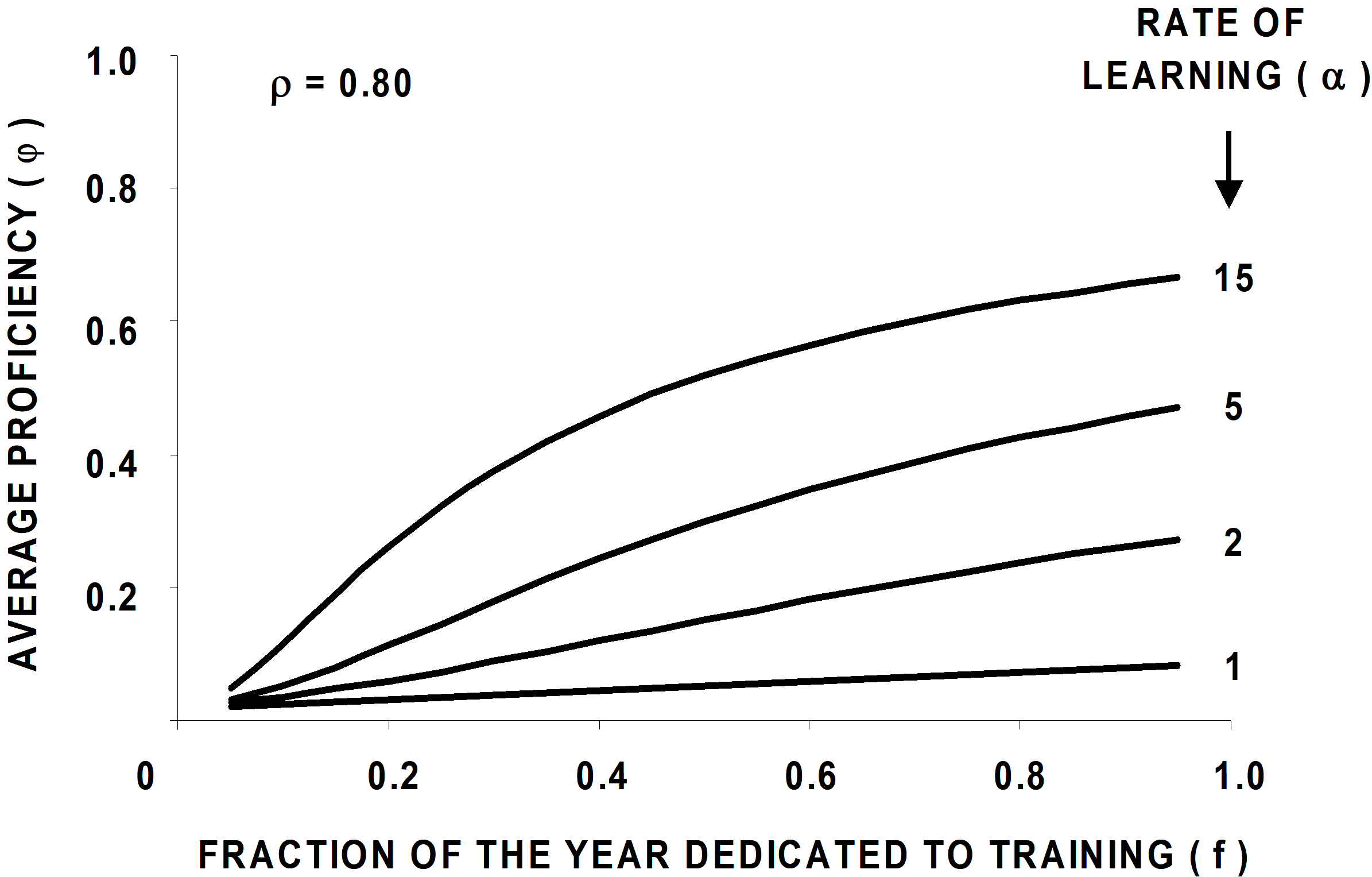
With the help of this figure, we should now be able to judge the extent to which humans are as perfectible as Network Centrism claims. If perfect proficiency corresponds to unity on the vertical axis in the figure, then getting perfectly proficient humans to serve in the military would take a miracle: the military establishment would have to be able to recruit individuals with considerable natural ability to learn, to retain nearly everybody that joined, and to give every one of them the opportunity to hone their skills almost continuously throughout their professional life. Since typical recruits do not have a very high natural ability to learn, and since the typical training fraction is less than ten percent, we should expect typical personnel to display proficiencies closer to twenty percent than to one hundred percent. A community constituted by individuals that joined it with such low individual proficiency levels would have to be unreasonably large to transform those individuals into highly proficient members. The reality of life in the military provides no comfort for the claim that networking would lead to synchronized action.
Confronted with the reality that, since individuals entering a military force are far from perfectible, networking it will not make the force any better, the proponents of Network Centric Warfare began pushing for automation. The notion is that, if humans are not sufficiently perfectible, then we should replace them with machines which, by definition, are perfect. Until we explore the limits of this new Network Centric claim that replacing humans by machines and then completely networking these machines among themselves is the way to go, we have not yet succeeded in controlling information technology. Therefore, we conclude this chapter by addressing the man-machine controversy.