
8.3.1 Limits Imposed By Human Individuality
We shall use the model of cohesion described above to prove that the degree of common understanding attained by a networked community strongly depends upon the degree of individuality characterizing the members of that community and that therefore the Network Centric claim to the contrary is valid only when sufficient leadership is present to counterbalance the limiting effect of individuality. Connecting individuals with highly different views of the situation tends to increase the opportunity for a debate amongst the connected parts rather than increase the common understanding unless, of course, the debate is monitored and eventually resolved under the guidance of a strong and foresighted leader.
To see this, imagine that in the discussion above, the common goal is represented by the desire to attain shared situational awareness and that community cohesion measures the degree of common understanding thus attained. Then, would characterize the community’s power to persuade and the degree of individuality manifested in one’s resistance to that power of persuasion. Using the self-consistent solution obtained above to solve for the ratio , we can write:
where:
and therefore and will be proportional to each other when the initial and final degrees of understanding, and , are kept constant. The resulting relationship is depicted in Figure 8.7.
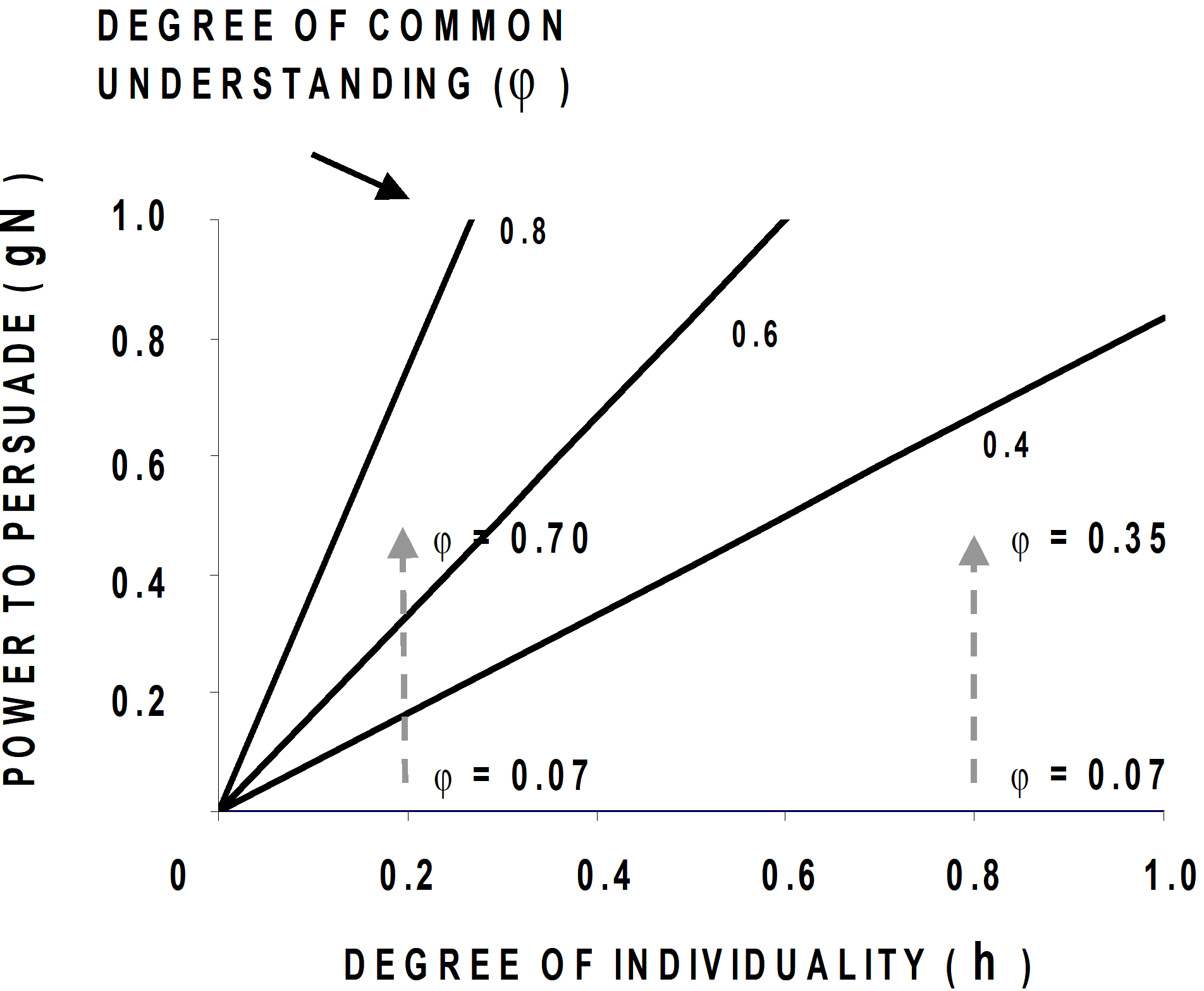
Now, according to Figure 8.7, if the degree of individuality characterizing the members of a community that is trying to collaboratively attain shared situational awareness is relatively small, say 0.2, increasing the community’s power to persuade by increasing the degree of networking will indeed produce a significant increase in the degree of common understanding. For instance, increasing the power to persuade by a factor of ten, from 0.05 to 0.5, the degree of common understanding increases by a factor of ten as well, from 0.07 to 0.7. If, on the other hand, the degree of individuality is relatively high, say 0.8, measurably less common understanding will be returned by the same increase in the community’s power to persuade; according to the figure, the degree of common understanding will increase only by a factor of five from 0.07 to 0.35.
The Network Centric claim that the information sharing and the collaboration characterizing a networked force will enhance shared situational awareness within that force must therefore be limited by the recognition that the degree of common understanding that can be achieved always depends upon the degree of individuality of the people making-up the force. Simply increasing networking will not automatically produce shared situational awareness; before networking, one must devise the means for reducing the degree of individuality without thereby creating an amen corner filled with pliable individuals ready to accept without question the picture handed down to them.