
8.2 THE LIMITS IMPOSED BY ENEMY EVASION WHILE UNDER ATTACK
Power to kill means destruction of the enemy war machine. Since war is a dynamic game in which the enemy is trying to destroy our war machine even as we try to destroy his, power to kill cannot be reduced to mere weapon effectiveness; one must also take into account the fact that the enemy will try to evade our attack while holding our attack assets at risk of destruction.
However, when Network Centrism insists that increasing our strike capability by increasing the quality of our information technology is always the right thing to do, they assume that the enemy target is doing none of these things; it simply sits there passively awaiting to be destroyed by our weapons. It is possible, therefore, that if the enemy were to react in some way to our attempt to kill him, acquiring more information technology would no longer be the right thing to do. We shall show now that even in this, the most-simple manifestation of war dynamics, the Network Centric claim turns out to be unfounded. Paying attention to the dynamics of war limits the claims of Network Centrism.
Imagine, for simplicity, that we are confronting a number of enemy targets operating in some area, and that, as shown in Figure 8.3, we deploy to that area two systems: an information-generating system designed to detect, localize and track as many of the targets as possible, and a killing system designed to destroy any target that has been detected by the information-generating system.
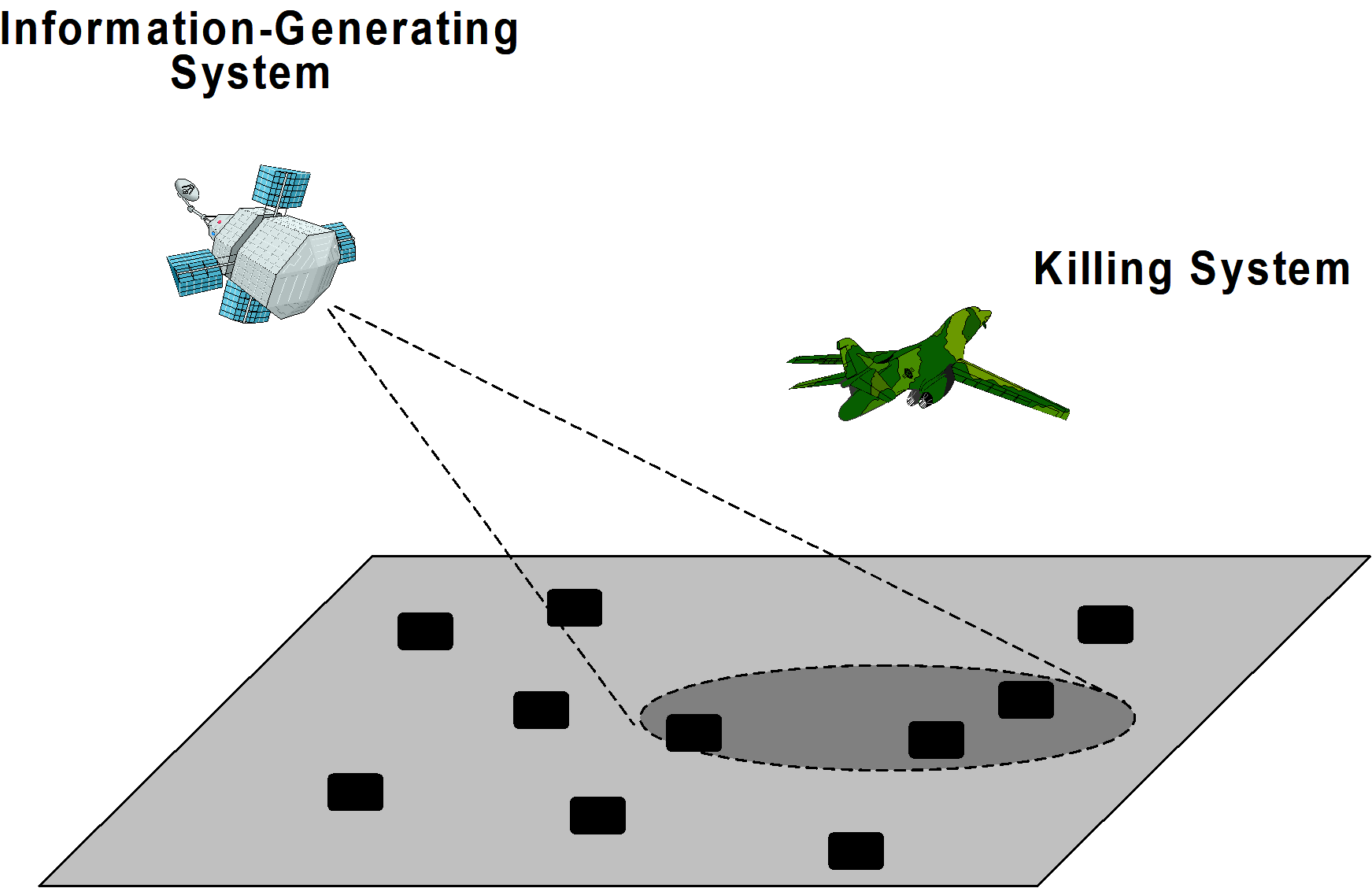
We shall now assume that the targets have the ability to react to the information-gathering system’s attempt to detect and localize it. Consequently, at any given time, targets can be partitioned into two classes: those that are under active surveillance and could be attacked with the higher precision corresponding to a well localized target, and those that are no longer under active surveillance but could still be attacked with the much lower precision corresponding to a fleeing target. Let represent the probability of kill given attack for the case in which the target is under active localization, and the same probability for the fleeing targets.
Let both the detection and the loss of detection processes be distributed Poisson, and let represent the rate at which targets are acquired by the information-gathering system and the rate at which detections are lost due to enemy evasion tactics. In steady state, the average number of targets that enter the detected state must be equal to the number of targets that leave that state. Therefore:
where represents the number of targets that are undetected and the number of targets that are. However:
so that:
The average number of targets killed under these circumstances is given by:
and the corresponding fraction of targets killed by:
Since is by definition larger than , we have:
where the lower limit is achieved when the detection rate is zero and the upper limit is attained when the escape rate vanishes. This average fraction of targets killed is a natural measure of our system’s power to kill, while the two rates are an equally natural choice for the two critical factors characterizing the question at hand. Therefore, the relevant trade space will be spanned by and , while the metric will be represented by the fraction of targets killed defined above. Figure 8.4 displays this trade space for and .
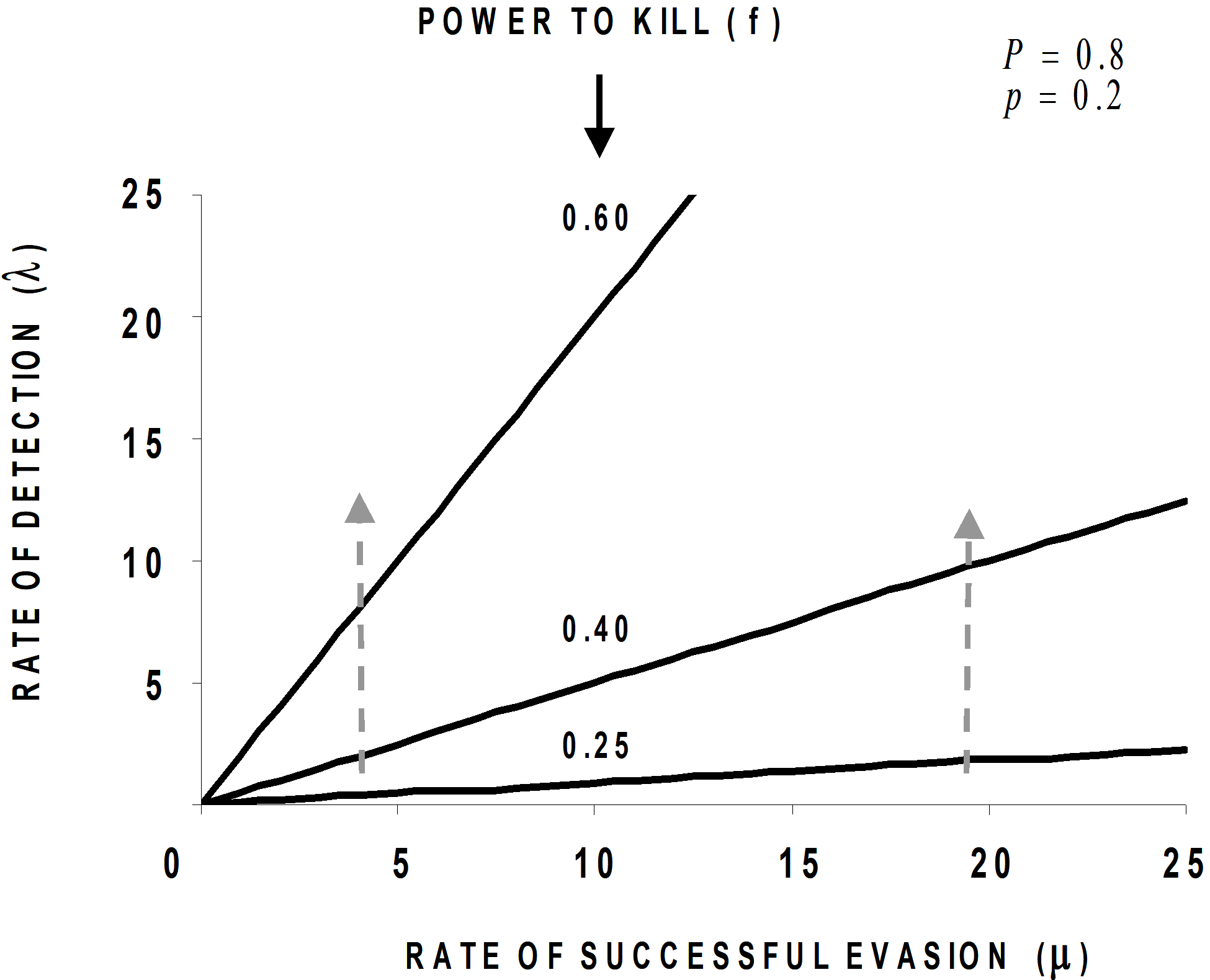
As seen in the figure, the curves along which the power to kill is constant are straight lines whose equation is given by:
Since these curves all pass through the origin, they tend to bunch-up for small values of the rate of evasion and fan-out as that rate increases. Consequently, for small values of the rate of evasion, increasing the detection rate tends to increase the power to kill rather quickly. For large evasion rates, however, the same increase in detection rate will produce significantly less improvement in the power to kill. In other words, an enemy that can evade our kill system with some degree of success, can degrade our kill capability in ways that cannot be counterbalanced by more information technology.
The dynamics of war, that allows the enemy to evade our attack, limits the military utility of additional information-gathering capability. This limit is therefore another sign post along the boundary surrounding the validity of Network Centrism. It is interesting to note, however, that we did not have to wander too far into the dynamic complexity of war before we sighted this sign post; even the simple process of evasion modeled above was enough to display the limiting effect that the dynamics of war appears to have upon the claims of Network Centrism. When it comes to the dynamics of war, the boundary seems to be quite constraining.