
3.3.1 What Kind Of Technology To Buy?
The debate about the kind of technology the military ought to buy seeks to identify the best among technological alternatives by comparing them to each other in an open market of competing interests. This trading process unfolds in a language that reflects the participant’s common understanding of the problem under debate, a language that, having emerged from the debate itself, captures the critical factors affecting the decision at hand. The proponents of each alternative technology would thus insist that their candidate technology would most beneficially affect these critical factors and, through them, the decision at hand, and eventually, the proponent that can substantiate his claim most convincingly would dictate the final decision.
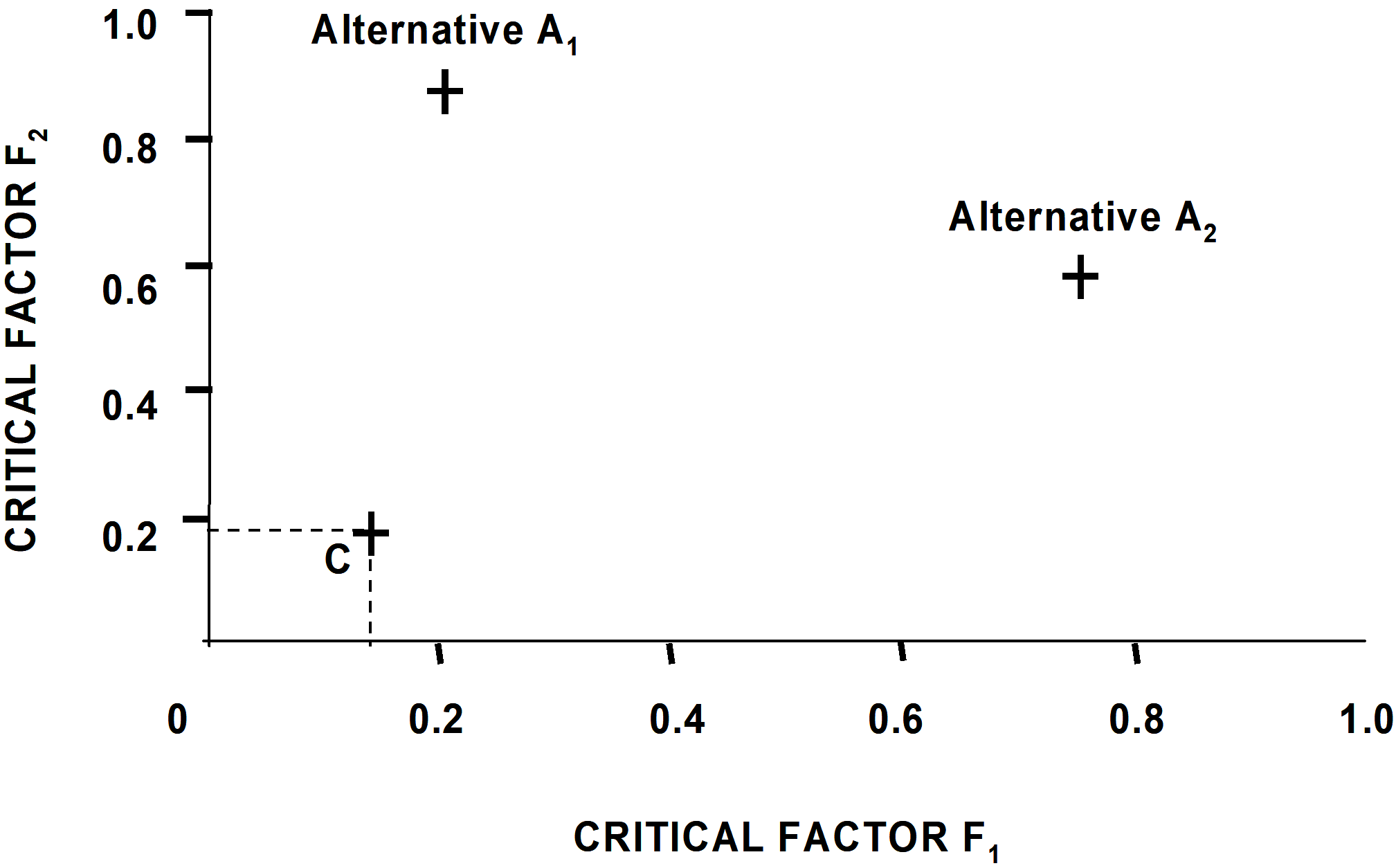
Therefore, the natural way of helping the debate along would be to provide the participants with an appropriately quantified representation of the trading process in which they are thus engaged. We can easily think of this trading process as a comparison between different points in a trade space spanned by the critical factors guiding the debate. Figure 3.1 illustrates how a trade space spanned by two critical factors, F1 and F2, might look like. For simplicity, we have assumed that each critical factor can vary between zero and one. While that is not always the case, illustratively assuming that it is does not affect the import of our argument. The location in this trade space corresponding to the current situation has been labeled  and can be determined either by calculating the values that each critical factor currently obtains or by ascertain those values from experience. Since the various technological alternatives would lead to different values for the critical factors, they would correspond to different points in the trade space. For instance, assuming for simplicity that we are concerned only with two alternative technologies, we might represent the two alternatives by the two points
  and
and  shown in the figure.
To compare the alternative technologies both to the current situation as well as to each other, we shall need a yardstick able to measure the distance between two points in the plane. A reasonable way of quantifying the trade space would be to use operational effectiveness within the context of the planning scenario as the yardstick for comparing alternative choices. Specifically, one might want to cover the decision space with constant operational effectiveness curves, as shown in Figure 3.2, and then measure the distance separating two points in trade space by the difference between the labels identifying the constant effectiveness curve passing nearest those two points. For instance, acquiring the technology corresponding to the point  would provide an operational effectiveness of 0.48, about half way between the curves labeled 0.40 and 0.60 in the figure; since the operational effectiveness corresponding to the current situation is according to the figure 0.15, one can then say that the points and are at a distance of 0.33 from each other. The corresponding distance between
  and is 0.47, and the distance between the two alternative technologies results equal to 0.14.
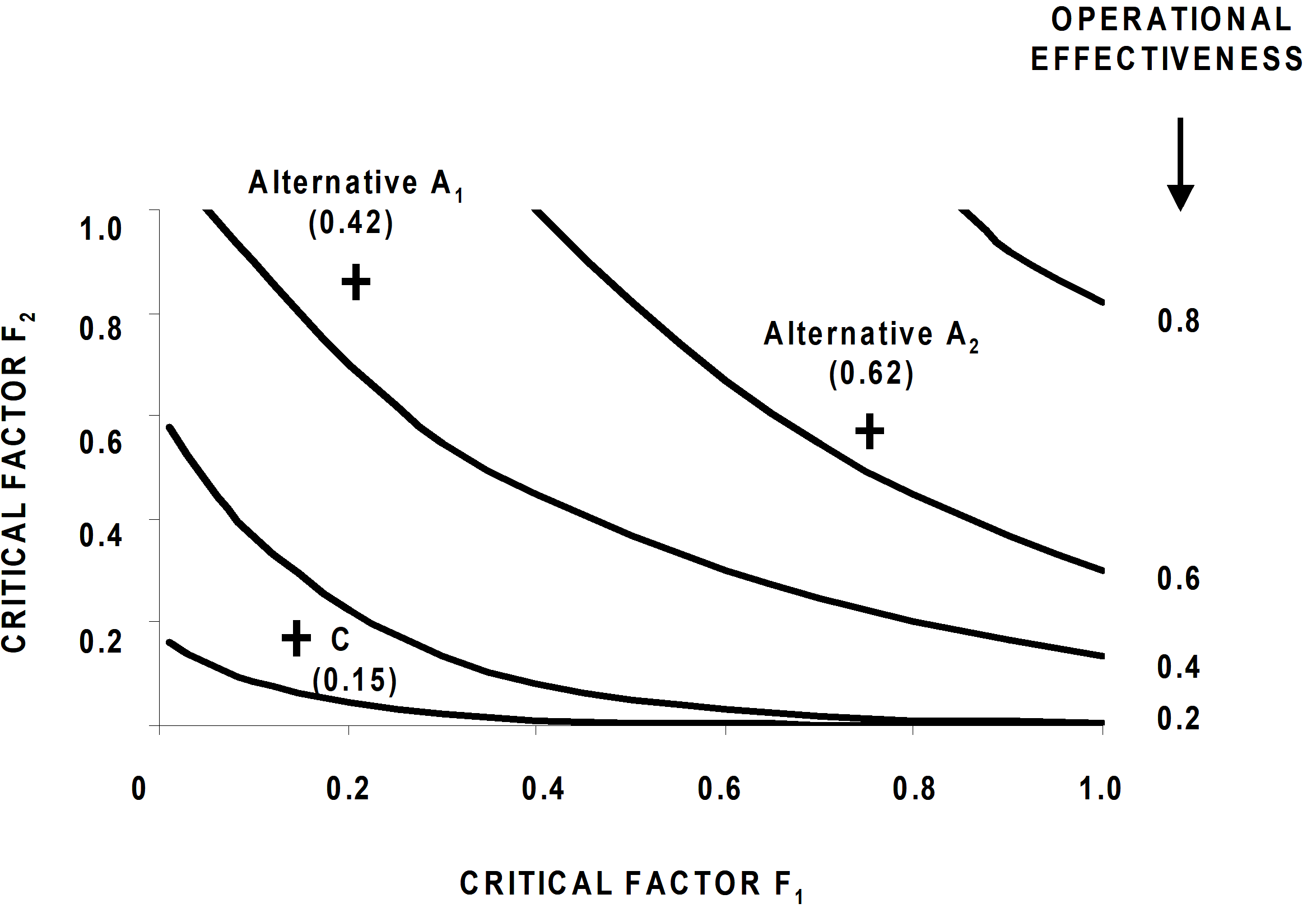
Provided with such a tool, decision makers would be able to learn at a glance the operational advantages of one technology over the others and of all technologies over the current situation. First of all, just being able to visualize the current situation would already be of considerable value since the trade space automatically identifies that situation in terms of operational effectiveness rather than merely in terms of the corresponding values for the critical factors. Second, the trade-space construct shown in the figure determines the improvement over current effectiveness made possible by each technology. Thus, the technology represented by would lead, if acquired, to a 220 percent improvement in operational effectiveness, while the technology represented by would improve current effectiveness by 310 percent.
Third, the trade-space construct would also allow for a comparison between various alternative technologies. Indeed, because the technology represented by the point provides an operational effectiveness of 0.62 while the technology corresponding to the point provides an operational effectiveness of only 0.48, this point is farther away from  than . Consequently, the technology corresponding to the point appears to produce a larger improvement in operational effectiveness than the technology represented by the point and, all other things being equal, should be chosen for acquisition. However, since all other things, such as cost, developmental risks, and politics, are never quite equal, the ultimate choice would have to weigh-in the difference between all those factors as well. In general, the trade-space dominance of one alternative technology over another, while informing the judgment of the decision maker, can not decide the issue for him.
Fourth, Figure 3.2 visualizes how the location of the current situation influences the decision between two alternative technologies. This influence is a consequence of the fact that the yardstick varies with its location in the trade space. Indeed, as seen in Figure 3.2, the equal-effectiveness curves in our illustration tend to bunch-up at the right-hand lower corner of the figure in such a way that moving along the horizontal axis would be almost identical with motion along a constant effectiveness curve and would therefore generate very little change in operational effectiveness. If, however, we relocate to the left-hand upper corner of the figure, the same motion would generate considerable change in effectiveness, as one would cross a large number of equal effectiveness curves on the way. This non-uniform topography is of particular importance because the improvement in operations effectiveness that a new technology would bring to the current situation would then vary strongly with the location of the point representing that current situation.
Finally, one can use the trade-off plane technique described above to construct an acquisition strategy for buying both technologies. All one would need to do in that case, is seek the acquisition sequence that starts at the point and crosses the largest number of constant effectiveness curves consistent with available funding.
We have called this technique an art rather than a science for two reasons. First, the choice of critical factors that span the relevant trade space is far from automatic and requires, in addition to considerable intellectual skill, a good measure of understanding of what is important for the decision at hand. Second, the analyst who constructs the mathematical model needed to generate operational effectiveness curves will have to imaginatively negotiate between a model that captures too much, and a model that captures too little. In other words, the mathematical model should not be so complicated as to obfuscate the issue under the consideration, but it will have to be encompassing enough to render all relevant contribution that the weapon systems incorporating the alternative technologies would make to the battle. To achieve this balance will also require a certain measure of ingenuity and prior understanding of what is important.
Both these choices, the choice of the relevant critical factors spanning the space and the choice of the appropriate level of complexity for the model used to generate the constant effectiveness curves, are not always beyond controversy. There is always the temptation to intentionally choose the set of critical factors and the model that would tend to favor one alternative over the others. But, far from being detrimental to the decision process, the controversial nature of these choices is precisely why trade-off analysis is illuminating. By forcing decision makers into an adversarial conversation that unfolds in the clear air of quantitative analysis, the technique of trade-off analysis informs the debate and moves it along.
For all these reasons, trade-off analysis can not be expected to provide the answer to the technology question; it can only quantitatively illustrate the understanding that emerges in the midst of the debate leading to that answer. It is therefore not a point solution to the question to be decided that systems analysis provides, but a means of identifying trends and of bringing to light the underlying assumptions and personal biases relevant to that question.