
8.3.2 The Limits Imposed By Human Proficiency
We shall prove in this section that, while networking might, under the right conditions, increase the ability to form a common understanding of the situation, the amount of networking needed to also attain effective synchronization of action depends strongly upon the proficiency of the individuals connected in the network. Connecting individuals with very low initial proficiency would produce sizable effect upon their final proficiency only in the limit when the number of individuals connected tends to infinity.
To see how that comes about, imagine that the initial alignment that we have introduced above represents the initial proficiency of an individual joining the community and that the equilibrium alignment represents the proficiency of that individual once he has become a full-fledged member of the community. Using the self-consistent solution for derived above, we can evaluate the size of the community as a function of the initial and final proficiencies of its members:
According to this relationship, if we kept the value of constant, the size of the community would decrease proportionately with the initial increase in proficiency . Therefore, the higher the initial proficiency of an individual, the smaller the community that would be needed to provide him with the same final proficiency. Figure 8.8 depicts these iso-proficiency curves for an order-disorder ratio of 0.01.
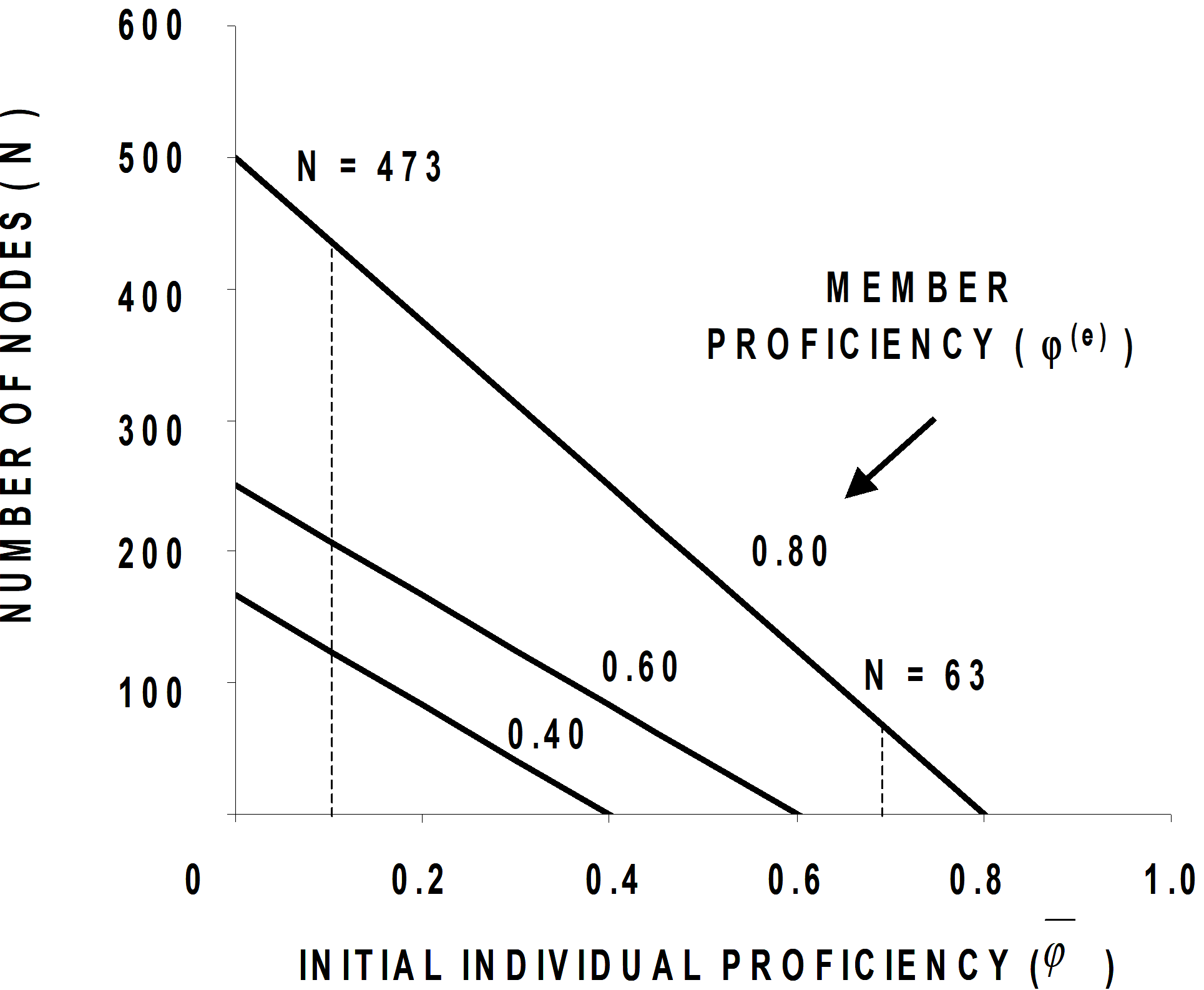
The curves, which are labeled by the constant proficiency which characterizes each member of the community, are much closer to a vertical than to a horizontal orientation, indicating thus that increasing individual proficiency has higher leverage that increasing the size of the community. Indeed, to reach a sizable increase in member proficiency starting from a low individual proficiency would require considerable increase in community size. For an individual with initial proficiency of 0.10, for instance, one would have to embed that individual into a connected community with 437 nodes if one wished that individual to attain a member proficiency of 0.80. By contrast, an individual with an initial proficiency of 0.70 would only need a community with 63 nodes to help him attain that same member proficiency. Since the size of the community is usually driven by other considerations than the proficiency of its members, simply networking a community will not necessarily produce high member proficiencies; one would first have to ensure that members arrive into the community with high proficiency.
Once again, then, Network Centric claims have turned out to be of far more limited applicability than the proponents would have had us believe. Just as we have found in previous sections of this chapter that both deceptive enemies as well as evasive enemies could render the fundamental tenets of Network Centrism largely invalid, we now find that the proficiency of our own people may do the same. Just as we have found that the wisdom of buying information technology is limited by the effects of enemy deception and evasion, we now find that the wisdom of investing in further networking the force is limited by effects of individual proficiency. The extent to which we ought to invest in creating individuals with enough proficiency to make networking a profitable proposition depends upon the return on investment one gets in the proficiency market. It should not surprise us therefore that the proponents of Network Centrism would argue that this return on investment is very high.
However, it is not at all clear that humans can, in fact, be perfected well enough to justify the drive towards networking that these proponents advise. Since there is no commodity called “human proficiency” that one could buy directly from the market, manpower monies can only be spent on infrastructure activities which contribute to the eventual creation of a proficient member of a military force, activities such as recruiting, training, and all those other programs that are designed to increase that member’s quality of life. Before we can accept the Network Centric recommendation for increased connectivity, we must therefore determine if, and under what conditions, the resulting individual proficiency would be large enough to justify such networking.