
8.5 THE MAN-MACHINE DEBATE
The issue of automation has played a very important role in the debates about reductions in manpower that have increasingly engaged the Services as the Defense Department’s budget decreased over the last decade. The argument has been that, by replacing man with machines, one can eliminate man from a variety of activities and thus save significant amounts of money. It has also been argued that, because machines are better than man in many ways, this automation would allow manpower reductions without significant loss of overall military effectiveness. This position is not contradicted by modeling and simulations because these, as we have pointed out, contain no representation of what man actually contributes to the warfighting machine. Decision makers bent on automation are therefore denied the benefit of a counter-argument precisely when they would benefit from it the most.
Clearly, decision makers know that machines are not always better than humans and that for each argument in favor of automation there might be another in favor of man. And so do the operators. The continued reluctance on the part of the Navy to automate the entire ship-board damage-control function is sufficient testimony to that. However, because the counter-arguments supporting man against machine have not been quantitatively made, the proponents of automation have tended to carry the day.
And yet, the argument is quite simple. When an automated machine is constructed for the purposes of performing some function, the “creator” must endow that machine with specific instructions concerning what it ought to do under all circumstances in which the function may have to be performed. If a circumstance occurred for which the creator had not provided, the machine would be as a car driven in the fog; in the best of cases, it would not know what to do, in the worst, it may do precisely the wrong thing. But, in a business as complex and unpredictable as war, the creator is more likely to miss important circumstances than not, and the machine he produces would therefore be dangerous.
The utility of automated machines for a given function depends therefore upon the probability that the creator’s vision of what may happen sufficiently coincides with what actually happens, a probability that for many functions may be high, but for others is likely to be small. Since man is better equipped to react intelligently to unforeseen circumstances than machines, replacing him by an automated machine would make sense only where the effect of the fog of war can be expected to be minimal. The debate between automation and man therefore is decided by the extent to which one could expect to predict the operational environment. It would lean towards automation when one believed oneself able to predict that environment, and towards man otherwise. No wonder the Navy has been reluctant to automate damage control, for there are few things in this world that are as unpredictable as spreading fire.
To illustrate the point, we have derived in Appendix B a relatively simple relationship between the effectiveness with which a mixture of humans and machines perform a given job and the number of humans in that mixture. The model relation we obtained there is depicted in Figure 8.11, from which it appears clear that the job effectiveness is not a monotonically decreasing function of the number of humans employed. Therefore, the situation when all humans are replaced by machines does not correspond to the situation with maximum job performance effectiveness. Rather, that situation is obtained when an appropriate mixture of men and machines is employed. As shown in Appendix B, the optimal mixture depends upon the probability that the creator of each machine has included in his vision the prevailing circumstances and upon the average proficiency of the humans employed. The better the humans employed and the worse the creator’s ability to predict the future operating circumstances, the further to the right does the maximum shift.
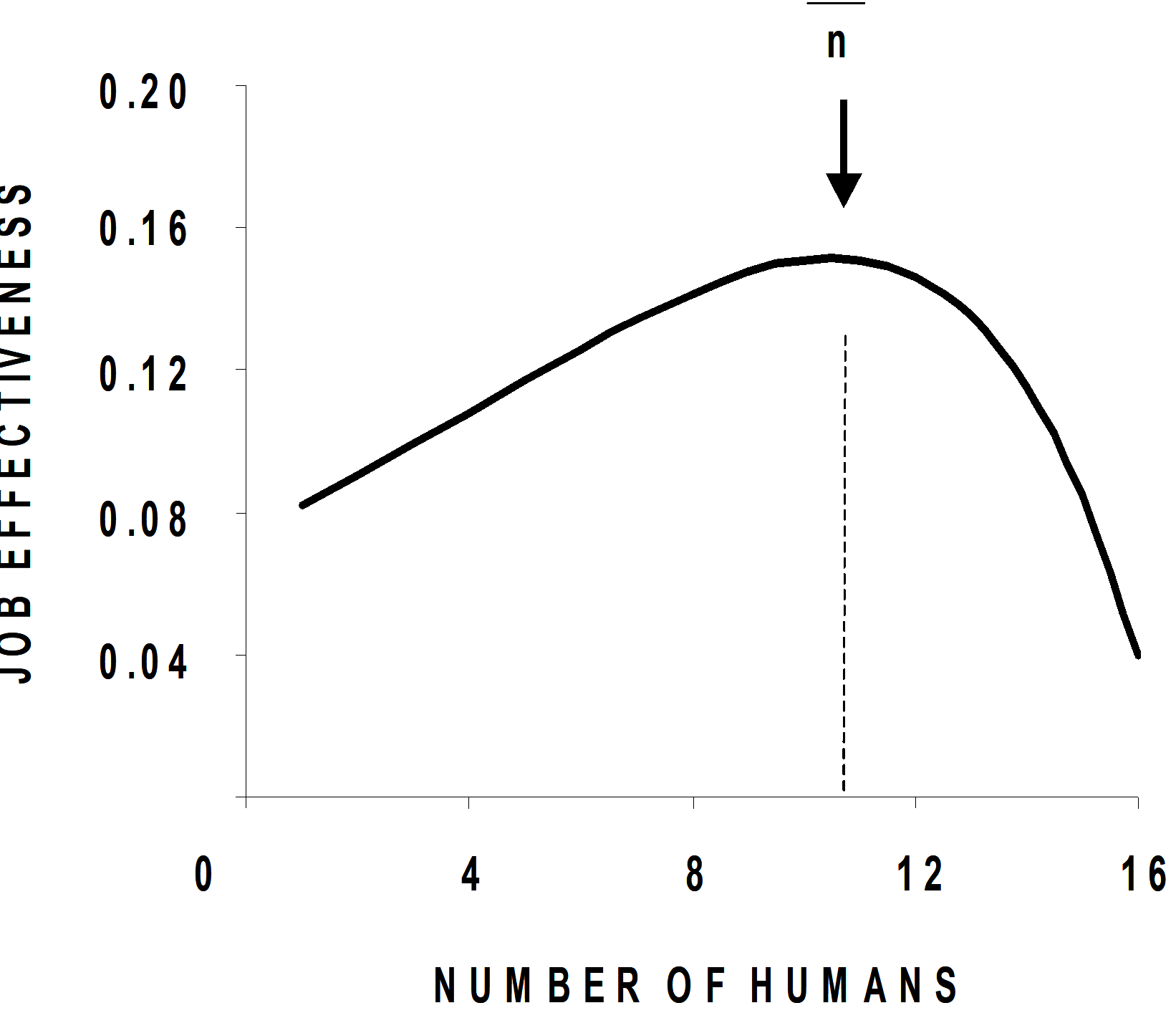
It follows from the preceding discussion that replacing humans with machines is not automatically a good idea. Despite the promise of a large financial advantage, wholesale automation of military tasks would be a mistake unless the machines one uses could be programmed to operate under almost all conceivable circumstances. Therefore, one ought to automate all those tasks the performance of which would not be unduly affected by the vagaries of war, and leave humans to deal with the tasks that are highly sensitive to changes in external circumstances. Otherwise, the day may come amidst the fog of war, when the captain of a ship would curse the decision that short-handed him in favor of machines.
With this recognition, the last opportunity for Network Centrism to escape the confines of the reality of war has been eliminated. The need to recognize the limited proficiency of human beings and the limited flexibility of machines, signal yet another sign post along the boundary that limits the validity of its claims.