
8.3 THE LIMITS IMPOSED BY THE HUMAN CHARACTER
The last sign post we shall visit in our survey of the boundary region that limits Network Centrism concerns the claim that increasing the extent to which the force is networked must always return significant improvements in our capability to conduct a war because networking leads to force cohesion. To test this assertion, we must find a way of quantitatively modeling force cohesion. The basic observation upon which one can construct such a model is that a community of military personnel, unlike a connected system of machines, has achieved its natural level of cohesion when two opposing forces balance each other off. One force has to do with man’s individuality and his indomitable tendency to do as his will would dictate; the other has to do with the leadership’s ability to counterbalance that tendency through discipline, collective training, and inspirational example. However, even before any of these forces get to act, there exists a natural force of cohesion that acts upon each member of the community by virtue of the fact that what each member asserts and does must fit into the overall structure of a common goal.
To illustrate the point, consider two people, one fully trained to control the accelerator of a car but not its wheel, the other fully trained to control the wheel but not the accelerator pedal. Should these two people ever get into the same car, one would expect them to end up against the nearest telephone post. The only way in which they could accomplish their common goal of keeping the car safely on the road would be to have them communicate with each other in an attempt to accommodate their respective activities to the accomplishment of that goal. In essence, they would begin to act as if an organizing force were acting upon them, demanding from both that they appropriately coordinate their activities for the purposes of keeping the car properly on the road.
Now, this organizing force will act on each individual that is connected to the community, forcing him to accommodate himself to the demands of the common goal despite his natural tendency to do otherwise. If the individual member happens to be a highly perceptive human with an undisciplined, head-strong personality, he may resist the action of the organizing force a lot more than another individual member who happens to be less perceptive and who is more disciplined and more pliable. Therefore, the equilibrium position attained by each individual under the action of these two forces, the organizing force of the common goal and the randomizing force of his own personality, will depend upon the individual.
However, the final equilibrium position that each member, and therefore the entire community, attains will also have a lot to do with the number and the personality of the members comprising the community. The larger the community, the larger the organizing force resulting from the joint action that all other members exert upon any given individual, and the more trained each individual is, the smaller his resistance to the dictates of the common goal. Furthermore, discipline and leadership, through their ability to reduce the randomizing effect of individual behavior, have a lot to do with the location of the equilibrium as well. All in all, the community is as cohesive as it can be when all these factors have been allowed to act for a sufficiently long period of time to allow an equilibrium to be achieved. What that equilibrium turns out to be, depends on the size of that community, the inherent quality of its members, their collective training, and the quality of the leadership in place; but there is no doubt that a given state of equilibrium will, in fact, be achieved each time.
A convenient way of visualizing all of this is shown in Figure 8.5. The figure represents each individual by an arrow of unit length oriented in some direction, an arrow that projects a certain degree of alignment upon the direction representing the common goal. The initial value, , of this degree of alignment measures the amount of natural alignment the individual member displayed when he first joined the community and therefore captures the individual character of that member. The final value measures the corresponding degree of alignment attained at equilibrium. Within this representation, the organizing force tends to “rotate” the arrow towards the direction of the common goal and thus increase the degree of alignment with that direction. Its value can be simply modeled as follows:
where represents the degree of alignment that the arrow representing the th community member makes with the direction of the common goal, is the strength of the organizing tendency exerted upon the th crew member by the rest the community, and is an unknown constant setting the strength-scale of the organizing force.
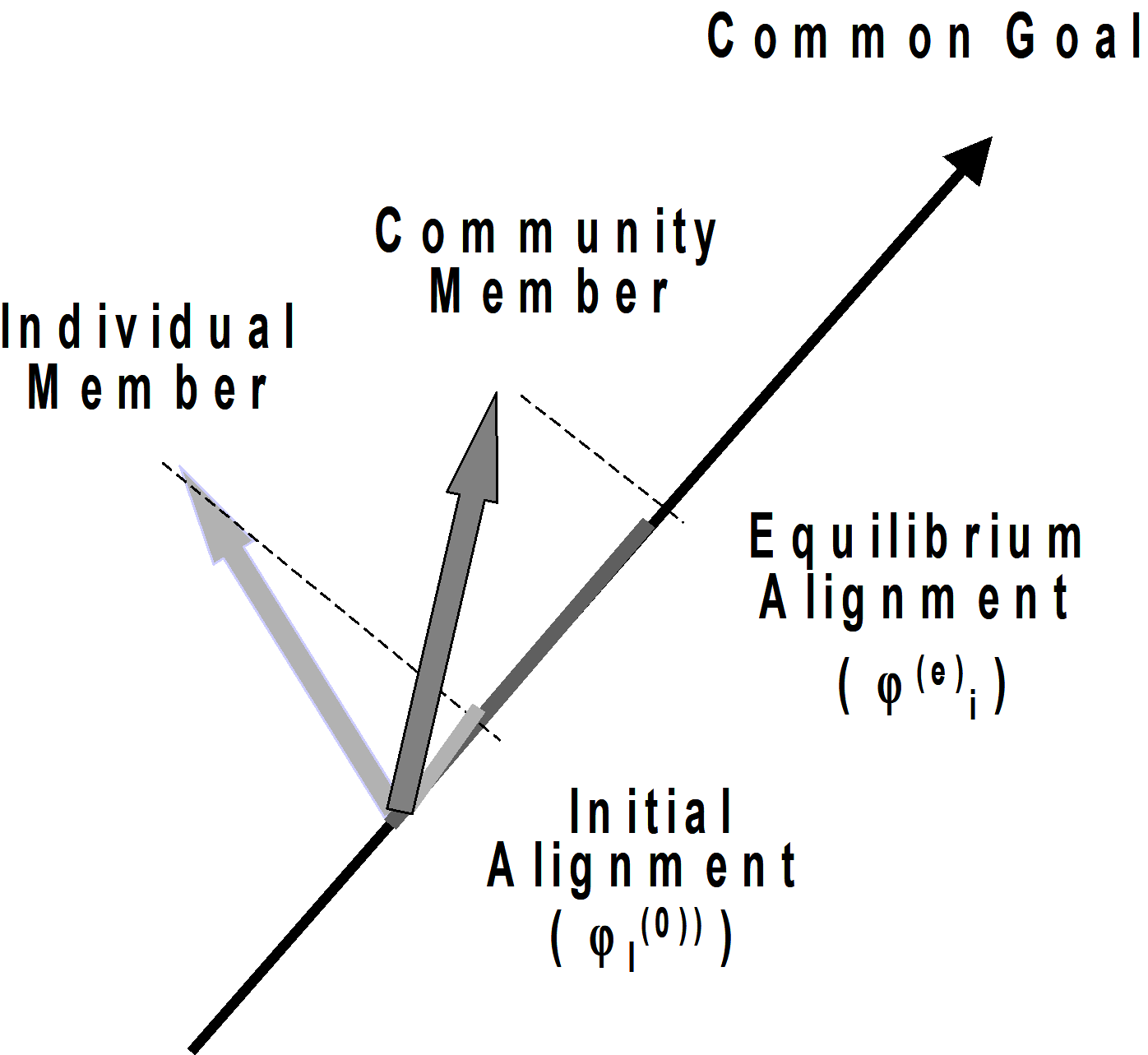
To this force there corresponds another one, representing the natural tendency of an individual to reject external direction, a force that, by opposing it, would tend to decrease the degree of alignment of the member arrow with the direction of the common goal. We model this force in the same way that we would model the response of a compressed mechanical spring:
where is another unknown constant setting the strength-scale of the disorganizing force. The value of the unknown constants must of course be ascertained through appropriate measurement. At equilibrium, these two forces become equal and one has:
To solve for the equilibrium value , we shall make the simple assumption that all the are equal to:
where the sum extends over the total number of individuals comprising the community; this number corresponds to the number of nodes in the network defining the community. The last two equations allow for a self-consistent solution given by:
where:
Figure 11 shows how this solution depends upon the number of nodes in the network and upon the order-disorder ratio , under the assumption that members start with the same degree of alignment:
Figure 8.6 displays community cohesion, as measured by the equilibrium alignment between the arrow representing each member and the direction of the common goal, as a function of the number of nodes characterizing the community. The three curves correspond to the three values of the order-disorder ratio shown. We have chosen to count the number of nodes in decreasing order in order to dramatize the catastrophic collapse of cohesion with decreasing community size.
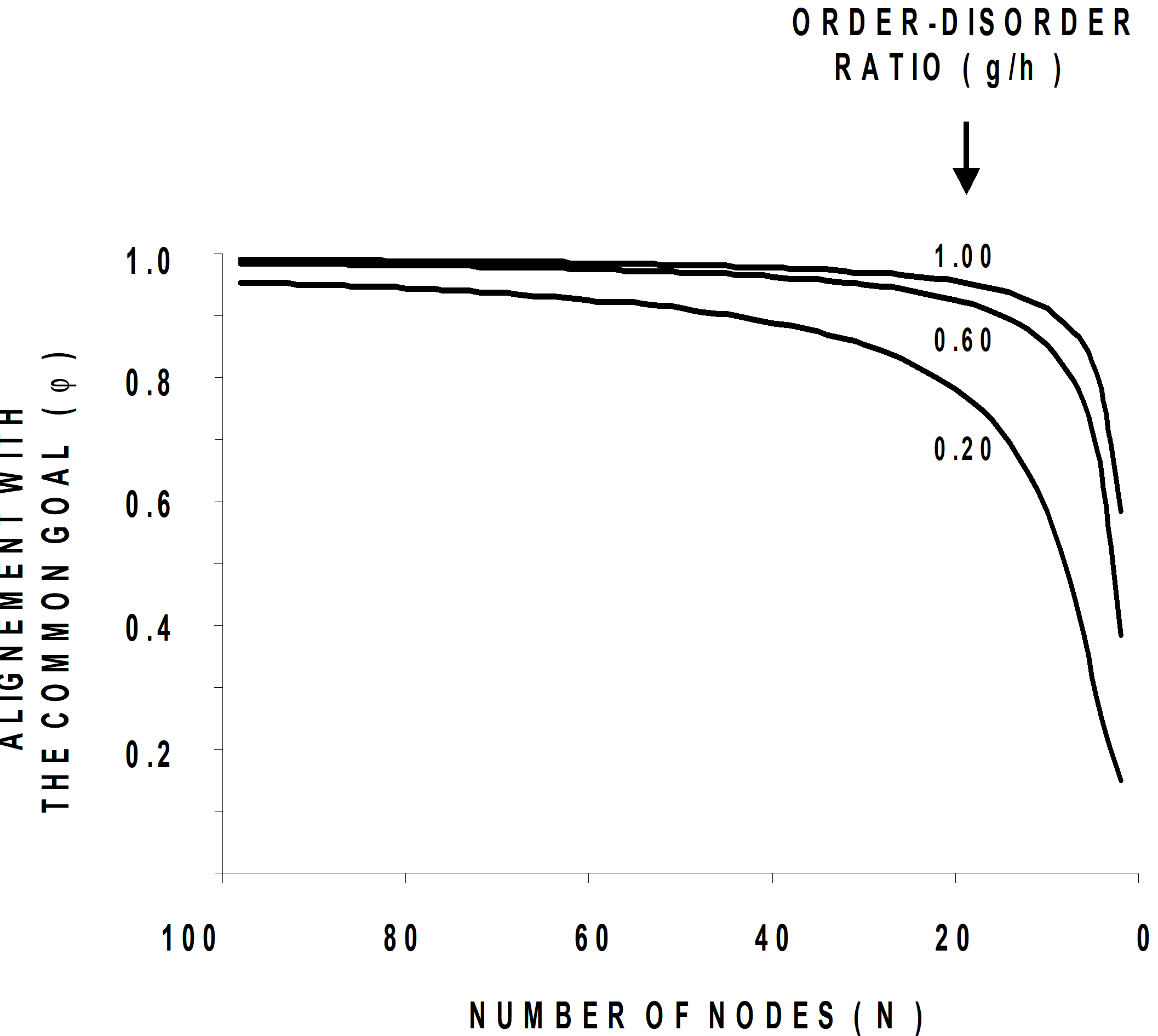
Anybody that has had command of a naval combatant will have recognized in this analytic description the general features of a ship’s crew. They will remember how a crew suddenly emerges from the group of people originally assigned to a given platform and how the qualities of that crew are shaped by the factors described above. They will now also understand that the average proficiency of each member in the crew will collapse just as suddenly if one reduced the size of that crew beyond some minimum number that depends upon the order-disorder ratio. Since this latter ratio measures the balance between discipline and chaos, its value will reflect the leadership qualities of the officer corps commanding the ship.
Depending upon the meaning we associate with the projection , we can employ this cohesion model to illuminate a number of different cohesion-related issues. Thus, in the next section we shall use the cohesion model to discuss the issue of cognitive cohesion, while in the following section, we shall use it to discuss the issue of cohesion in action.