
8.1 THE LIMIT IMPOSED BY ENEMY DECEPTION
As discussed in Chapter 7, nimbleness means being at the right place at the right time. The use of the word “right” in the definition of nimbleness indicates that we are interested in countering the true actions of the enemy, not what we happen to think might be his true actions. To achieve that, we must be able to surveil and reconnoiter enemy activity, quickly decide what to do in consequence of what has been learned, attain to the appropriate force posture at the appropriate time, execute the job as fast as possible without loosing too much of the force, and quickly move on to the next job. However, to the extent that our enemy is able to deceive us concerning his true operational intentions, we may end up being in the wrong place at the wrong time, a fact that would detract from the nimbleness of our war machine.
We focus therefore on the following two quantities: the enemy’s ability to hide his actual plan of action from us, and the quality of the information technology we use to defeat that deception. These two parameters are critical factors in the sense of Chapter 3 and therefore, as described there, they span a two-dimensional space within which any given encounter, consisting of our forces confronting an enemy trying to deceive us as to his actions, corresponds to a point. The two coordinates of this point represent the ability of our forces to gain a correct understanding of the action contemplated by the enemy and the enemy’s ability to deceive us.
Within this trade space, encounters between differently characterized war machines and enemies, will be represented by other points. Therefore, getting a birds-eye understanding of how enemy deception would affect the military utility of some information technology designed to improve the nimbleness of our war machine, is now the same with comparing the location of different points in this trade space. This comparison involves the metric of the space, that is, the yard stick that measures the distance between two arbitrarily chosen point in the space. It stands to reason that the most militarily meaningful choice of a yard stick for the case under consideration should involve the measure of a war machine’s nimbleness.
To be specific, let us imagine that, as described in Chapter 3, the trade space is covered densely with curves along which the measure of effectiveness is constant (see Figure 3.2). Then, the distance between two points representing encounters between two possible war machine-enemy pairs can be defined as the difference between the nimbleness values characterizing the two curves that pass nearest the points under consideration. Within this construct, one can easily determine the extent to which the current war machine has adequate nimbleness by reading the nimbleness value associated with the curve passing through the point representing the encounter in which that war machine is employed against the most likely enemy. If one perceived a shortfall in nimbleness in the current war machine, one would then be driven to consider alternative war machines that offered more nimbleness against the likely enemy than was offered by the current machine. All other thing being equal, one would naturally prefer the war machine that was farthest in trade space.
All that remains to be done, then, is to specifically define the measure of nimbleness and to relate it to the two coordinates spanning the trade space. Remembering that a nimble war machine is one that will be in the right place at the right time, a natural measure of nimbleness would be the spatio-temporary mismatch between the achieved and the desired states of military affairs. To be specific, if the true enemy position and his true intentions would suggest that our war machine should be deployed in a particular pattern at time , but, to the best of our ability to picture the situation and then deploy to it efficiently, we can only achieve a pattern different from , and do so at time later than , then the closer the two patterns are, both in time and space, the nimbler the war machine.
And now, let us try to relate the measure of nimbleness just defined to the two dimensions of the trade space listed above. The key is to identify a reasonable means by which to characterize the strategic and tactical pattern of a deployed war machine. A simple way of achieving the desired characterization is to specify the location of all the points in the battle space that have military significance for the contemplated encounter by the pattern . This pattern, representing the enemy deployment at time , will change with time in accordance to the enemy war plan. Our war machine, on the other hand, will generate another pattern which differs from the original one only because our machine’s ability to survey, reconnoiter, assemble, and then disseminate the information in real time is short of perfect. The difference between the two patterns, described by the set , is a stochastic process because the performance of the systems employed to generate the second pattern is random and because the enemy’s deception plan is designed to generate uncertainty. The moments of the corresponding distribution, that is, its mean, variance, kurtosis, and so on, will then depend on the quality of those information-generating systems and upon the enemy’s ability to deceive; in fact, one should be able to relate those moments to the two parameters that span the decision space, thereby completing the quantification scheme.
In general, the distribution will indicate a non-vanishing probability for the mismatch set taking on any value; however, mismatches larger than some finite value, both in time and space, would not serve for much because one could not usefully accomplish one’s mission if one’s information were significantly off reality. Let this limiting value be denoted by the set . Then, the measure of nimbleness could be defined as the probability that the actual mismatch is smaller than the limiting values, a probability that can be evaluated by the integral of the mismatch distribution over the limiting set.
We shall now assume, for illustrative purposes, that there is only one relevant point in the battlespace, say the location of the enemy force. Let point in Figure 8.1 be that location at time . Our information system, however, thinks that the enemy is located at the point instead. Based on that belief, our forces positions themselves at point where they expect the enemy to be at time according to their estimate of his direction of movement and speed of advance. In reality, of course, the enemy, which is trying to deceive our information system, will have reached point , a location the enemy draws from a random distribution whose mean is located at , the point which he would have reached had he moved from according to our estimate of his velocity.
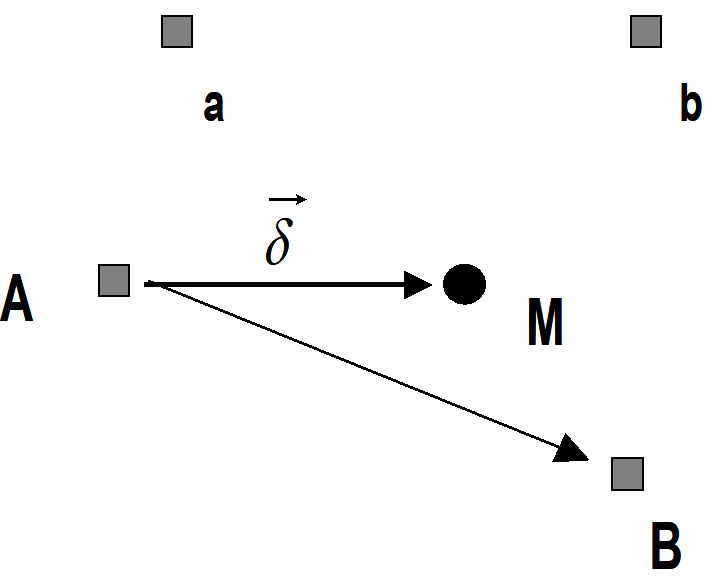
We shall further assume that the probability distribution which describes the ability of our information system to locate the enemy at any given time, as well as the probability distribution reflecting enemy deception, are Gaussian, and that their moments are known functions of the two critical factors spanning the trade space. In fact, we shall take one of the critical factors to be the variance of the distribution from which the enemy chooses his deceptive action, the other to be the variance of our information-generating process.
Then, we can write these distributions as follows:
where represents the distance the enemy is expected to have moved, on average, in time . The probability distribution for the mismatch between the location of our forces at time and the actual location of the enemy at that time is therefore the convolution of the two distributions above:
which represents a normal distribution with variance:
The measure of nimbleness corresponding to this distribution is therefore:
where is the cube of side in the space of three coordinates . This measure depends only upon the sum of the squares of the two variances involved, one measuring the quality of our information system, the other the enemy ability to deceive. Therefore, constant-nimbleness curves are circles in the trade plane spanned by our two critical factors, and . Figure 8.2 shows these curves in the plane spanned by these two variances measured in units of the maximum-allowed mismatch .
Assume now that we are dealing with an enemy that is relatively unable to deceive. For such an enemy the value of should be relatively small, say . Under these circumstances, as it is evident from the figure, increasing the quality of our information system by decreasing the value would significantly increase nimbleness. However, should our forces confront an enemy with a large value of , say , the same increase in information capability would buy us almost nothing.
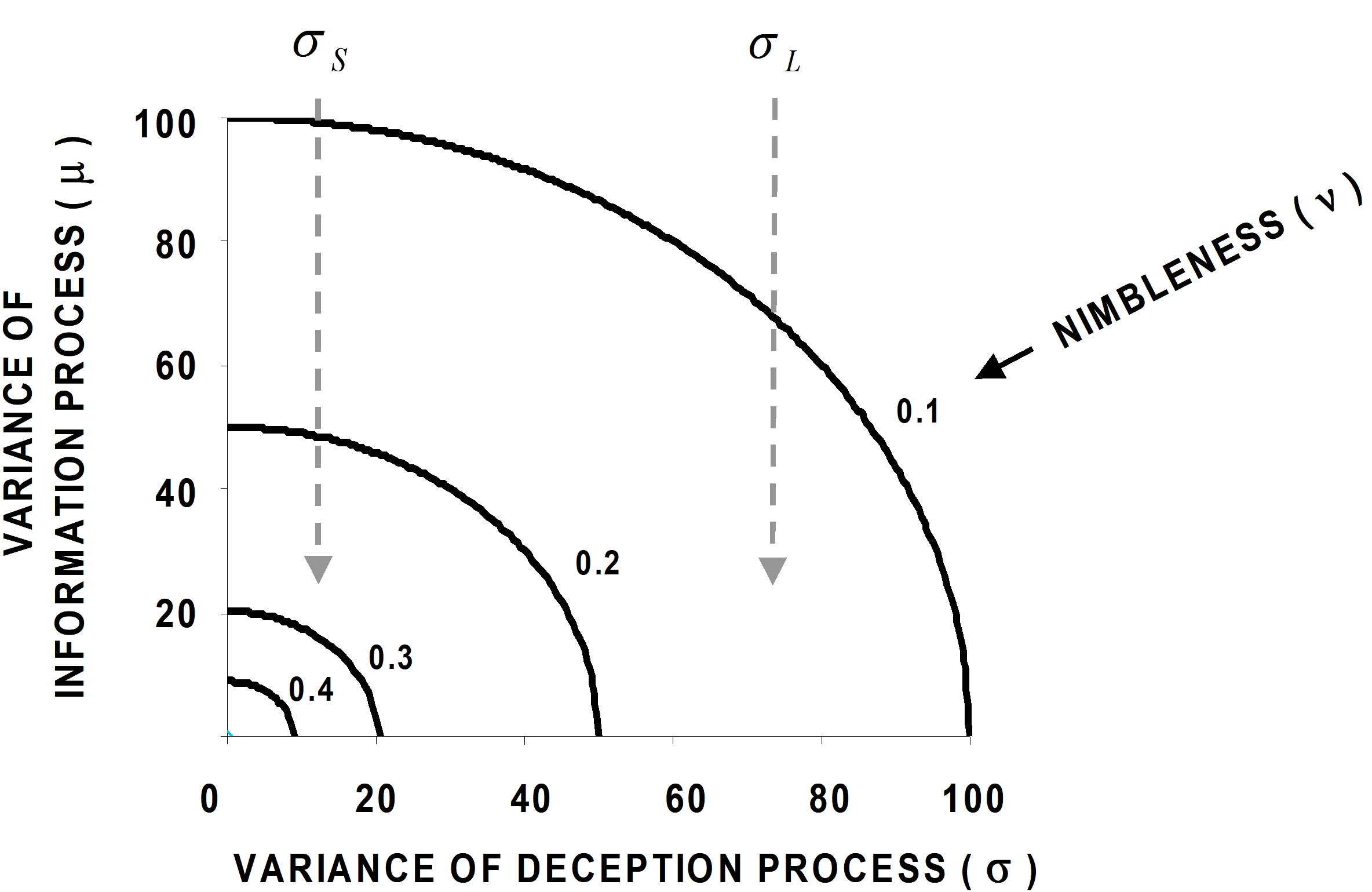
In other words, a predictable enemy has no ability to exploit the singular vulnerability in the nimbleness of our forces, in which case current information technology would probably suffice, but an unpredictable one can. In that case, contrary to the Network Centric claim, acquiring more and better information technology will not avail us. Therefore, consideration of enemy conduct limits the otherwise unqualified Network Centric claim that buying information technology is always a good idea, which might explain why Network Centrism has constantly insisted that enemy conduct is not relevant to our technology planning.
It is manifest that the analytic construct we used in the illustration above does not provide the decision maker with the most militarily useful course to follow, as in fact it should not; it does however help him seek such a course in full comprehension of what the operational strength and weaknesses of each possible choice are. Combined with the decision maker’s military experience, on the one hand, and prevailing political considerations, on the other, this analytic methodology replaces a decision that would otherwise rest entirely on subjective considerations with one that acknowledges the operational consequences of that decision in a quantitative way.
It is also manifest that the calculations involved in executing the program above are significantly less detailed than the modeling and simulation the community routinely employs today. That should not disturb us, for, as we have said before, this construct is intended to serve a totally different purpose than the modeling and simulation technique. While the latter is designed to evaluate the performance of our military machine, with or without improving features, when employed in specific operations, the former is intended to aid decision makers explore the universe of choices available to him; modeling and simulation seeks to describe the war machine, systems analysis seeks to understand it. The knowledge that enemy deception would affect the leverage of information technology was the cause for how we constructed our model, not a consequence of it; all our model did, was to replace the various adjectives with numerical estimates, thus quantitatively illustrating pre-existing insight.