
7.1.1 How To Identify Singular Vulnerabilities
As indicated above, identification of singular vulnerabilities requires an analysis of our capabilities with an eye to any possible seam and nothing else. Specifically, it requires understanding the fundamental assumptions about an enemy that are necessary to ensure that our capabilities produce the desired operational effects upon his force.
Now, capability means having attributes to produce or accomplish something, and therefore each military capability must specify that something which it will produce or accomplish. For instance Intelligence, Surveillance, and Reconnaissance are military capabilities that produce respectively information, a picture of the theater, and the disposition of enemy forces. The problem is that capabilities and their products do not directly point to the corresponding effects; to understand the effects, one must also know the purpose for which those products are used. Thus, the operational effect that the products of Intelligence, Surveillance, and Reconnaissance generate is an ability to place our forces in the right place at the right time, something that is not explicit in the mere capabilities themselves.
Therefore, to identify the singular vulnerabilities, we need to find a systematic way for making the leap from capabilities-generated products to operational effects. We do that in this section. The basic idea is to first identify the qualities of a war machine, by which we mean that selection of operational effects which makes the war machine what it is, and then let these qualities illuminate the path from products to operational effects. We describe these qualities and their associated operational effects in the next sub-section.
7.1.1.1 The Four Qualities Of A War Machine
Clausewitz says that the aim of warfare is to make the enemy comply with our will. Since in general the enemy has no wish to comply voluntarily, we must force him to do so against his will. The only way to accomplish that is to render the alternatives more painful to him by comparison. Individual examples to the contrary notwithstanding, there are only two things humans cherish more than their ability to be free of foreign imposition: life and property. Consequently, we must endanger these if we want him to comply with our will. History knows of only one way of doing so, employment of a military machine designed to kill people and destroy property.
If unopposed, a military machine so designed would control the enemy’s behavior by killing enough people and destroying enough property to overcome his determination to resist our will. If the consequences of his resistance could be made clear to the enemy aforehand, we might even be able to accomplish our goal merely by credibly threatening to destroy enemy life and property. Historic examples of this can be found in the many occasions when cities opened their gates to an invading army whose reputation for destruction preceded its arrival.
The same is hardly true if the enemy has a military machine of its own to oppose ours. They could use their machine to do two things: reduce the capacity of our machine to mete out the destructive power that it would otherwise be able to do, or press their own power until the alternatives to war begin to look more attractive to us. In either case, the center of our attention will then shift from destruction of life and property to disarming the enemy war machine. In fact, warfare evolved to the point where it is no longer thought acceptable to conduct military operations directed at civilians, in the civilized world, anyway. Such operations, if undertaken, are called by other names than war, such as terrorism, atrocities, and so on, each of which carries a strong connotation of immorality. The fact that some people are nevertheless killed by way of disarming the military machine of the enemy has been made palatable both by using uniforms to distinguish between civilians and military personnel and by recognizing the unpredictable nature of war.
Disarming, is a human act which has come to symbolize the formal submission of one side in a military conflict to the will of the other, much like animals submit to the more powerful specimen by engaging in certain rituals recognized by their species as ways of stopping the conflict. As such, disarming does not occur until one side manages to bring the other side’s war machine to the point of inefficiency. This can be done in two ways: either one forces the enemy machine into a position from which it can no longer execute its function, or one reduces the machine’s power to function by destroying its components in detail. To do the former requires considerably more ingenuity than killing, to do the latter requires considerably more killing than ingenuity, although ingenuity as well as killing are involved in both. World War I is a particularly plastic illustration of war by attrition of the enemy’s war machine, while the German advance in the early days of World War II is a good example of how one can render the enemy war machine ineffectual.
In the more recent past, the Allies relied heavily on ingenuity as they fought the Soviet Union to a victory under the umbrella of nuclear deterrence. Although not always directly acknowledged, future American warfare plans rely more on killing than on strategic and tactical ingenuity. Given our recently acquired ability to destroy objects with exquisite precision, this is a matter of convenience and expediency. On the other hand, likely enemies rely more on tactical ingenuity than on killing because they can not hope to match us in our strength but can easily exploit our most conspicuous military vulnerabilities, such as our critical reliance on detailed tactical information, our relative immobility, and our lack of patience.
In actual warfare, both ways are employed in combination. This requires a military machine that is both nimble and powerful. And, since wars often last much longer than one expects them to last, war machines must also be quite resilient. To be all this, however, a war machine must be coherent; without coherence between its component parts, a military machine will not have the required speed, capacity, and stamina to make it respectively nimble, powerful, and resilient. In the manner of all human projects, this coherence can only be attained if the pieces are intelligently glued together by means of information-based planning and leadership; planning because war is a project, leadership because war involves a large number of components. Our war machine must therefore be a coherent entity able of nimble, powerful, and resilient action.
7.1.1.2 From Qualities To Operational Effects
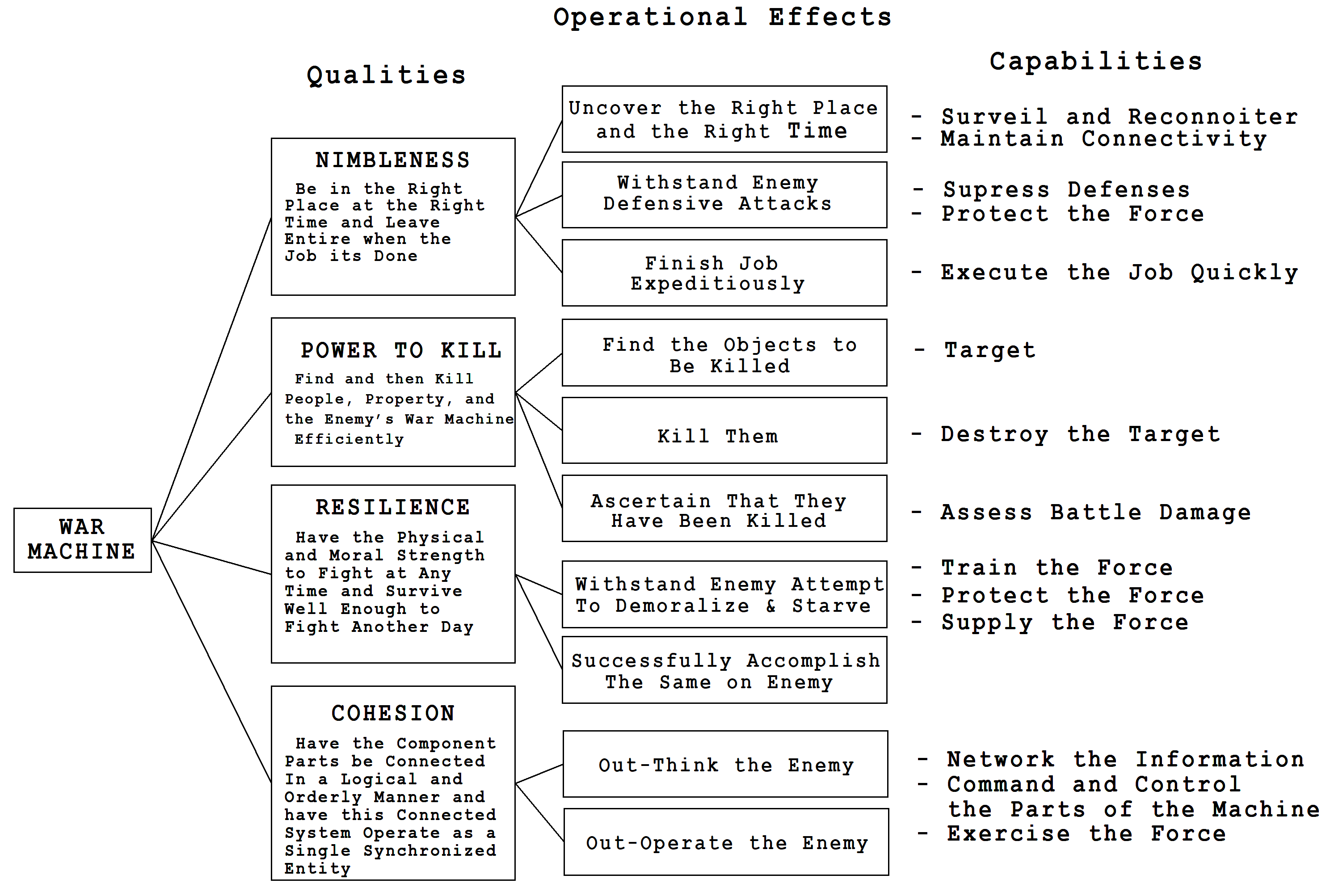
To possess the qualities mentioned in its definition, the military machine must be able to generate certain operational effects. The effects we have in mind here are not those devised to attain some particular goal within some particular set of circumstances, for both are changeable; rather, we aim at characterizing the operational effects that provide the war machine with its cohesive structure exhibiting the main qualities of nimbleness, power to kill, and resilience.
To be nimble, a war machine must always position itself in the right place at the right time and leave more or less entire as soon as the job is done. To achieve this, the war machine must therefore generate three effects: uncover where the right place is and what the right time is despite enemy attempts to hide that information, successfully withstand enemy defensive attacks, and finish the job in the most expeditious manner. The first two effects rest on the capability to conduct operations known in military parlance as gathering information, conducting surveillance and reconnaissance, and communicating all that onward throughout the structure of the war machine. The third effect results from the capability to conduct defensive operations referred to as force protection. The final effect, that of finishing the assigned job expeditiously, is provided by operations that give the machine its coherence and are known as Command and Control.
To have the power to kill, a war machine must always find and then kill people, destroy property, and dismantle the enemy’s war machine with efficiency. To achieve this, the war machine must therefore generate three effects: find the objects to be destroyed despite enemy attempts to hide them, destroy them despite enemy attempts to evade destruction, and then ascertain that they have indeed been destroyed. The corresponding operations are known as targeting, striking, and battle damage assessment. The first effect rest on the capability to detect and track targets, the second on the capability to hit and destroy detected targets, and the third on the capability to monitor the state of the battlespace.
The war machine must have the stamina to stay the course as long as the war aims demand it. Thus, it must have the physical and moral strength to fight at any time and survive well enough to fight another day. To achieve this, the machine must therefore generate two effects: overcome enemy attempts to demoralize, logistically starve, and decimate our forces, and successfully accomplishing the same against enemy forces. To that end, we must have the capability to conduct operations intended to train, supply, and protect our forces against enemy attacks, and to conduct operations intended to stress enemy supply lines and decimate his forces.
Finally, the war machine must be cohesive. This requires that its component parts be connected in a logical and orderly manner and that this connected system be able to operate as a single, synchronized entity. Since all systems stand as a balanced compromise between the individuality of their components, on one hand, and the overarching pressure to contribute to the common good, on the other, our military machine must be networked for efficient information flow between the components, must be controlled to ensure that the common goal is properly implemented, must be commanded to reduce the friction generated by the individuality of the parts, and must be fully exercised as a whole. The resulting path from qualities to effects and from effects to capabilities is summarized in Figure 7.1.
Now, to exploit an Achilles’ heel means to deprive the corresponding capability of its intended effect. Therefore, when searching for singular vulnerabilities, we are interested in traveling this path in the opposite direction, from capabilities to effects. One might then wonder why we bothered with defining the qualities of a war machine when directly connecting capabilities to effects would have been simply enough. The reason we had to generate the entire taxonomy first is that, in principle, it is impossible to decide from capability alone what the intended effect is; one needs to know what qualities a war machine must have before deciding what effects to generate.
7.1.1.3 The Search Methodology
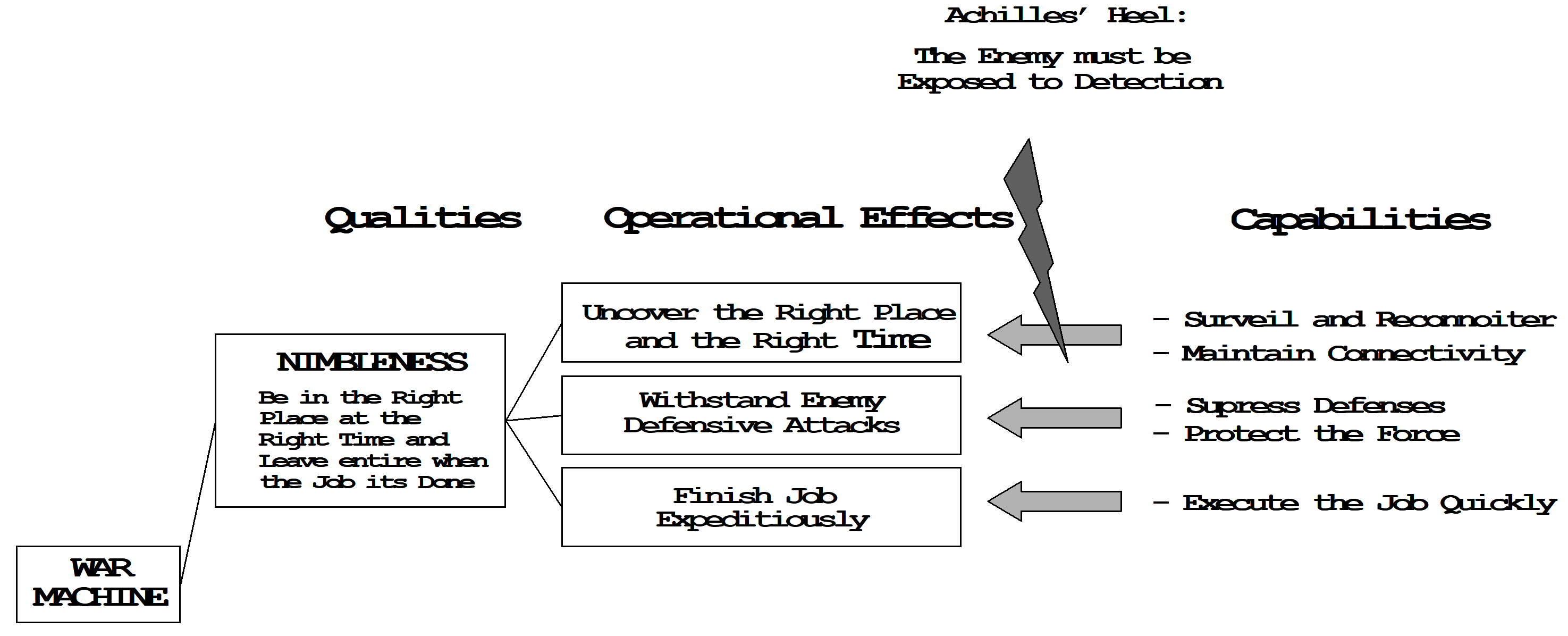
To find the corresponding singular vulnerabilities, one must exhaustively identify the assumptions underlying the link connecting capabilities and their products with the operational effects. Specifically, for each capability identified above, one would inquire after the fundamental assumptions we make about an enemy when we expect that the capability under consideration will, in fact, provide the specified effects; each assumption identified in this manner is then an exploitable seam in our military capability. For instance, as shown in Figure 7.2, there is a seam separating surveillance and reconnaissance capabilities from the intended effects of discovering where and when to locate our forces during the battle. To exploit this singular vulnerability, all an enemy would have to do is hide.