
6.7.3 Quadrature Amplitude Modulation (QAM)
Although 8PSK and 16PSK achieve higher data rates for a given bandwidth, increasing the number of phase states while maintaining constant amplitude reduces the angular separation between constellation points. The smaller the phase difference, the more susceptible the signal becomes to noise and phase distortion. Beyond a certain point, the advantages of higher data rate are outweighed by increased demodulator complexity and higher error probability.
Quadrature amplitude modulation (QAM) increases bit rate without requiring unmanageably small phase separations by varying both the amplitude and phase of the carrier. Figure 6.30 shows a 16QAM constellation, in which each symbol represents four bits through a unique combination of amplitude and phase.
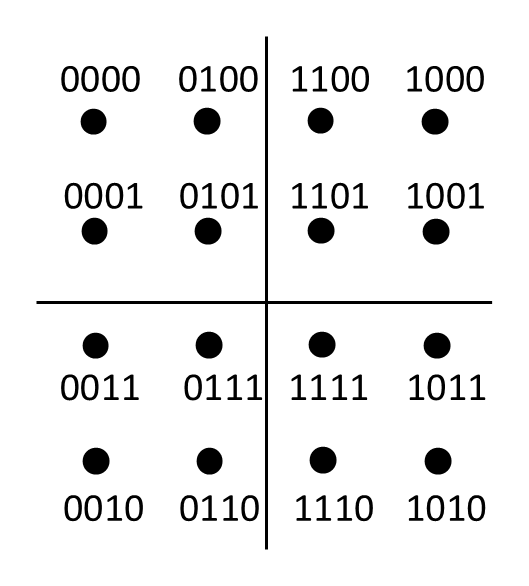
As the number of amplitude and phase states increases in QAM, the distance between constellation points decreases in both dimensions. This makes the system more vulnerable to additive noise and to nonlinear distortion from high-efficiency amplifiers, such as those used in satellite transponders. Consequently, QAM cannot maintain a constant-envelope carrier and is less tolerant of nonlinear amplification than PSK. Consequently, QAM systems require linear amplification to avoid distortion of the amplitude dimension of the constellation.
Despite these limitations, QAM is widely used in television broadcasting, Wi-Fi, cellular networks, and satellite communication systems because it offers an excellent compromise between spectral efficiency and implementation complexity.
Back to reading