
6.3.9 Independent-Sideband AM
From a system perspective, one further disadvantage of SSB is that each channel still requires one transmitter. Since an AM transmitter is capable of transmitting two sidebands, this is somewhat inefficient. Two different channels can be transmitted using only one transmitter through the use of independent-sideband (ISB). The basic principle of an ISB system is shown in Figure 6.16, where two modulating signals at two analog channels with maximum frequency fm each modulate the same carrier frequency fc.
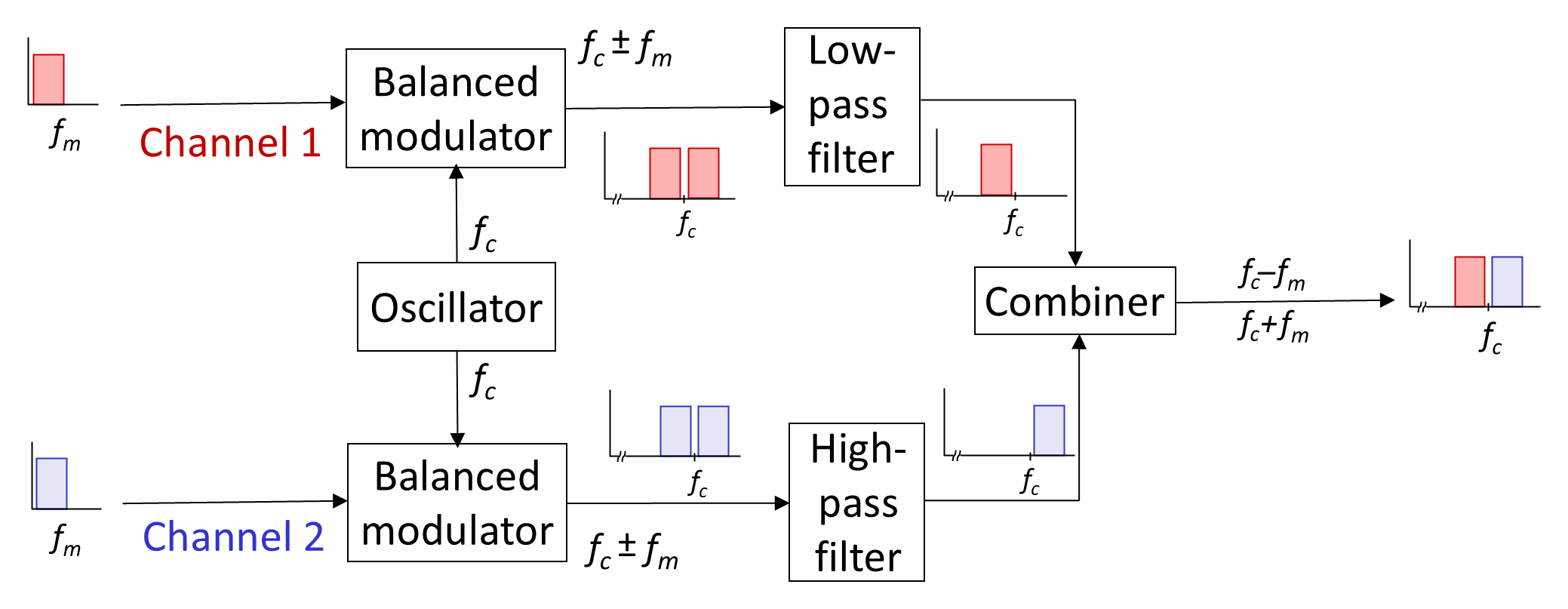
The outputs of the two balanced modulators are DSB waveforms at frequencies fc±fm and fc±fm respectively. Two band-pass filters are used to select the upper sidefrequency fc+fm in one channel and the lower sidefrequency fc–fm in the other. The selected sidebands are combined to produce a DSB signal in which each sideband carries different information.
ISB has the advantages of SSB but allows closer packing of the channels, providing more efficient spectrum utilization. The major limitation is that both channels must be destined for the same receiver.
In modern digital communication systems, many of the principles developed here—carrier suppression, quadrature generation, coherent detection—reappear in digital modulation schemes such as QAM and PSK. Analog SSB can therefore be viewed as a conceptual precursor to modern quadrature modulation.
The modulation techniques examined so far—AM, DSB, SSB, ISB and VSB—are all forms of amplitude modulation, in which the information is conveyed by variations in the carrier amplitude. As noted earlier, amplitude-based schemes are inherently susceptible to additive amplitude noise in the channel. An alternative approach is to convey information by varying the frequency or phase of the carrier instead. These angle-modulation techniques offer significantly improved noise performance at the expense of increased bandwidth.
We now turn to frequency modulation (FM), the most widely used form of analog angle modulation.
Back to reading