
6.7.2 M-Ary PSK (MPSK)
The concept of phase modulation can be extended to use multiple discrete phase states in what is known as M-ary phase-shift keying (MPSK). Figure 6.29(a) shows the constellation for 8PSK and Figure 6.29(b) for 16PSK, which represent three and four bits per symbol, respectively. Because QPSK, 8PSK, and 16PSK carry two, three, and four bits per symbol, their data rates are two, three, and four times greater than that of BPSK for the same symbol rate and occupied bandwidth. For a given bandwidth, however, increasing the number of phase states reduces the angular separation between constellation points, making the system more susceptible to noise and phase distortion. The minimum Euclidean distance between constellation points decreases as M increases, directly increasing susceptibility to noise for a given signal energy.
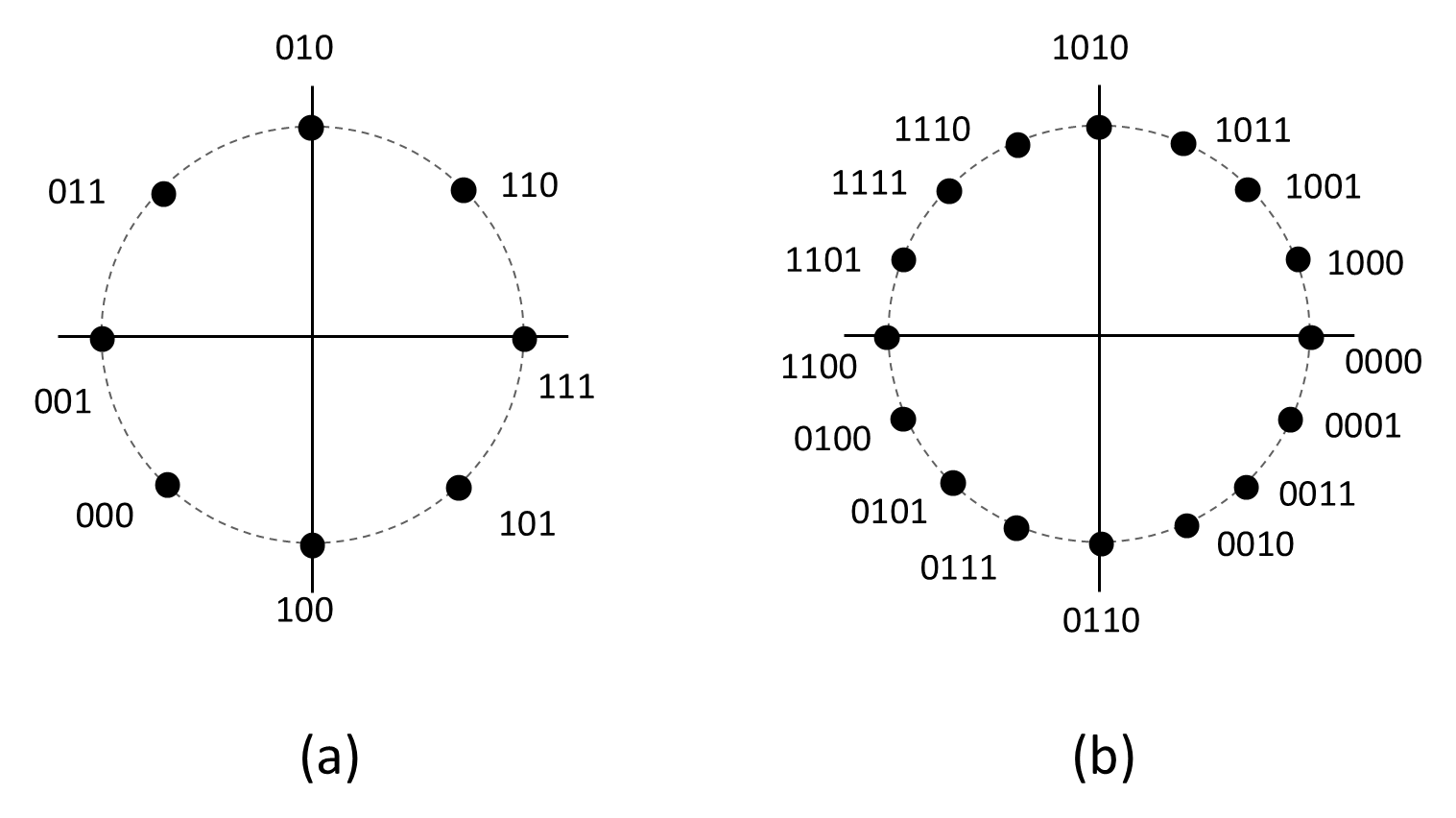
For example, 8PSK and 16PSK exhibit similar theoretical bandwidth efficiency but higher bit-error rates than QPSK under identical carrier-to-noise conditions. To maintain performance, these higher-order systems require more complex demodulators capable of accurately distinguishing smaller phase shifts. Error-correction coding can be added to mitigate these misinterpretations, but the added redundancy reduces the effective information rate within the same bandwidth.
M-ary PSK techniques are highly bandwidth-efficient and have the added advantage of maintaining a constant-envelope carrier. Since the carrier amplitude remains constant and carries no information, the signal can tolerate amplitude distortion from nonlinear power-efficient amplifiers (such as those used in satellite transponders) without significant degradation in performance.
Back to reading