
6.3.6 Double-Sideband Suppressed-Carrier AM
Since the carrier component conveys no information, any power used to transmit it is effectively wasted. Transmission of the two sidebands without the carrier results in double-sideband suppressed-carrier (DSBSC) or, more commonly, DSB. The abbreviation DSSC is also used. If the carrier component is suppressed after modulation, Equation (6.6) is reduced to:
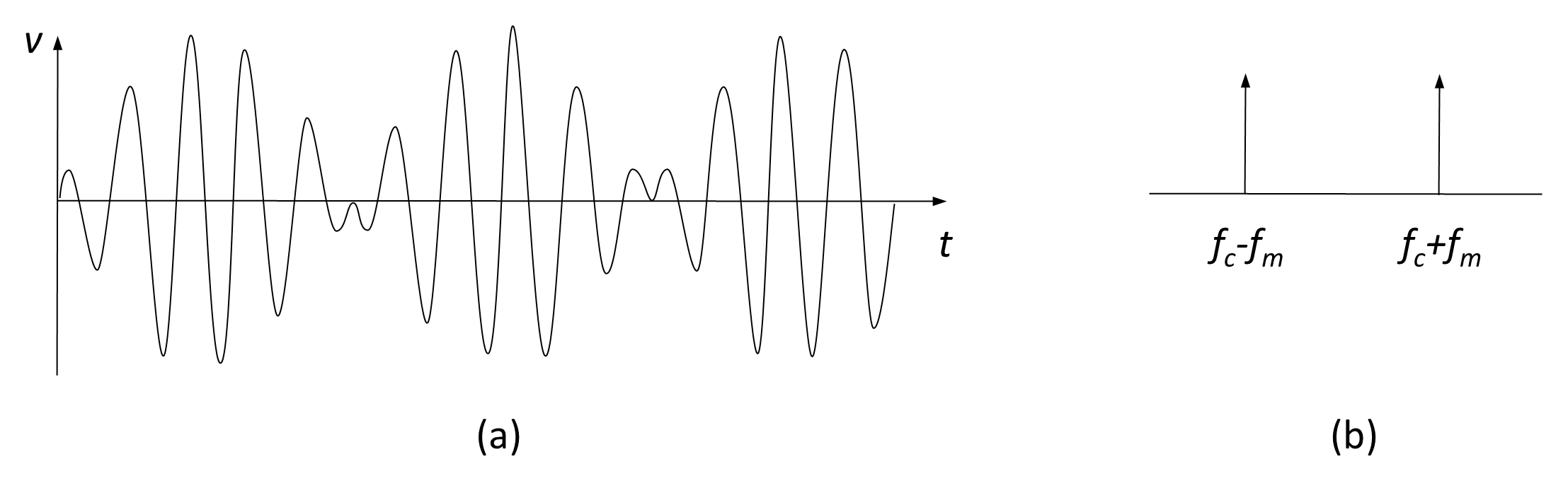
The waveform for a DSB transmission is shown in Figure 6.9. The resultant waveform can be considered as the multiplication of the modulating and carrier waves in accordance with Equation (6.19). More simply, as Equation (6.8) predicts with the carrier component suppressed, the DSB waveform is the result of the addition of the upper- and lower-sidefrequency waveforms.
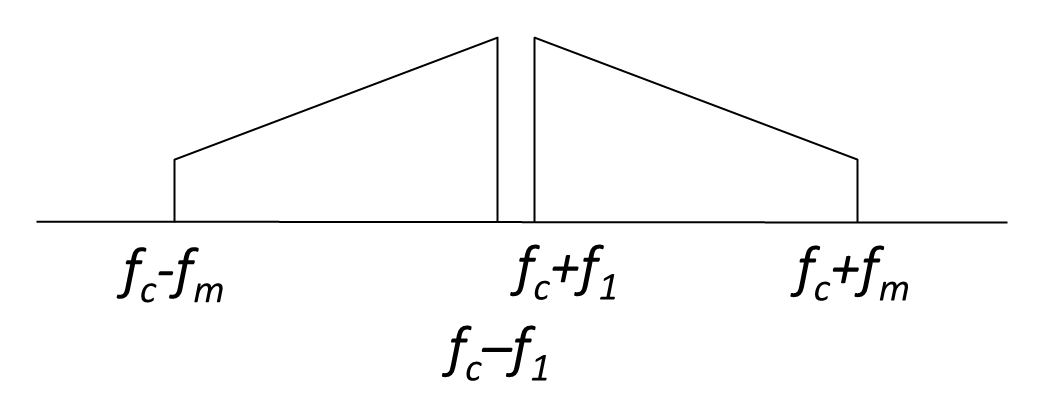
Figure 6.10 shows the frequency spectrum of the DSB waveform, which is identical to that of the AM spectrum except, of course, the carrier is not present.
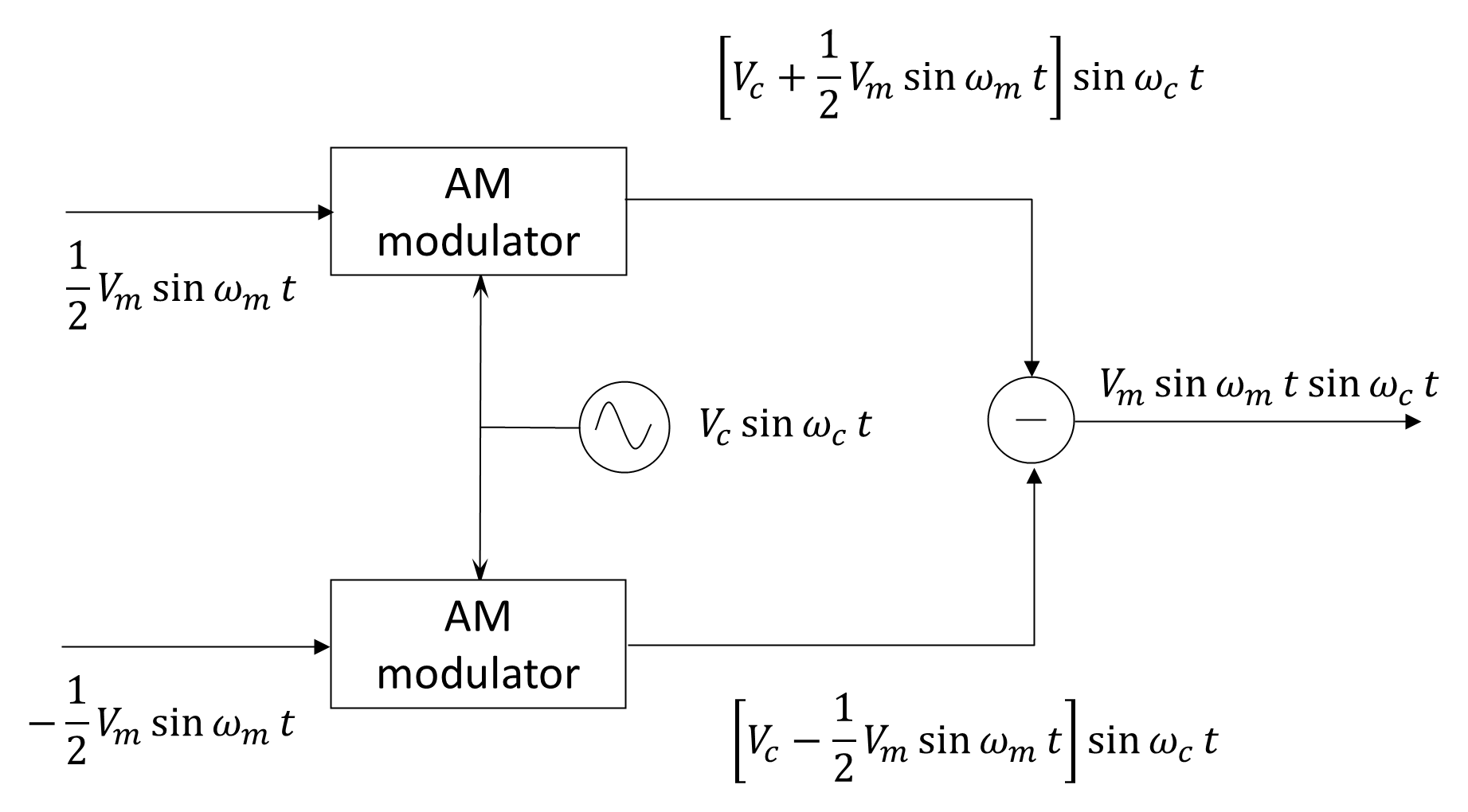
DSB modulators. The square-law modulator can be used to generate DSB. Unfortunately, perfect square-law devices are rare, so high-frequency DSB is normally obtained by using two AM modulators arranged in a balanced configuration to cancel out the carrier. Figure 6.11 shows a block diagram of this balanced modulator, which is also a multiplier.
DSB demodulation. Because the carrier is suppressed in DSB transmission, the envelope of the received signal does not directly correspond to the modulating waveform. Envelope detection is therefore not suitable. Instead, DSB requires synchronous (coherent) detection. In coherent detection, the received DSB signal is multiplied by a locally generated carrier that is matched in frequency and phase to the original carrier. This multiplication recreates the baseband component along with a high-frequency term at twice the carrier frequency. A low-pass filter then removes the high-frequency component, leaving the recovered message signal. Accurate carrier recovery is essential: any frequency or phase error between the transmitted and locally generated carriers results in distortion of the demodulated signal. In practice, carrier synchronization may be achieved using phase-locked loops or pilot tones.
Despite being more power efficient than AM, DSB is still power-inefficient since the transmitter power is divided among the two sidebands and they are redundant. Consequently, DSB is only used in specialized applications such as the transmission of analog TV (to transmit color information) and for VHF stereo broadcasts (sending L+R and L-R channels).
Back to reading