
6.6.1 Amplitude-Shift Keying (ASK)
ASK is the digital counterpart of amplitude modulation. In its simplest form, known as on-off keying (OOK), the carrier is switched between two amplitude levels—typically “on” for a binary 1 and “off” for a binary 0—as illustrated in Figure 6.21.
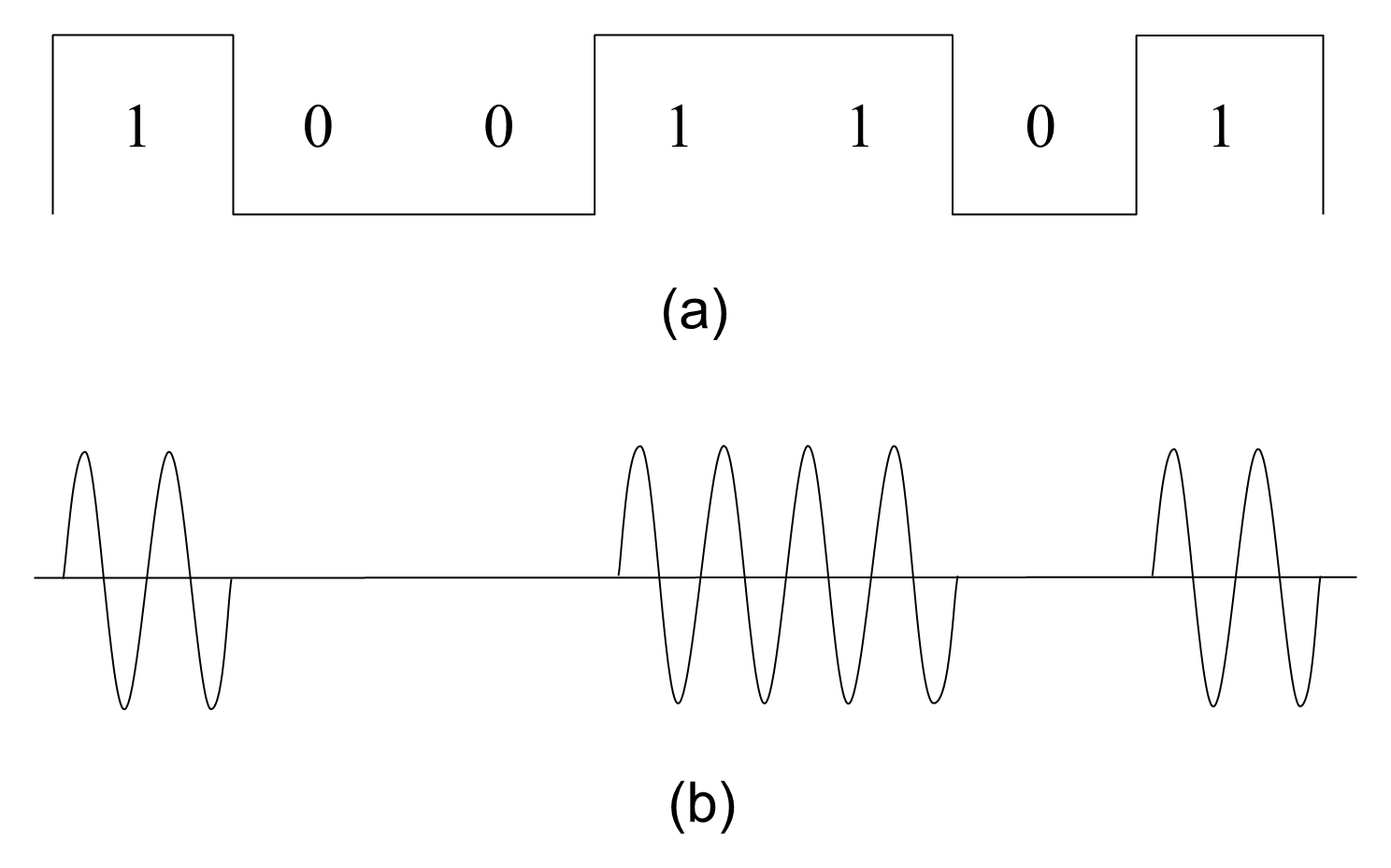
While ASK is simple to generate and detect, it inherits the principal weakness of analog AM: susceptibility to amplitude noise and fading. Variations in received signal strength can be mistaken for symbol transitions, making ASK relatively unreliable in noisy wireless environments without additional coding or error control.
Nevertheless, ASK remains useful in applications where simplicity and low cost are paramount, such as optical intensity modulation, RFID systems, infrared remote controls, and some short-range wireless links. For high-reliability radio communication systems, however, phase- or frequency-based digital modulation is generally preferred.
Back to reading