
6.4 FREQUENCY MODULATION
Instead of varying the carrier amplitude, the other ways of embedding information in the carrier are to vary the frequency or the phase of the carrier in accordance with the message signal. Since frequency and phase appear in the argument of the sine and cosine functions, FM and PM are collectively called angle modulation (and are sometimes described as nonlinear modulation). We focus first on frequency modulation because it is the preferred angle modulation technique. PM has no inherent advantage over FM and was originally more expensive to produce, so it is not used for analog systems.
In FM, the amplitude of the carrier remains constant while its frequency varies in accordance with the instantaneous amplitude of the modulating signal. If the modulating signal is sinusoidal, the carrier frequency varies sinusoidally as shown in Figure 6.17. Because the information is carried in frequency variations rather than amplitude changes, any amplitude fluctuations in the received wave can be suppressed before demodulation. This gives FM a significant advantage in noise immunity over AM. The main trade-off, however, is that FM requires a much wider transmission bandwidth.
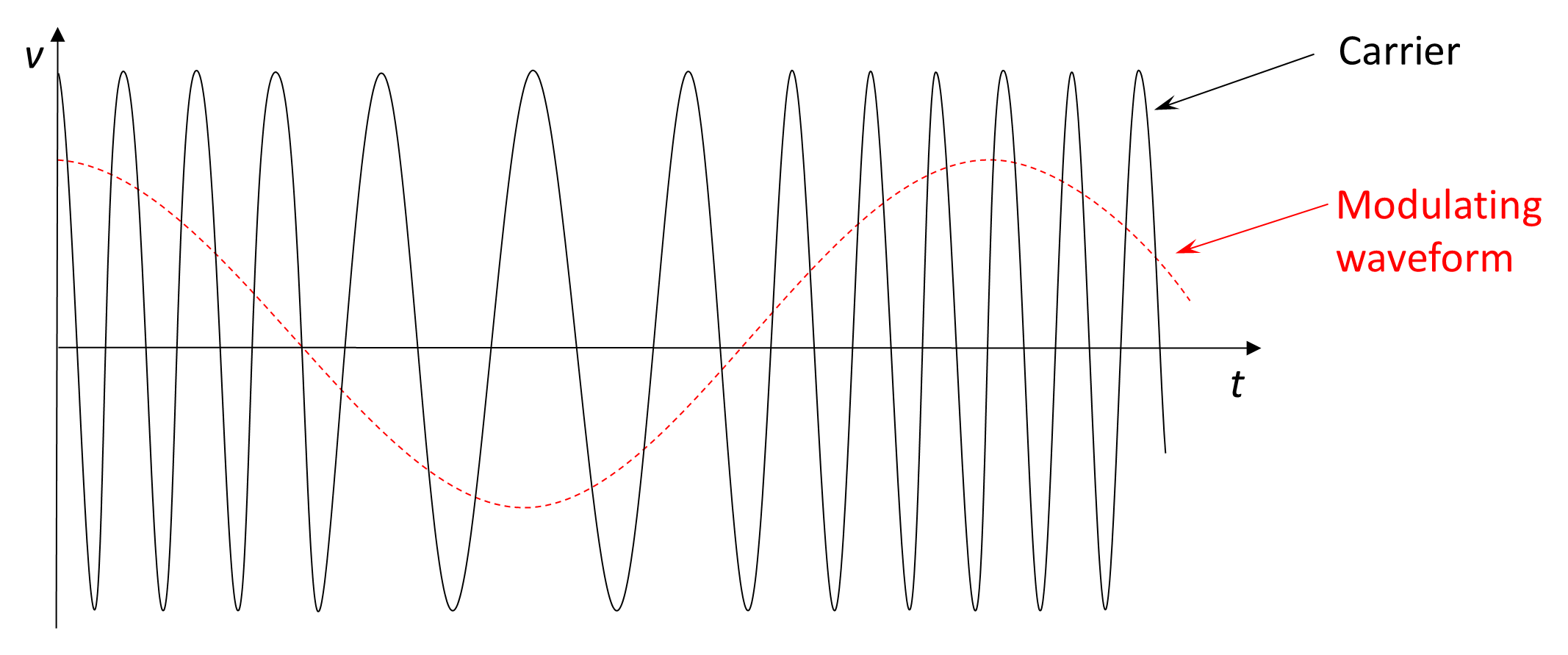
The FM carrier reaches its highest frequency when the modulating waveform is at its positive peak, and its lowest frequency when the waveform is at its negative peak. At zero modulation amplitude, the carrier returns to its resting frequency. The extent of this frequency shift is proportional to the modulating signal’s amplitude. The maximum shift from the resting frequency is known as the frequency deviation (Δf), a key parameter in FM systems. By observing the deviation, the receiver can reconstruct the original waveform:
- The modulation amplitude determines how far the carrier shifts from its resting frequency.
- The modulation polarity determines the direction of the shift.
- The modulation frequency determines the rate at which the carrier swings back and forth.
The unmodulated carrier is described as:
where fc is the carrier frequency. The modulating sinusoidal signal is described as:
As noted earlier, the instantaneous carrier frequency varies about the resting frequency fc so that:
where f∆ is the frequency-deviation constant (Hz/V), representing the sensitivity of the modulator to variations in the baseband signal. For video signals, f∆ ≈ 10 MHz V–1.
The instantaneous angular frequency is then:
The instantaneous phase, θ(t), can be found by integrating ω with respect to time:
Hence, the FM wave can be expressed as: