
6.4.14 Phase Modulation
Phase modulation (PM) is closely related to frequency modulation because phase and frequency are mathematically linked: instantaneous frequency is the time derivative of instantaneous phase. Because frequency is the derivative of phase, any FM signal can be generated by integrating the modulating signal and applying phase modulation; conversely, a PM signal can be viewed as the derivative of an FM process. In PM, the instantaneous phase of the carrier is varied in direct proportion to the modulating signal amplitude, while the carrier amplitude remains constant. For a sinusoidal modulating signal, m(t)=Vmcoswmt, the PM waveform may be written as:
where is the peak phase deviation (in radians), which serves as the modulation index for PM. Figure 6.20 illustrates the phase-modulated waveform produced from a carrier and a sinusoidal waveform.
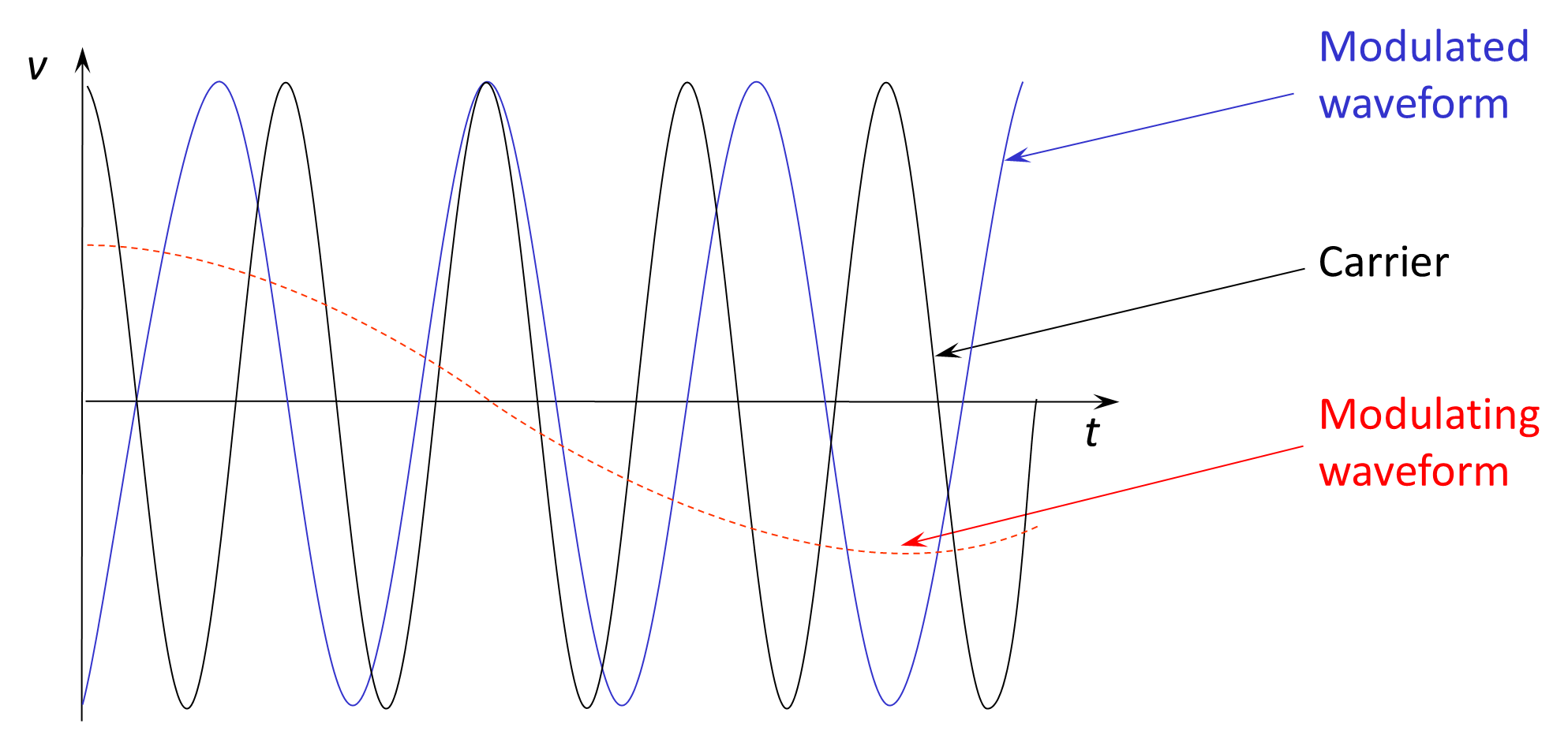
A key distinction between FM and PM lies in how deviation depends on the modulating signal. In FM, the peak frequency deviation depends only on the amplitude of the modulating signal and is independent of its frequency. In PM, the peak phase deviation depends only on the amplitude of the modulating signal; however, because instantaneous frequency is proportional to the time derivative of phase, the resulting frequency deviation in PM is proportional to both the amplitude and the frequency of the modulating signal. Thus, higher-frequency components in the message produce proportionally larger frequency excursions in PM.
As a consequence, the transmission bandwidth of a PM signal increases more rapidly with increasing modulating frequency than in FM when both are driven by the same signal amplitude. In analog systems, this behavior makes bandwidth control and noise optimization more straightforward in FM than in PM. For this reason, FM became the preferred angle-modulation technique for analog broadcasting and voice systems.
The situation differs in digital communications. In many digital modulation schemes, the modulating signal is piecewise constant over each symbol interval. In such cases, PM produces no frequency deviation during the symbol itself, since frequency is proportional to the time derivative of phase and the phase is constant between symbol transitions. FM-based digital schemes, by contrast, intentionally impose a frequency offset for each symbol. Consequently, phase-based digital modulation (such as PSK and QAM) generally occupies less bandwidth than simple frequency-shift keying for comparable data rates. For this reason, phase modulation forms the conceptual foundation of most modern digital modulation schemes.
Back to reading