
6.3.7 Single-Sideband Suppressed-Carrier AM
Although there is no carrier and the transmitter power is now devoted solely to the sidebands, DSB is also still inefficient because the transmission bandwidth must still be twice that of the message bandwidth due to the transmission of two sidebands, both of which contain identical information. When only one sideband is transmitted, the transmission is called single-sideband suppressed carrier (SSBSC), or more commonly, SSB. Generally, the term used refers to the particular sideband transmitted and the transmission is called upper side band (USB) or lower sideband (LSB). SSB reduces the transmission bandwidth to approximately the baseband bandwidth and is power-efficient since all of the transmitted power goes toward transmitting the baseband information. Figure 6.12 shows the frequency spectrum of an LSB waveform.

SSB modulation. The most straightforward method of generating SSB is to generate DSB and to filter out the redundant sideband. As shown in Figure 6.13, however, an ideal cut-off characteristic is required for the sideband filter to ensure that the modulator neither attenuates a portion of the desired pass band nor passes a portion of the undesired sideband. Fortunately, this problem is most difficult when the baseband signal comprises frequencies from zero upwards. If the baseband signal is audio, for example, the frequencies will extend from approximately 300–3,400 Hz giving sufficient margin at the lower end of the sideband to accommodate the inefficiencies of the cut-off filter. SSB can also be generated by the phase-shift method that removes the need for sideband filters. However, the design of the phase-shift circuitry is not straightforward and distortion of low-frequency components means that the system still only operates best with baseband signals that have small low-frequency content.

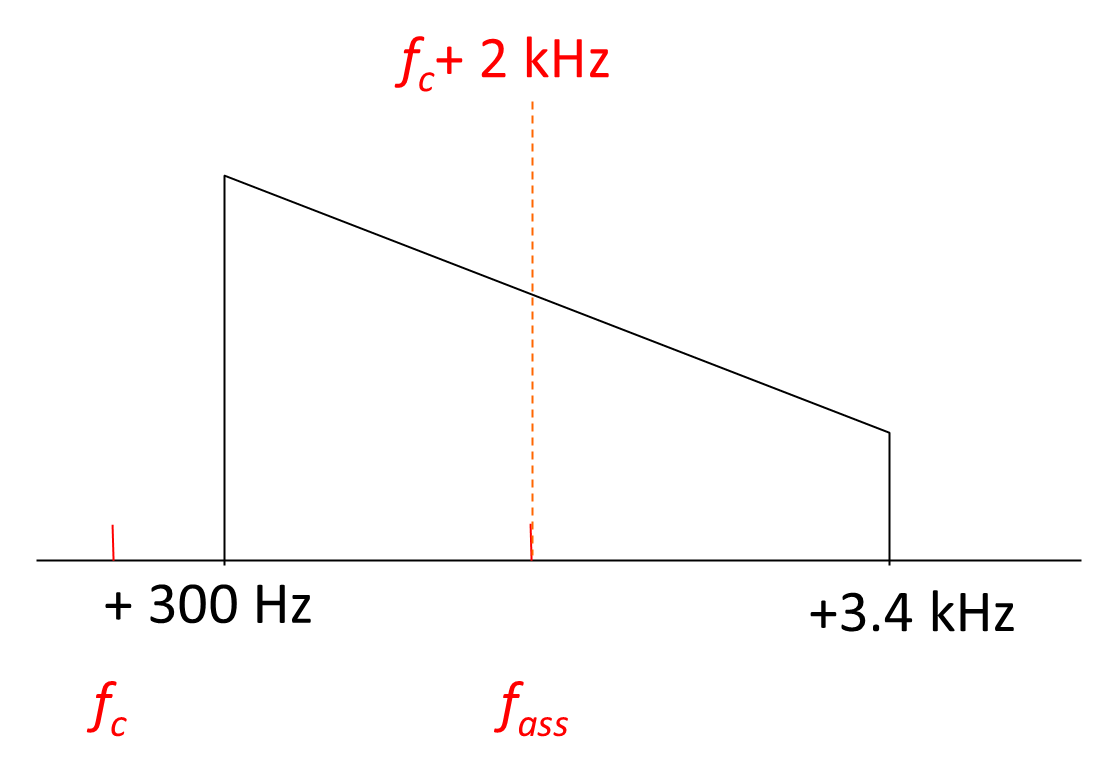
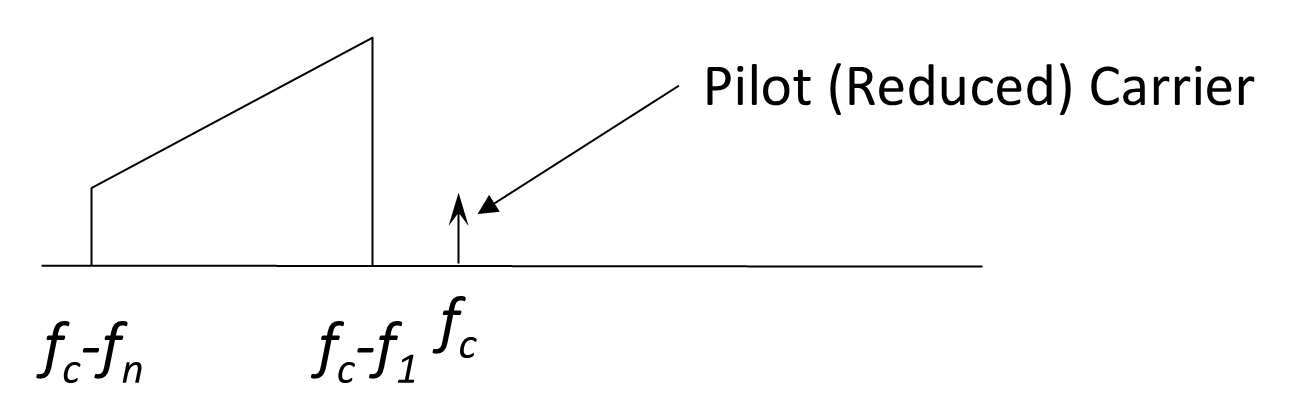
SSB reception. In SSB systems, the suppressed carrier frequency lies at one edge of the transmitted spectrum. As illustrated in Figure 6.14 for USB, early analog SSB receivers often appeared to require tuning approximately 1.5–2 kHz away from the center of the transmitted sideband because the receiver display referred to the suppressed carrier frequency rather than the spectral center of the transmitted signal. Modern synthesized and DSP-based receivers automatically generate the required carrier insertion frequency internally, so operators simply tune to the assigned channel frequency. To assist the receiver, as illustrated in Figure 6.15 for LSB, the transmitter can also insert a pilot (or reduced carrier) which uses a little additional power but aids the receiver in synchronizing to the carrier.
SSB applications. Analog SSB has numerous applications, even in a digital world:
- As a transmission, SSB is employed for radio communications in the HF band to conserve bandwidth and allow more users in a limited band, particularly in the skywave window. SSB is therefore very common for maritime, military, and amateur long-range communications, allowing carrier-to-noise ratios to be maximized for minimum transmit power.
- SSB is used in frequency-division multiplexing (FDM)—see Chapter 7.
- Up-conversion in many applications to translate the baseband signal up to the channel frequency.
- Similarly, down-conversion devices called mixers in radio systems such as the superheterodyne radio (see Chapter 9) are effectively SSB demodulators.
SSB demodulation. As with DSB, the complexity and hence the cost of the SSB receiver is increased by the need for the carrier to be re-inserted extremely accurately to avoid distortion of the demodulated signal. In modern receivers a frequency synthesizer can be used to generate a very stable carrier. In older radios, a low-amplitude pilot carrier is transmitted in addition to the sideband. The pilot carrier is used by automatic frequency control (AFC) circuitry in the receiver to maintain the frequency of the re-inserted carrier within the prescribed limits.
Advantages of single-sideband operation. SSB is the preferred modulation for HF radio communications since it occupies minimum bandwidth. SSB operation of a radio system has a number of advantages over AM and DSB:
- The bandwidth for SSB is equal to the original message bandwidth (half that required by DSB/AM), which allows a greater number of channels to be provided by the transmission medium.
- The signal-to-noise ratio at the output of an SSB system is higher than the equivalent AM/DSB system due to a higher sideband power and lower noise in the smaller bandwidth.
- An SSB transmitter is more efficient than an AM transmitter because it does not produce a power output at all times regardless of whether information is being conveyed.
- Transmissions via the ionosphere are vulnerable to distortion due to selective fading of frequencies—the wider the bandwidth at skywave frequencies, the greater the effect of selective fading. SSB transmissions are less vulnerable than AM due to the narrower bandwidth.
Disadvantages of single-sideband operation. Although SSB is more bandwidth- and power-efficient than AM and DSB, it has a number of disadvantages:
- SSB requires transmitters and receivers that are more complex than AM and DSB. The transmitter needs sharp filters and a very stable local oscillator, and the receiver is more complicated and expensive due to the need to re-insert the carrier before demodulation.
- SSB is an amplitude-modulation scheme and therefore suffers from the effects of additive noise and interference in the channel.
- It is more difficult to generate SSB at high power levels.