6.3.3 Demodulation Of AM
There are two common techniques for demodulating or detecting AM: synchronous detection and envelope detection.
6.3.3.1 Synchronous Detection
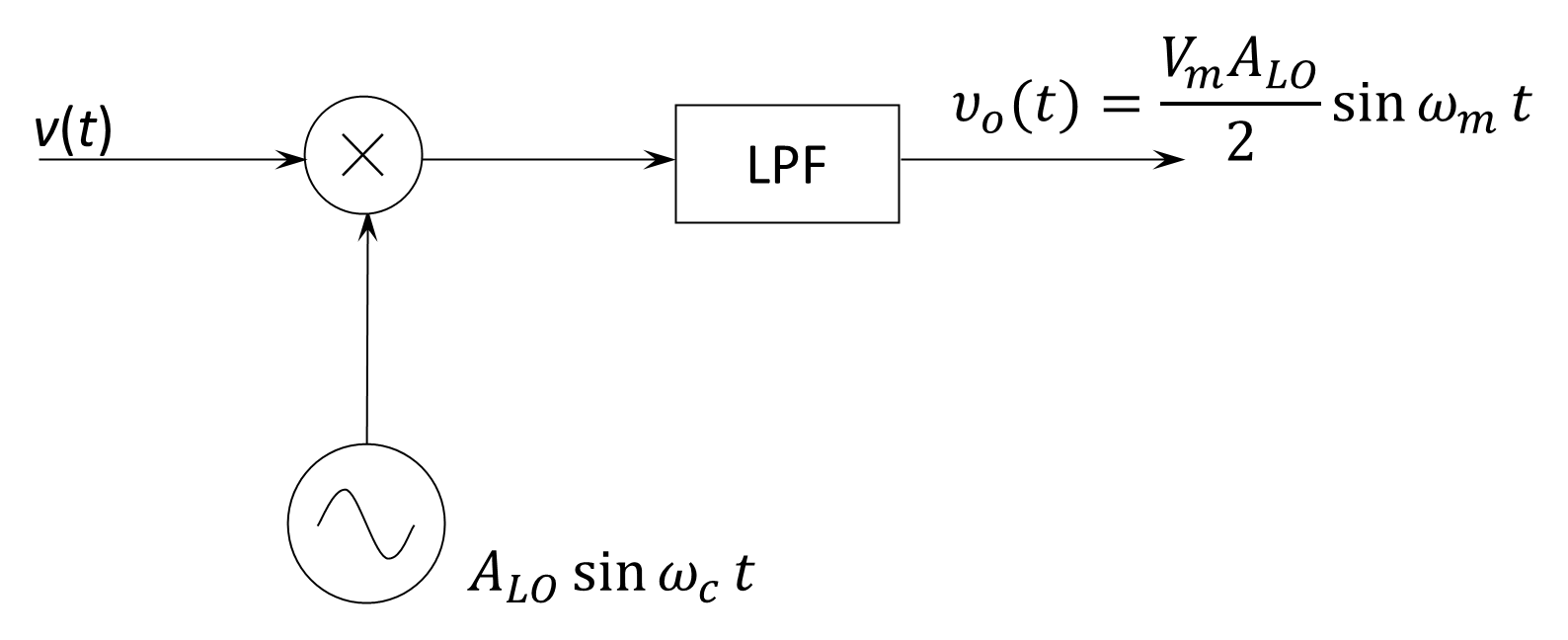
AM can be detected by the product demodulator illustrated in Figure 6.7. The incoming signal is first multiplied with a locally generated sinusoid wave that is exactly synchronized in frequency with the incoming carrier. The resultant product is then low-pass filtered with a filter whose bandwidth is the same as the message bandwidth. Because the local oscillator must be synchronized to the incoming carrier, this type of detection is called synchronous detection or coherent detection.
For example, if v(t) is an AM wave from Equation (6.6), then the output of the low-pass filter is:
While product demodulation is straightforward in theory, it can be quite difficult in practice due to the requirement for the transmitter and receiver carriers to be synchronized. One way to meet this requirement is to use very stable, crystal-controlled oscillators at both the transmitter and receiver. Other techniques include phase-locked loops and homodyne detection in which the receiver uses the received signal to derive the carrier.
6.3.3.2 Envelope Detection
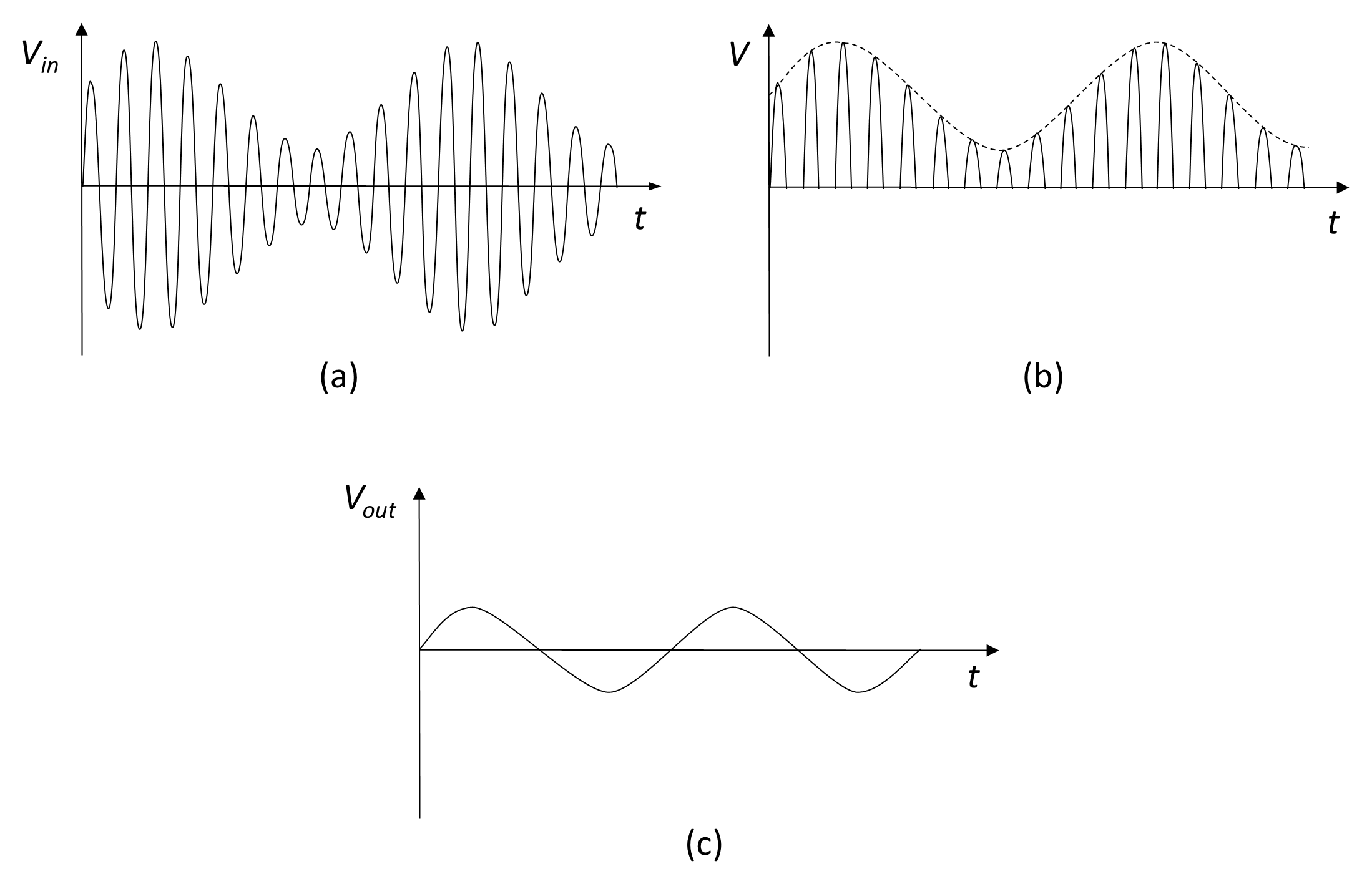
A much simpler approach to AM demodulation uses an envelope detector that follows the envelope rather than the carrier. The waveform is first rectified so that the negative half cycles are lost, as shown in Figure 6.8(b). The envelope is followed and, finally, the waveform is passed through a DC block to produce the waveform in Figure 6.8(c).