
6.3.1 Modulation Factor
When we consider the performance of AM systems, we use a parameter called the modulation factor (m), defined as:
The modulation can be expressed as a percentage, when it is known as the percentage modulation or the depth of modulation. For sinusoidal modulation the maximum amplitude of the modulation envelope is, from Equation (6.5) and Figure 6.1, Vc+Vm and the minimum amplitude is Vc–Vm so that Equation (6.9) becomes:
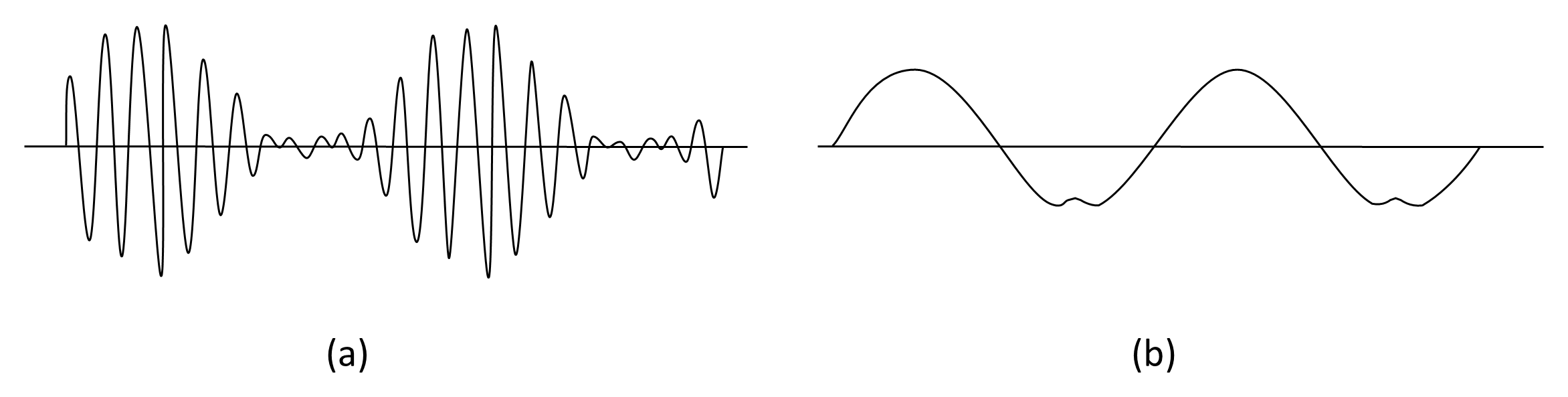
For envelope detection (Section 6.1.2.3.2), the maximum value of the modulation factor is unity (1) since this gives a minimum value of zero to the envelope. If a larger modulation factor is used, the envelope no longer resembles the modulating waveform. Figure 6.4(a) shows the effect of even a small amount of over-modulation with m=1.2. Figure 6.4(b) shows the resulting distortion once the waveform has been demodulated using envelope detection. For telephone-quality speech the average modulation depth is approximately 50%.
Since the modulation factor is an important design consideration for a system, the equation for AM, Equation (6.5), is commonly rewritten as: