14.5.7 Concluding Perspective On Personal Area Networks
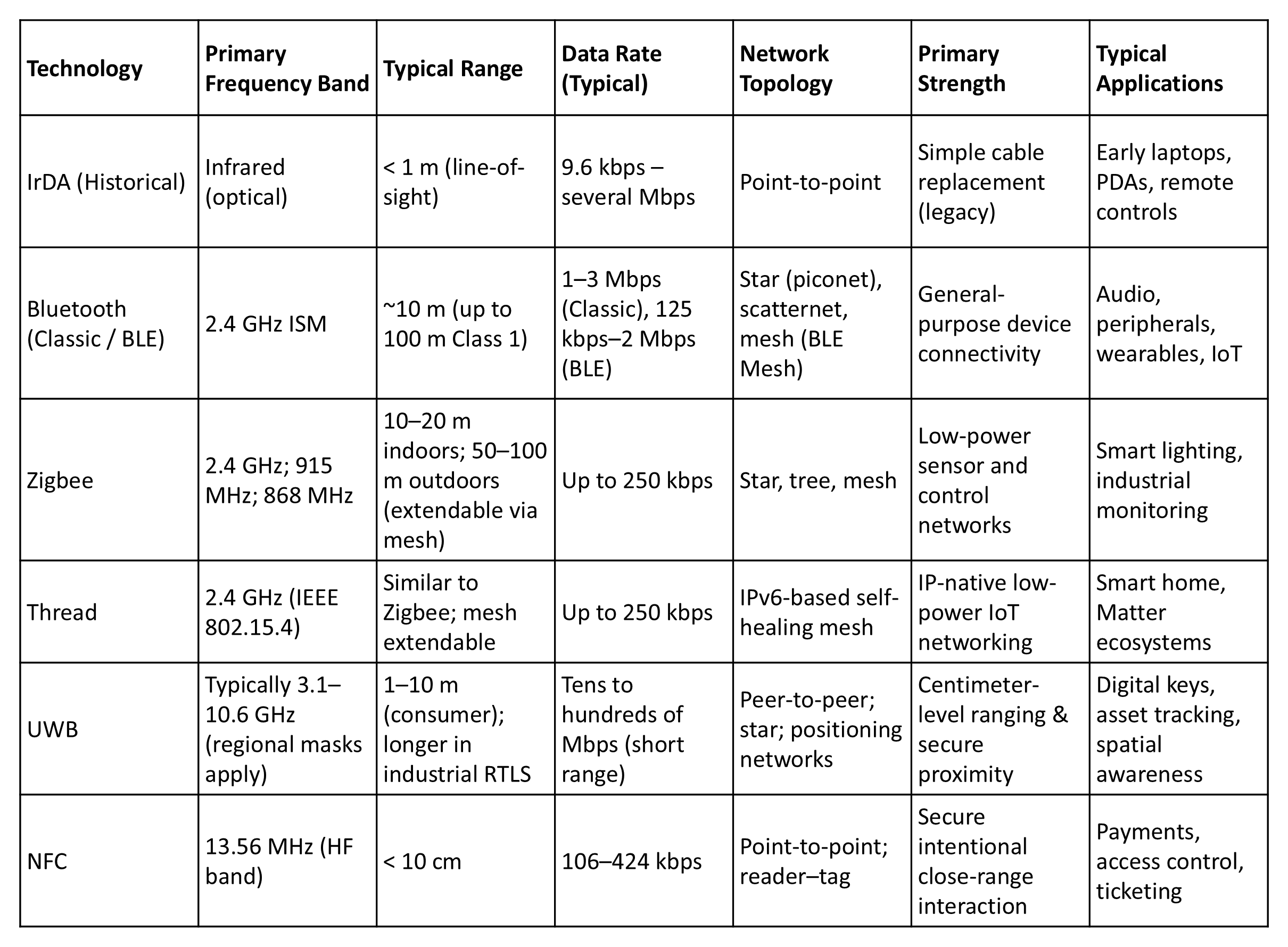
Personal Area Networks encompass a spectrum of short-range technologies optimized for different combinations of range, power consumption, data rate, topology, and security. Although these systems operate over distances measured in meters—or even centimeters—they serve markedly different architectural purposes.
Historically, infrared systems such as those standardized by the Infrared Data Association provided early cable-replacement functionality but were constrained by line-of-sight requirements. Radio-based technologies subsequently replaced optical links, enabling non-line-of-sight operation and greater flexibility.
Bluetooth emerged as the dominant general-purpose personal area networking technology, combining moderate data rates, low power consumption, and widespread interoperability. Its evolution toward Low Energy operation, mesh networking, and spatial capabilities—including direction finding (AoA/AoD) and channel sounding—has extended its role from peripheral connectivity to IoT networking, indoor positioning, and device-level spatial awareness.
Zigbee and Thread, both built upon IEEE 802.15.4 radios, address a different design objective: scalable, low-data-rate, low-power mesh networking for largely static sensor and control applications. Zigbee provides an integrated application framework, while Thread adopts a fully IPv6-based architecture to enable native Internet interoperability.
UWB, also implemented over IEEE 802.15.4 derivatives, occupies yet another niche within the PAN domain. Rather than prioritizing throughput or large mesh topologies, UWB emphasizes precise time-of-flight measurement, secure proximity detection, and centimeter-level spatial awareness. In contrast to Bluetooth’s angle-based direction finding and phase-based channel sounding, UWB achieves high ranging accuracy through extremely wide bandwidth pulses that enable fine time resolution.
At the shortest range, NFC operates through magnetic near-field coupling rather than radiative propagation, enabling intentional, secure interactions over distances of only a few centimeters. Unlike Bluetooth and UWB, which support room-scale spatial awareness, NFC is deliberately constrained to enforce user intent and transaction security. NFC is particularly suited to payments, authentication, and access control.
Taken together, these technologies illustrate that PAN design is not defined solely by range. Instead, each system reflects a different optimization:
- Bluetooth: general-purpose connectivity and moderate data rates
- Zigbee / Thread: scalable low-power mesh networking
- UWB: precision ranging and secure spatial awareness
- NFC: secure, intentional, centimeter-range interaction
The diversity of PAN technologies reflects the diversity of application requirements. No single solution is optimal for all short-range communication scenarios; rather, modern systems increasingly integrate multiple PAN technologies within the same device—using, for example, Bluetooth for connectivity, UWB for precise localization, and NFC for secure transaction initiation—to leverage their complementary strengths.
Figure 14.13 provides a summary comparison of major PAN technologies.