
14.2.3 IEEE Network Standards
Standards for local and metropolitan area networks are defined within the IEEE 802 family, maintained by the IEEE 802 LAN/MAN Standards Committee (LMSC). These standards specify the Physical (PHY) layer and the Media Access Control (MAC) mechanisms used to transmit data over shared or point-to-point media.
IEEE 802 standards map primarily to the lower two layers of the OSI model. Within the Data Link Layer, IEEE 802 subdivides functionality into:
- The Logical Link Control (LLC) sublayer, which provides a common interface to the Network Layer (historically defined in IEEE 802.2).
- The Media Access Control (MAC) sublayer, which governs access to the transmission medium and frame formatting.
The principal IEEE 802 standards are briefly described in Figure 14.4.
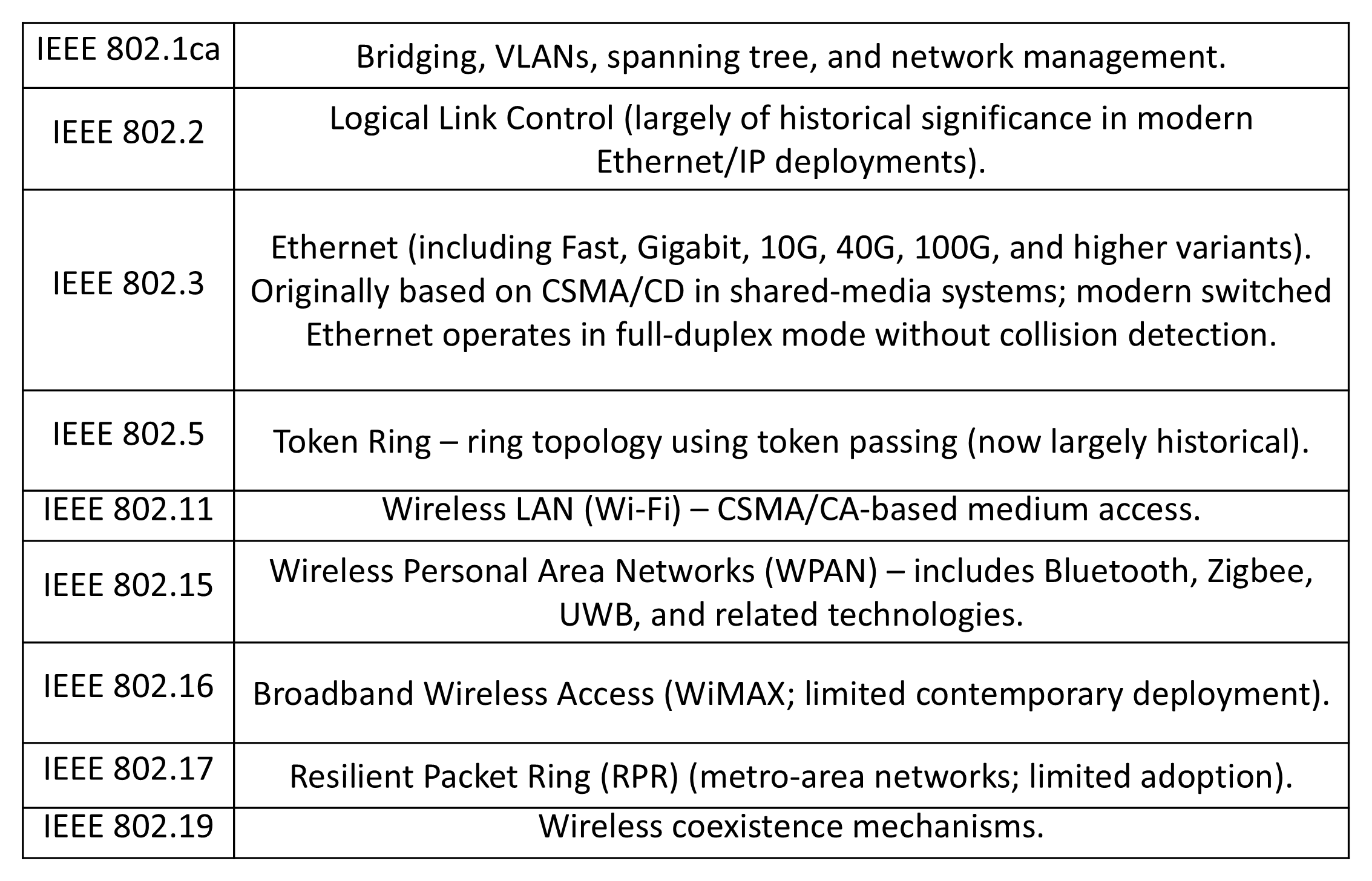
The IEEE 802 standards define how data is transmitted across local and metropolitan networks, primarily addressing the lower layers of the OSI model. However, modern communication systems extend beyond individual LAN or MAN segments. To enable end-to-end connectivity across heterogeneous networks, a broader architectural framework is required. This role is fulfilled by the TCP/IP protocol suite, which provides the foundation of the global Internet.
Back to reading