
14.2.2 ISO OSI Reference Model
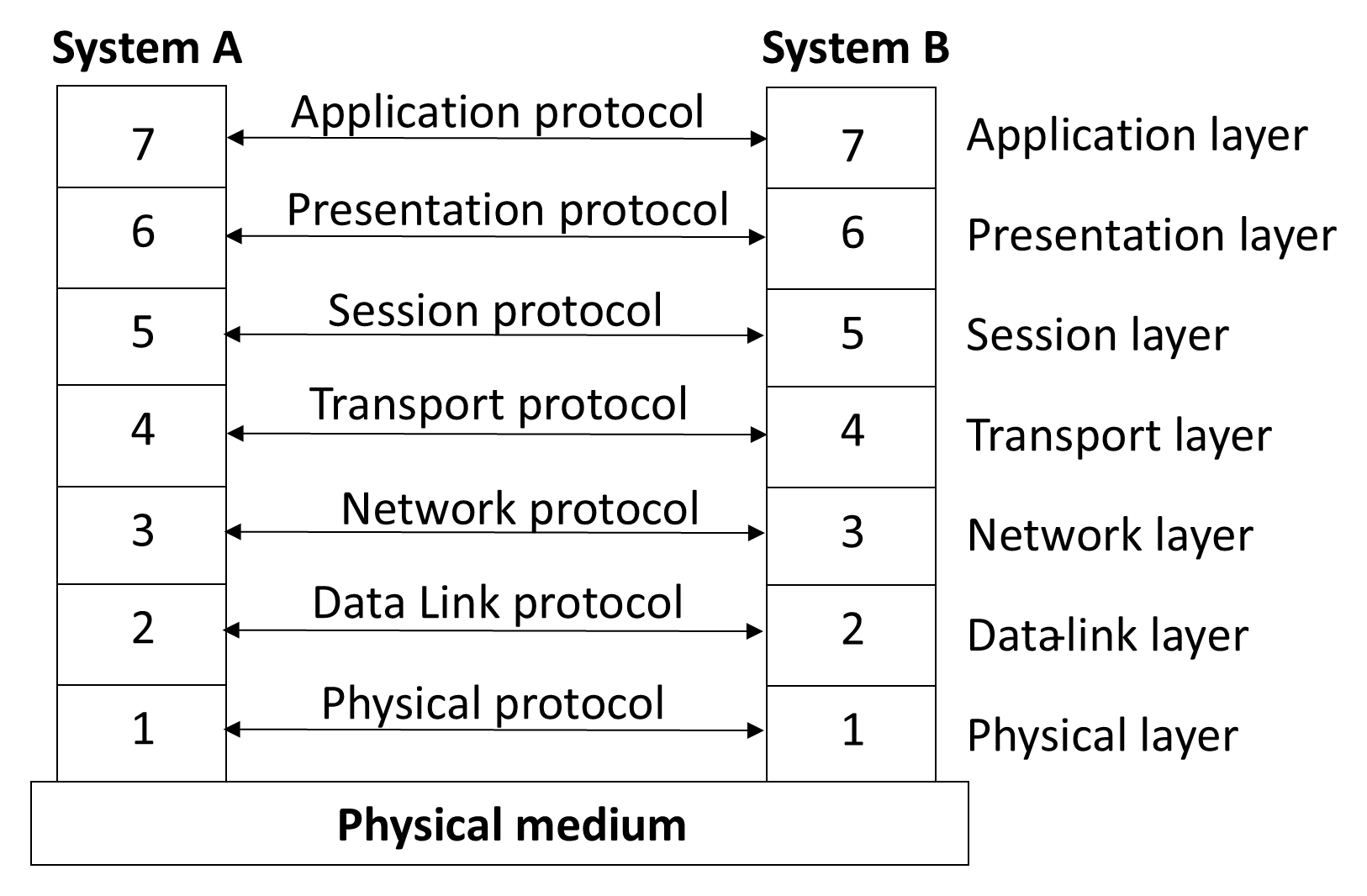
The ISO OSI Reference Model (Figure 14.3) organizes network communication functions into seven hierarchical layers, each of which is responsible for the implementation of one or more of the functions required in the communications between the two systems:
- Layer 1—physical layer. Defines the mechanical, electrical, functional, and procedural characteristics required for physical transmission. It specifies connectors, signaling levels, timing, modulation, and transmission media.
- Layer 2—data link layer. Organizes bits into frames and provides reliable node-to-node delivery. Functions include framing, error detection (and sometimes correction), medium access control, and flow control.
- Layer 3—network layer. Provides logical addressing and routing between networks. Functions include path selection and packet forwarding across interconnected networks.
- Layer 4—transport layer. Provides end-to-end data transfer between hosts. It performs segmentation and reassembly, error recovery, and flow control.
- Layer 5—session layer. Establishes, manages, and terminates communication sessions between applications. It may provide dialog control and synchronization services.
- Layer 6—presentation layer. Ensures that exchanged data is represented in a mutually intelligible format. It performs encoding, compression, and encryption/decryption.
- Layer 7—application layer. Provides services directly to user applications, such as file transfer, email, network management, and web services.
While the OSI model provides a complete conceptual hierarchy for communication systems, practical local and metropolitan networks are defined by specific standards that implement portions of this architecture. The most influential of these for LAN and MAN technologies are the IEEE 802 standards.
Back to reading