14.4.4 Physical Layer Evolution
While the previous sections examined WLAN architecture and medium access, overall system performance is ultimately constrained by the capabilities of the physical layer. The IEEE 802.11 PHY has undergone substantial evolution to increase data rate, spectral efficiency, and robustness. The physical layer of 802.11 has evolved significantly since its introduction. The original 802.11 standard defined frequency hopping spread spectrum (FHSS), direct sequence spread spectrum (DSSS), and a diffuse infrared option. Although infrared networking was explored in parallel by the Infrared Data Association (IrDA), such optical wireless techniques were not widely adopted for WLAN deployment and are discussed further in Section 14.5.1 in the context of PANs. IEEE 802.11b extended DSSS using Complementary Code Keying (CCK) to achieve data rates up to 11 Mbps. These early spread-spectrum techniques are now largely of historical interest and have been superseded by OFDM-based systems.
OFDM-Based WLANs
Orthogonal frequency division multiplexing (OFDM), introduced in 802.11a and later adopted in 802.11g, became the foundation of modern Wi-Fi systems. OFDM divides a channel into multiple orthogonal subcarriers, allowing parallel transmission of modulated symbols. In early 802.11a/g implementations, 64 subcarriers were defined, of which 48 were used for data transmission and four for pilot tones, with guard bands at the channel edges. The raw data rate therefore depends on the number of data subcarriers, the modulation scheme applied to each subcarrier, and the symbol duration.
The effective throughput is further reduced by forward error correction (FEC) channel coding. Early OFDM-based systems employed convolutional coding with coding rates of 1/2 or 3/4. For example, with BPSK modulation the uncoded bit rate is reduced by the coding rate, resulting in final data rates of 6 Mbps (1/2 rate) or 9 Mbps (3/4 rate). Higher-order modulation schemes combined with different coding rates produce a range of data rates up to 54 Mbps.
Subsequent standards increased performance through higher-order modulation (256-QAM, 1024-QAM, 4096-QAM); wider channels (20, 40, 80, 160, and 320 MHz); and improved coding schemes and shorter guard intervals.
MIMO and Spatial Multiplexing
IEEE 802.11n (Wi-Fi 4) introduced multiple-input multiple-output (MIMO) technology. MIMO systems use multiple transmit and receive antennas to improve reliability through spatial diversity and to increase throughput via spatial multiplexing. Multiple spatial streams allow simultaneous transmission of independent data streams within the same RF channel, significantly increasing capacity without requiring additional spectrum.
In addition to spatial multiplexing, 802.11n introduced channel bonding, whereby two adjacent 20 MHz channels are combined to form a single 40 MHz channel. By increasing the occupied bandwidth, the number of OFDM subcarriers available for data transmission is effectively doubled, thereby increasing the achievable data rate. Later standards extended this principle: 802.11ac supports 80 MHz and optional 160 MHz channels, while 802.11be allows channel widths up to 320 MHz in the 6 GHz band.
Channel bonding increases peak throughput but also consumes more spectrum and reduces the number of non-overlapping channels available within a given band. In dense deployments, particularly in the 2.4 GHz band, wide channel configurations may therefore increase co-channel interference. Effective WLAN design must balance channel width, spatial reuse, and regulatory constraints to achieve optimal performance.
Multi-User and OFDMA Enhancements
IEEE 802.11ax (Wi-Fi 6 and 6E) introduced OFDMA to divide a channel into smaller frequency-time resource units (RUs), enabling simultaneous transmission to multiple stations within a single channel access opportunity.. This significantly improves spectral efficiency in dense deployments. Wi-Fi 6 introduced uplink and downlink multi-user MIMO (MU-MIMO), and BSS coloring to reduce co-channel interference. Wi-Fi 6E also extends operation into the 6 GHz band, providing additional spectrum and reduced congestion.
Wi-Fi 7 and Extremely High Throughput
IEEE 802.11be (Wi-Fi 7) further increases capacity through 320 MHz channel bandwidth, 4096-QAM modulation, Multi-Link Operation (MLO), and enhanced multi-user capabilities.
These enhancements support multi-gigabit wireless throughput suitable for high-density enterprise and data-intensive applications.
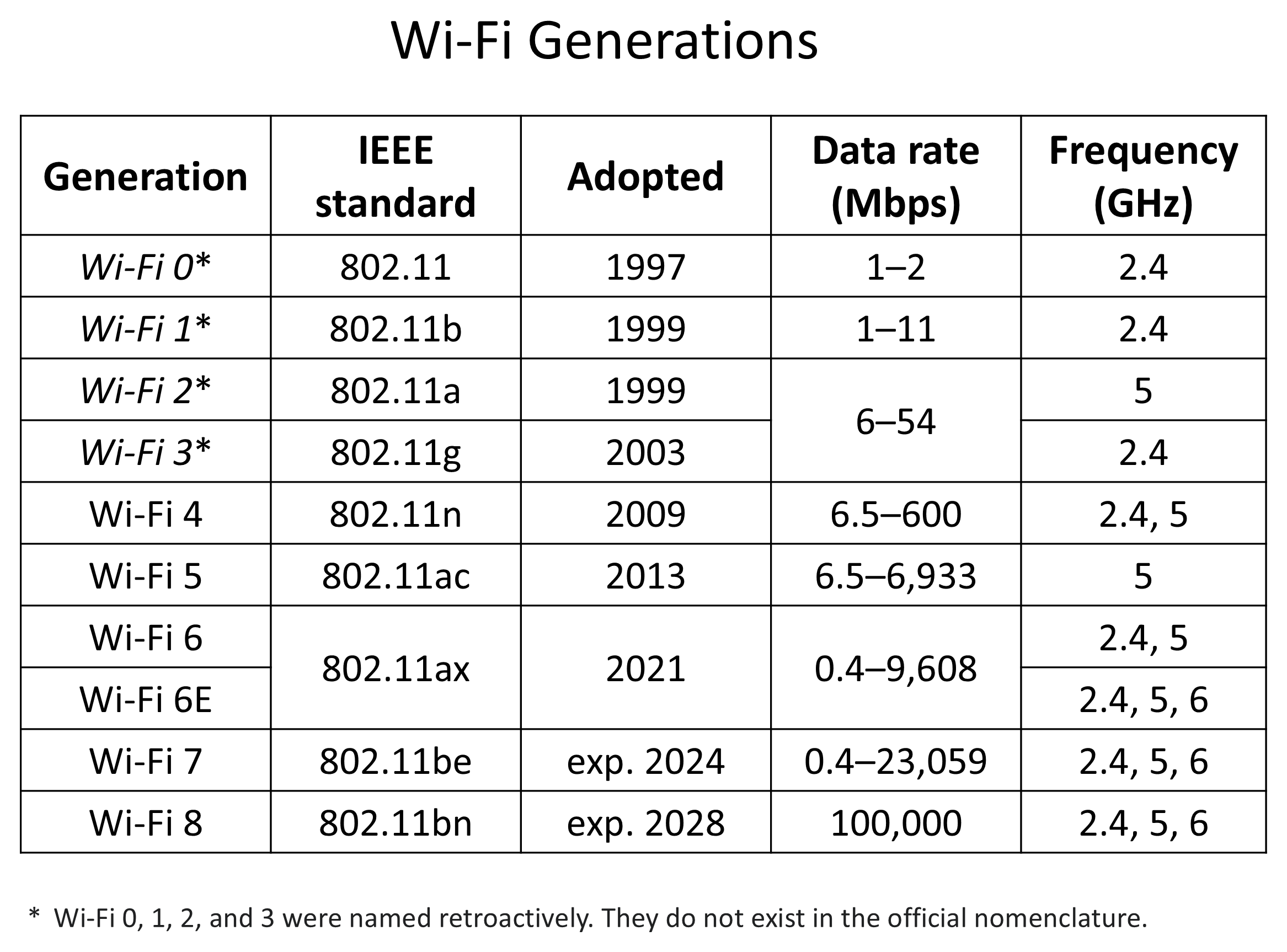
Figure 14.10 summarizes the Wi-Fi generations. It should be noted that Wi-Fi 0, 1, 2, and 3 were named retroactively. They do not exist in the official nomenclature.