
14.5.2 Bluetooth
Bluetooth is a short-range wireless technology designed primarily to replace cables between electronic devices. The name derives from King Harald “Bluetooth” Gormsson, who unified Denmark and parts of Norway in the 10th century—symbolic of the technology’s goal of unifying disparate digital devices under a common standard.
Bluetooth originated in 1994 at Ericsson as a short-range radio link for mobile-phone headsets. In 1998 Ericsson, IBM, Intel, Nokia, and Toshiba formed the Bluetooth Special Interest Group (SIG) to establish an open industry standard. Although early versions were published as IEEE 802.15.1, subsequent development has been managed directly by the Bluetooth SIG, which oversees specification evolution, qualification, and trademark licensing.
Bluetooth has since evolved from a cable-replacement technology into the dominant PAN platform, supporting audio, data transfer, IoT sensing, mesh networking, and precision ranging.
14.5.2.1 Technical Overview
Bluetooth Classic (BR/EDR) uses 79 channels of 1 MHz with fast frequency hopping, whereas Bluetooth Low Energy (BLE) uses 40 channels of 2 MHz (including dedicated advertising channels) and a different channel selection and hopping behavior. This rapid hopping mitigates interference from other 2.4 GHz systems (Wi-Fi, microwave ovens, cordless phones) and allows multiple Bluetooth networks to coexist. The original specification employed Gaussian frequency-shift keying (GFSK) at 1 Msymbol s–1. Later versions introduced higher-order modulation schemes to increase throughput.
Bluetooth supports synchronous connection-oriented (SCO) links for real-time services such as voice and asynchronous connectionless (ACL) links for packet-based data.
This dual capability makes Bluetooth well suited to headsets, keyboards, mice, and low-bandwidth peripherals.
14.5.2.2 Device Classes And Range
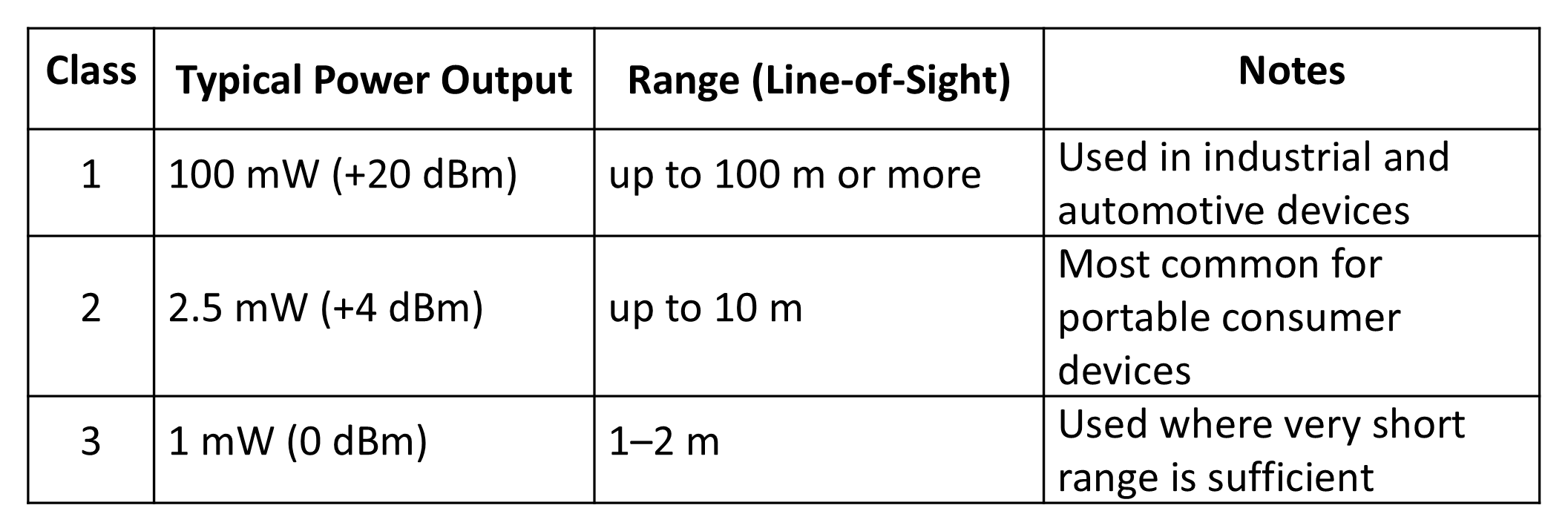
Bluetooth devices are categorized by transmit power—see Figure 14.12. Actual range depends on antenna efficiency, receiver sensitivity, propagation environment, and orientation. While Class 1 devices may exceed 100 m under favorable conditions, most consumer applications operate within 10 m.
14.5.2.3 Network Architecture
Bluetooth forms small ad hoc networks called piconets. In Bluetooth Classic, one device provides timing and coordination for up to seven active devices, while additional devices may remain synchronized but inactive. (BLE uses a related central–peripheral model with different link procedures.) Multiple interconnected piconets (“scatternets”) are defined historically but are uncommon in modern deployments.
14.5.2.4 Bluetooth Protocol Stack
Bluetooth’s functionality is divided into protocol layers, broadly grouped as transport, middleware, and application:
- Radio layer: Physical channel, modulation, power.
- Baseband layer: Link control, hopping, error control, security.
- Link Manager (LM): Authentication, encryption, QoS negotiation.
- Host Controller Interface (HCI): Standardized hardware–host interface.
- Logical Link Control and Adaptation Protocol (L2CAP): Multiplexing, segmentation, service-level management.
- Higher-layer protocols and profiles: Application behavior definitions.
This separation enables interoperability across vendors and platforms.
14.5.2.5 Error Control And Reliability
Bluetooth uses forward-error correction (1/3 or 2/3 rate FEC depending on packet type) and automatic repeat request (ARQ) with CRC protection. Combined with frequency hopping, these mechanisms provide reliable operation in congested 2.4 GHz environments.
14.5.2.6 Device Discovery And Pairing
Devices periodically transmit inquiry responses when in discoverable mode. A master issues inquiries and establishes a connection using the device’s unique 48-bit address. Modern pairing procedures employ authenticated key exchange and encryption to protect against eavesdropping and man-in-the-middle attacks.
14.5.2.7 Profiles And Applications
A profile defines a set of behaviors and parameters that specify how applications should use the Bluetooth protocol stack. Profiles ensure interoperability among devices from different vendors by standardizing the command and data formats for common use cases. Examples include:
- Headset Profile (HSP): Connects headphones or earbuds to phones or computers.
- Hands-Free Profile (HFP): Links a mobile phone with a car audio system for voice calls.
- Advanced Audio Distribution Profile (A2DP): Enables stereo audio streaming to wireless speakers or headsets.
- Health Device Profile (HDP): Connects sensors such as heart-rate monitors or digital thermometers to health apps.
- Human Interface Device Profile (HID): Supports keyboards, mice, and game controllers.
- Object Push Profile (OPP) and File Transfer Profile (FTP): Manage file exchange and synchronization.
- Video Distribution Profile (VDP): Streams video from cameras to displays or recorders.
Profiles simplify application development by defining standard methods for device discovery, connection setup, data formatting, and control signaling.
Bluetooth applications are now found in almost every consumer and industrial domain. Common uses include wireless audio, automotive infotainment, personal-area networking, fitness trackers, health-monitoring devices, keyboards and mice, game controllers, and smart-home systems. Bluetooth is also used in real-time location systems, asset-tracking tags, and industrial sensors.
14.5.2.8 Channel Sounding And Precision Ranging
Bluetooth 6.0 introduced enhanced channel sounding capabilities to support high-precision distance measurement between devices. Channel sounding enables accurate ranging by analyzing the characteristics of the wireless channel between two transceivers.
Unlike RSSI-based proximity estimation, which infers distance from signal strength and is highly susceptible to multipath fading, channel sounding techniques use controlled signal exchanges to measure phase and timing characteristics of the radio channel. By analyzing phase shifts across multiple frequencies and employing round-trip timing measurements, devices can estimate separation distance with significantly improved accuracy.
Channel sounding enables more accurate ranging by using controlled exchanges that exploit phase and/or timing information rather than received signal strength alone, improving accuracy and robustness in multipath environments. Because ranging relies on controlled measurements rather than RSSI, it can be made more resistant to certain relay/spoofing strategies when combined with appropriate security procedures. This makes it suitable for secure access control, digital key systems, and location-based services.
Channel sounding provides distance information, but not angular direction. For angular estimation, Bluetooth employs separate direction-finding techniques based on antenna arrays.
14.5.2.9 Direction Finding (AoA/AoD)
Whereas channel sounding provides precise distance measurement, Bluetooth 5.1 introduced direction-finding capabilities using angle of arrival (AoA) and angle of departure (AoD) techniques. These mechanisms allow the direction of a received signal to be estimated using antenna arrays and phase-difference measurements.
In AoA systems, the transmitting device emits a constant tone extension (CTE) appended to the packet. A receiving device equipped with multiple antennas samples the phase of the incoming signal across its antenna array. By measuring phase differences between antennas, the angle at which the signal arrives can be calculated.
In AoD systems, the transmitter uses multiple antennas to send the CTE sequentially from different elements. A simpler receiver can then estimate the direction of the transmitter based on known antenna switching patterns.
Unlike RSSI-based positioning, which estimates distance from signal strength and is susceptible to multipath fading, AoA/AoD techniques use phase information and therefore provide significantly improved angular accuracy.
Direction finding complements Bluetooth’s existing proximity-based applications and supports scalable indoor positioning systems, enabling indoor positioning and asset tracking, secure device localization, real-time location systems (RTLS), and navigation assistance.
It is important to distinguish between Bluetooth direction finding (AoA/AoD) and the channel sounding mechanisms introduced in Bluetooth 6. Direction finding estimates angular direction, while channel sounding provides precise distance measurement. Together, these mechanisms enable two-dimensional and three-dimensional spatial positioning in Bluetooth systems.
14.5.2.10 Mesh Networking
Bluetooth Mesh (introduced in 2017) enables many-to-many communication using managed flooding. It supports large-scale lighting control, building automation, and sensor networks while maintaining low energy consumption and authenticated messaging.
14.5.2.11 Power Management And LE Audio
Bluetooth defines multiple low-power operating states, including active, sniff, hold, and park modes, which reduce duty cycle and power consumption in connected devices. Bluetooth Low Energy (BLE) further optimizes power usage by employing short transmission bursts separated by long sleep intervals. Advertising intervals, connection intervals, and packet size are configurable, allowing designers to trade latency for battery life. Coin-cell-powered sensors can operate for multiple years under typical duty cycles. BLE transformed Bluetooth from a short-range cable-replacement technology into a foundational IoT platform.
Recent enhancements also introduced LE Audio, where “LE” denotes low energy, indicating that audio transmission operates over the BLE physical layer rather than the earlier Bluetooth Classic (BR/EDR) radio. LE Audio uses the Low Complexity Communications Codec (LC3), providing improved audio quality at lower bit rates while maintaining low power consumption. It supports multi-stream audio to multiple devices, broadcast audio (Auracast), hearing-aid integration, and improved power efficiency for earbuds and wearable devices.
By operating over BLE, LE Audio significantly reduces energy consumption compared with classic Bluetooth audio profiles, extending battery life in portable devices.
14.5.2.12 Summary Of Standards Evolution
Bluetooth has evolved through several major generations:
- Bluetooth 1.x–2.x: 1 Mb/s.
- Bluetooth 2.x: Enhanced Data Rate up to 3 Mb/s.
- Bluetooth 3.0 + HS: Optional Wi-Fi high-speed data path.
- Bluetooth 4.x: Introduction of BLE, optimized for ultra-low power.
- Bluetooth 5.x: Increased BLE data rates, extended range, direction finding (AoA/AoD), LE Audio, Mesh support, industrial enhancements.
- Bluetooth 6.0 (2024): Channel sounding for precision ranging and spatial awareness.
14.5.2.13 Security
Security in Bluetooth has evolved from simple PIN-based pairing to modern public-key and authenticated encryption methods. Bluetooth 2.1 introduced Secure Simple Pairing (SSP) using Elliptic-Curve Diffie–Hellman (ECDH) key exchange. Later versions added LE Secure Connections, encryption key-size control, and protection against passive eavesdropping and man-in-the-middle attacks. Current implementations support AES-CCM encryption at the Link Layer and defined security modes and levels governing authentication and key establishment.
14.5.2.14 Summary
Bluetooth has evolved from a headset cable-replacement solution into the dominant global WPAN platform. It is embedded in virtually all smartphones, vehicles, audio devices, wearables, and IoT products. Annual shipments exceed five billion units, and the installed base numbers in the tens of billions. With Low Energy, Mesh networking, LE Audio, and Channel Sounding, it now supports applications ranging from ultra-low-power sensing to high-fidelity audio and precision positioning. Its combination of ubiquity, backward compatibility, and continual enhancement ensures its continued central role in short-range wireless communication.
While Bluetooth increasingly supports positioning features, its core role remains low-power connectivity. Ultra-Wideband (UWB), by contrast, was designed around fine time resolution and secure ranging, and therefore complements Bluetooth within the PAN ecosystem.
Back to reading