14.4.1 WLAN Architecture
The IEEE 802.11 standards define both the logical architecture of a WLAN and the functional roles of the devices that participate in it. Before examining medium access and physical-layer operation, it is useful to understand how access points, stations, the wireless medium, and the distribution system are organized to form a coherent wireless network.
14.4.1.1 Network Components
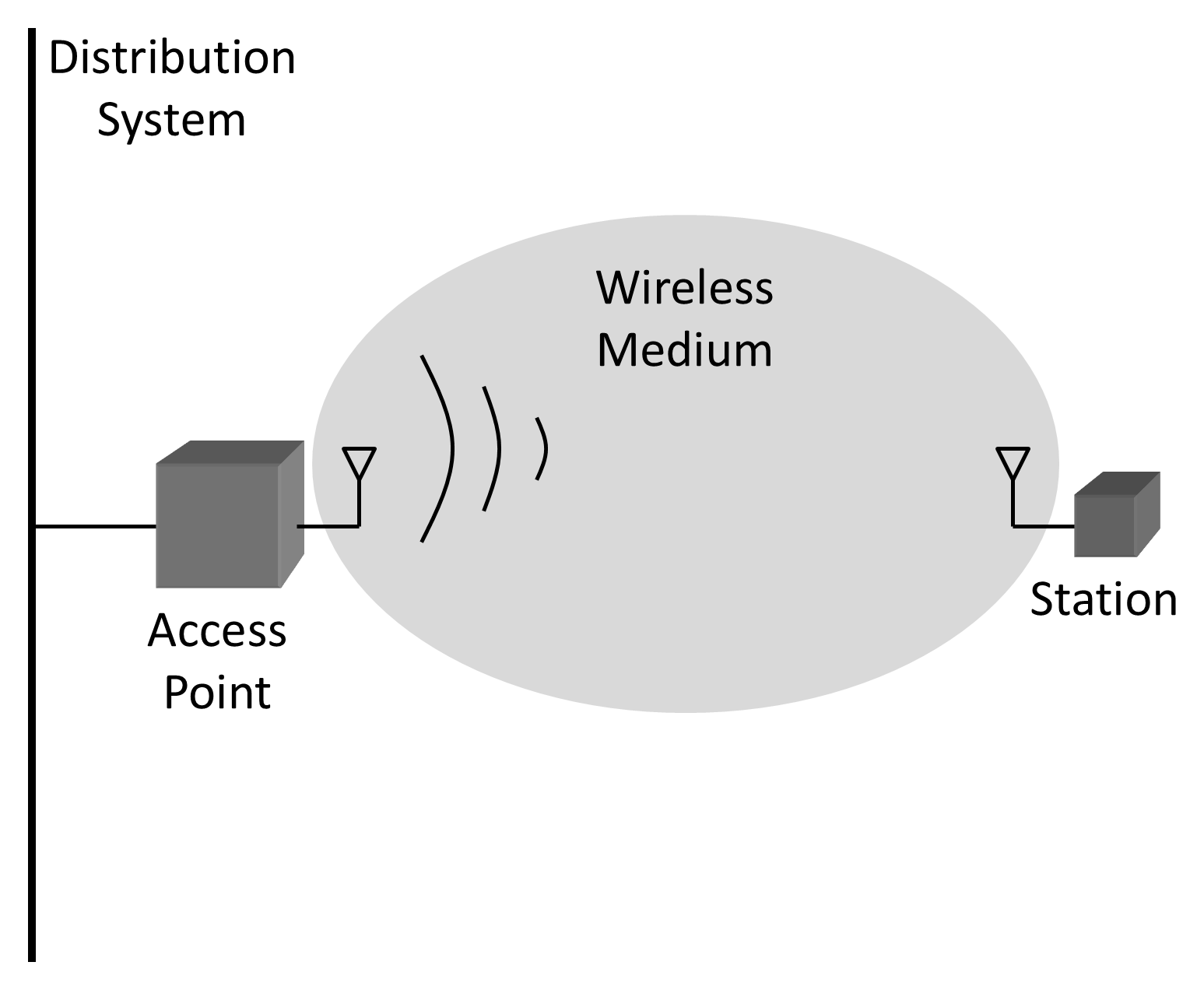
The standard IEEE 802.11 network (see Figure 14.7) comprises one or more access points (APs) that provide wireless connectivity for stations (STAs) and interconnect them with a distribution system, typically a wired Ethernet LAN, via a shared wireless medium. The distribution system delivers data to the access points, which operate as Layer-2 bridges between the wired infrastructure and the shared radio channel. Stations are end devices equipped with wireless network interfaces, which are now commonly integrated into most portable and fixed computing platforms.
14.4.1.2 Basic Service Sets (BSS)
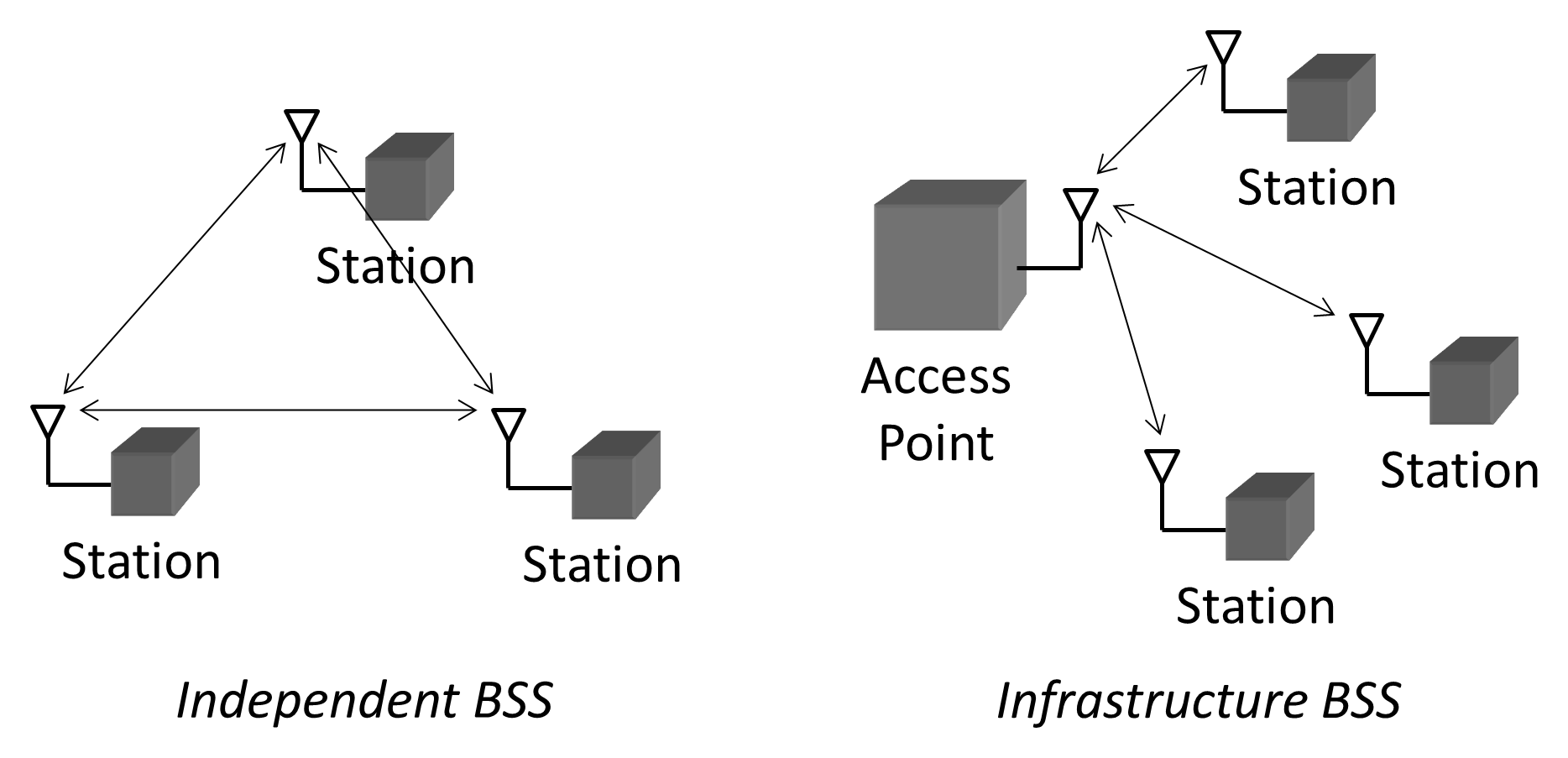
A group of stations that can communicate with each other is called a Basic Service Set (BSS). The physical region over which this communication is possible is the Basic Service Area (BSA). Two types of BSS are defined (Figure 14.8). An independent BSS (IBSS) provides an ad hoc configuration with no access point, in which stations communicate directly with one another but have no connection to a distribution system. An infrastructure BSS includes an access point and provides connectivity to a distribution system, thereby enabling communication beyond the local service area. Although IBSS operation remains defined in the standard, most modern WLAN deployments operate in infrastructure mode.
14.4.1.3 Extended Service Sets (ESS)
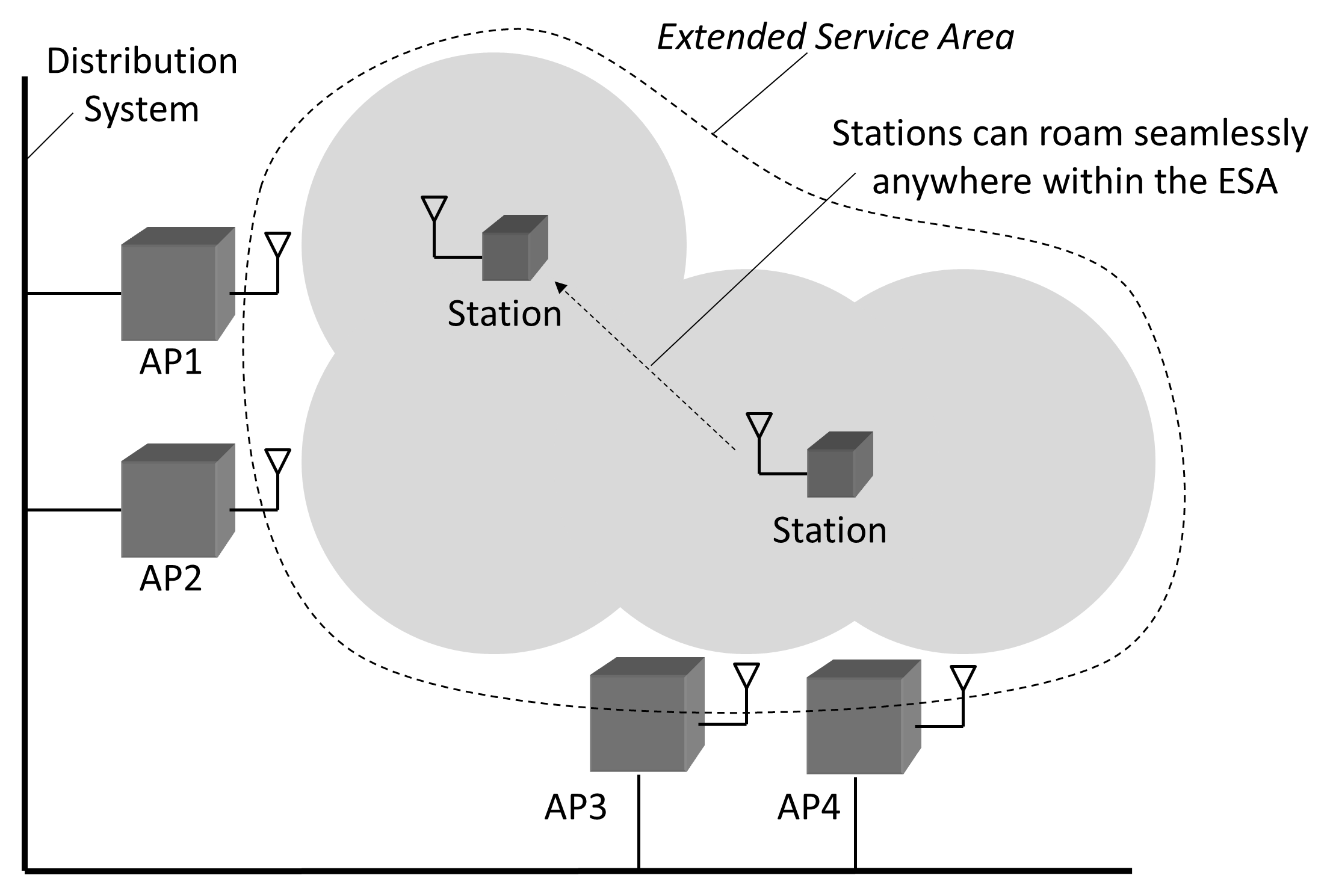
Multiple BSSs may be interconnected via the distribution system to form an Extended Service Set (ESS), covering an Extended Service Area (ESA) (Figure 14.9). Within an ESS, a station retains a single MAC address and is recognized throughout the extended network, allowing it to move between BSAs while maintaining logical network connectivity. The 802.11 standards define mechanisms that support roaming between access points with minimal disruption to active sessions, including fast transition procedures specified in IEEE 802.11r. Modern enterprise WLANs frequently employ centralized controllers to manage multiple access points, enabling coordinated radio resource management, mobility optimization, and policy enforcement across the ESS.