
14.3.2 Ethernet Frame And MAC Operation
At the Data Link Layer, Ethernet defines the format of the frame that carries higher-layer data and specifies the Media Access Control (MAC) functions used to deliver frames within a local network. These functions include framing, addressing, and error detection, and they operate independently of the physical medium used to transmit the bits. We therefore begin by examining the Ethernet frame structure, and then consider MAC addressing and the frame check sequence used for error detection.
14.3.2.1 Ethernet Frame Structure
One of the principal reasons for Ethernet’s longevity is the stability of its Data Link Layer frame format. Although Ethernet has evolved from shared bus systems to high-speed switched and multi-gigabit networks, the fundamental frame structure defined in IEEE 802.3 has remained unchanged. This continuity ensures interoperability across generations of hardware and simplifies integration with higher-layer protocols.
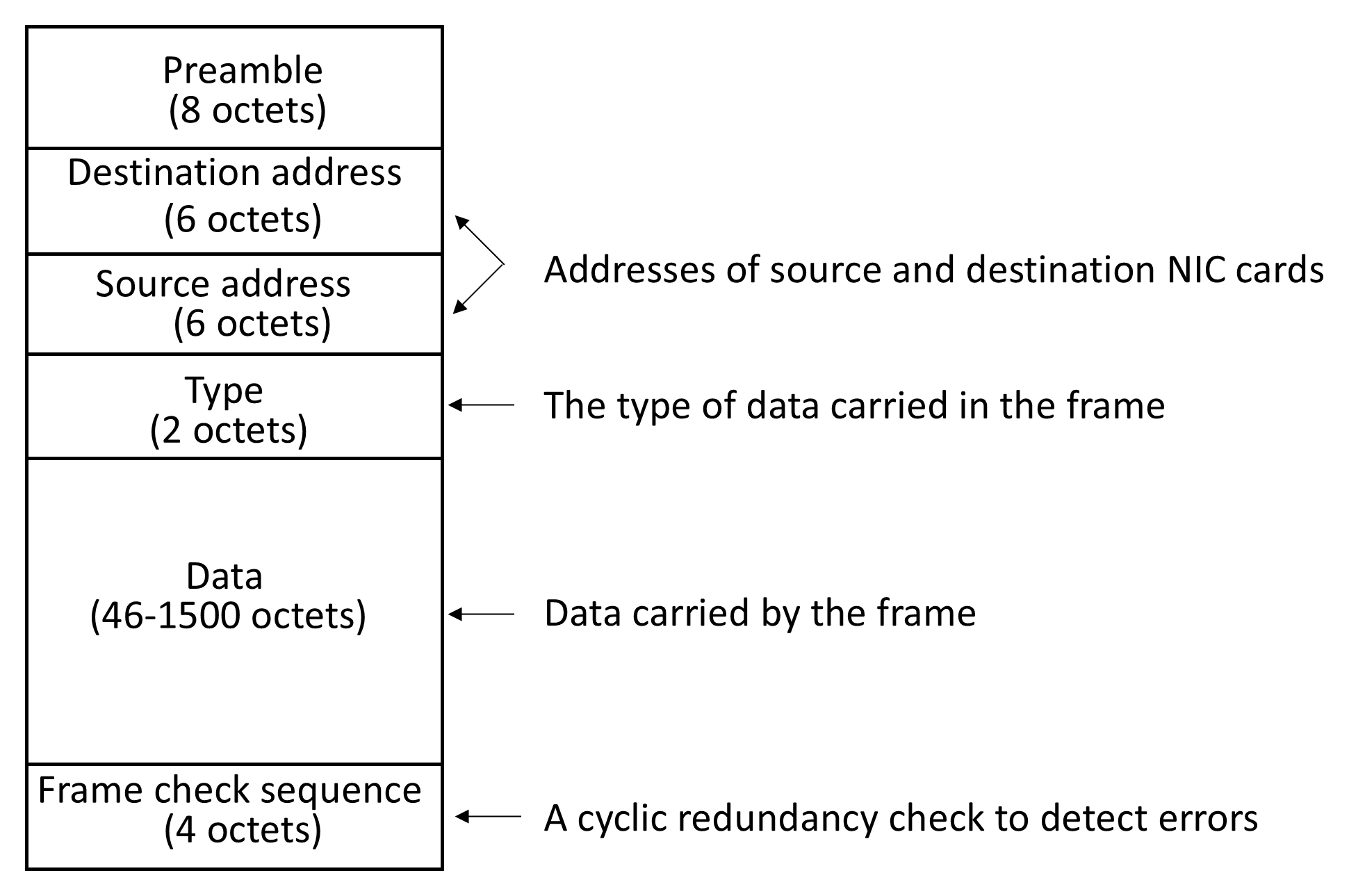
The Ethernet frame (see Figure 14.5), defined under IEEE 802.3, specifies how higher-layer data is encapsulated, addressed, and error-checked prior to transmission across the physical medium. The frame structure consists of the following fields:
- Preamble (7 octets): A synchronization sequence that enables the receiver to achieve bit-level timing lock.
- Start Frame Delimiter (1 octet): Marks the precise beginning of the frame.
- Destination MAC Address (6 octets): Identifies the intended recipient of the frame.
- Source MAC Address (6 octets): Identifies the transmitting station.
- Length/Type Field (2 octets): Indicates either the payload length (IEEE 802.3 format) or the upper-layer protocol type (Ethernet II format).
- Payload (46–1500 octets): Encapsulated data from higher layers (typically IP packets).
- Frame Check Sequence (4 octets): A 32-bit cyclic redundancy check (CRC) used for error detection.
If the payload is less than 46 octets, padding is added to ensure that the minimum frame size requirement is satisfied. The minimum frame length of 64 octets was originally determined by collision-detection timing constraints in shared-medium Ethernet. Although modern full-duplex Ethernet no longer requires collision detection, the minimum frame size remains for backward compatibility.
The stability of this frame format has allowed Ethernet speeds to increase from 10 Mbps to hundreds of gigabits per second without altering higher-layer protocol interfaces. While the logical structure of the frame has remained constant, the physical techniques used to represent and transmit its bits have evolved substantially.
While the frame defines the structural container for transmission, its addressing fields determine how frames are delivered within a LAN. We therefore examine MAC addressing in greater detail.
14.3.2.2 Media Access Control (MAC) Addressing
Each Ethernet network interface is assigned a globally unique 48-bit Media Access Control (MAC) address. The first 24 bits identify the manufacturer with an Organizationally Unique Identifier (OUI), and the remaining 24 bits uniquely identify the device.
When a frame is transmitted, the destination address determines which station should accept the frame and the source address identifies the sender.
Addresses may represent:
- A unicast destination (single device).
- A multicast group.
- The broadcast address (all ones), delivered to all devices within the broadcast domain.
In early shared Ethernet, all stations physically received every frame and filtered locally based on the destination address. In modern switched Ethernet, switches examine the destination MAC address and forward the frame only to the appropriate output port.
14.3.2.3 Error Detection
Ethernet employs a 32-bit cyclic redundancy check (CRC) in the Frame Check Sequence field. The receiver recalculates the CRC over the received frame and compares it with the transmitted value. If the values match, the frame is accepted. If an error is detected, the frame is discarded. Ethernet does not provide automatic retransmission at the Data Link Layer; reliability, if required, is handled by higher-layer protocols such as TCP.
Back to reading