
14.2.1 The Utility Of Protocol Layers
Modern communication networks are inherently complex systems. They must interconnect heterogeneous devices, operate over diverse physical media, evolve over time, and permit independent implementation by multiple vendors. Designing such systems as monolithic entities would be impractical. Instead, networking architectures are structured into layers, each responsible for a well-defined subset of the overall communication task.
As illustrated in Figure 14.1, each layer provides defined services to the layer above and relies on services from the layer below. It is important to distinguish clearly between three related but distinct concepts: a service (the set of functions that a layer makes available to the layer above), an interface (the means by which those services are accessed across the boundary between adjacent layers), and a protocol (the formal set of rules and message formats governing communication between peer entities at the same layer in different systems). Confusing these concepts can obscure the logic of layered design. Lower layers treat higher-layer information as opaque payload, adding their own control information without interpreting upper-layer semantics. This abstraction separates conceptual design from implementation details, facilitating modularity, interoperability, and standardization.
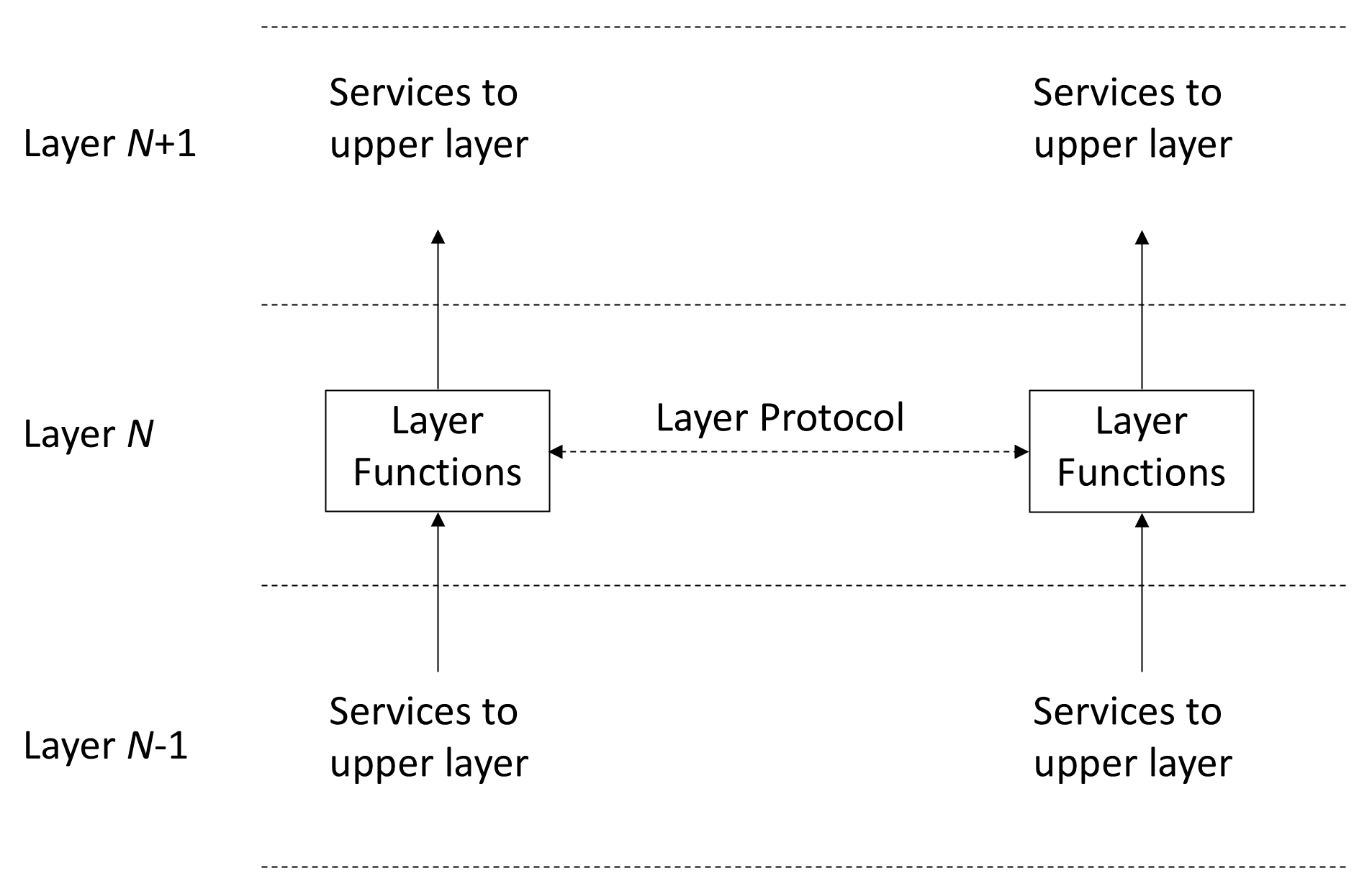
During transmission each layer appends a protocol header (and in some cases a trailer) containing control information relevant to that layer’s function. A frame travelling across a network therefore contains a series of nested headers in front of the original user data. At the receiving end, the corresponding layer interprets and removes its header before passing the remaining data upward. Eventually the user data, stripped of all headers, is delivered to its destination by the final layer. This process—known as encapsulation and de-encapsulation—is fundamental to all layered architectures.
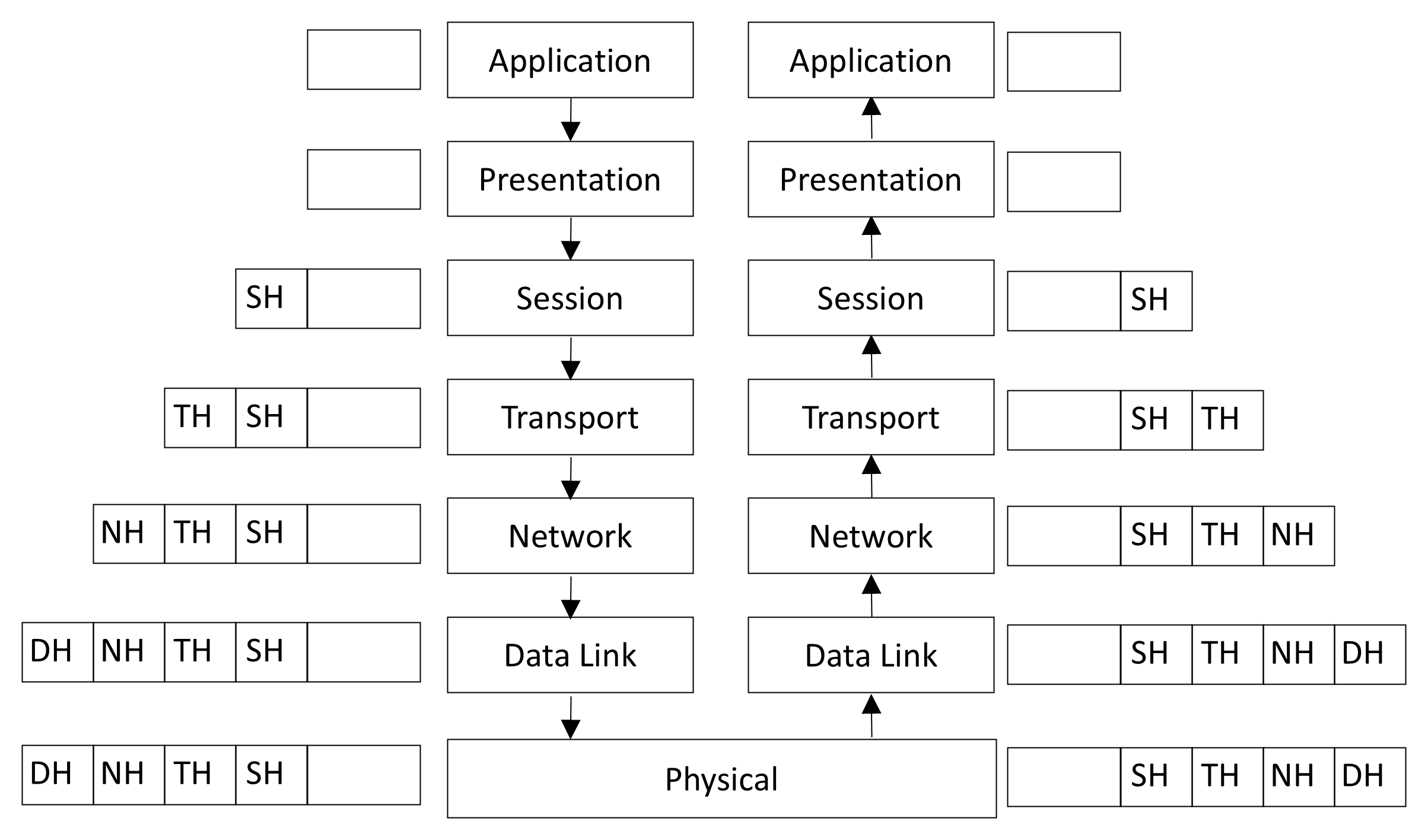
Not all protocols operate solely by prepending headers. Some also append trailers or insert additional control information within the data stream. For example, a data link protocol may mark the beginning and end of a frame with special characters and insert escape characters where necessary to prevent ambiguity. Nevertheless, the principle of layered processing remains the same: each layer performs a distinct transformation of the data unit it receives.
Layering simplifies protocol design because the sending and receiving software for each layer can be designed, implemented, and tested independently of other layers. This modularity allows new technologies to be introduced at one layer without redesigning the entire system.
In practice, however, layers are not entirely independent. For reasons of efficiency, optimization, and historical development, protocols are typically grouped into specific protocol stacks. Protocols within one stack generally interoperate only with corresponding protocols in the same stack, although translation or gateway mechanisms can provide interworking between different stacks. A single computer may implement multiple stacks simultaneously; a protocol identifier field within each frame or packet determines which stack should process the incoming data.
The principles described above are expressed formally in several standardized reference models. Among these, the ISO Open Systems Interconnection (OSI) Reference Model provides the most comprehensive and systematically structured articulation of layered communication functions.
Back to reading