
8.9 TIME HOPPING
Time-hopping spread spectrum distributes signal energy in the time domain rather than continuously across frequency. Instead of transmitting a continuous waveform or hopping among carrier frequencies, the transmitter emits very short pulses at pseudo-randomly selected time positions within a larger frame structure. The pulse position is determined by a time-hopping sequence shared between transmitter and receiver.
Time hopping is commonly implemented using impulse-based signaling techniques such as pulse-position modulation (PPM), binary phase (polarity) modulation (BPM), or related impulse radio schemes. Because the transmitted pulses are extremely short—often on the order of nanoseconds—the resulting signal occupies a very large bandwidth, frequently hundreds of megahertz or more. For this reason, time-hopping systems are often associated with ultra-wideband (UWB) transmission, which is discussed in more detail in Section 14.5.3.
Figure 8.23 illustrates the time–frequency characteristic of a time-hopping transmitter. The transmitter is active only during very short bursts, each occupying a wide instantaneous bandwidth. Between pulses, no power is transmitted. Over time, the sequence of pulse positions spreads signal energy across a larger time interval in a pseudorandom manner.
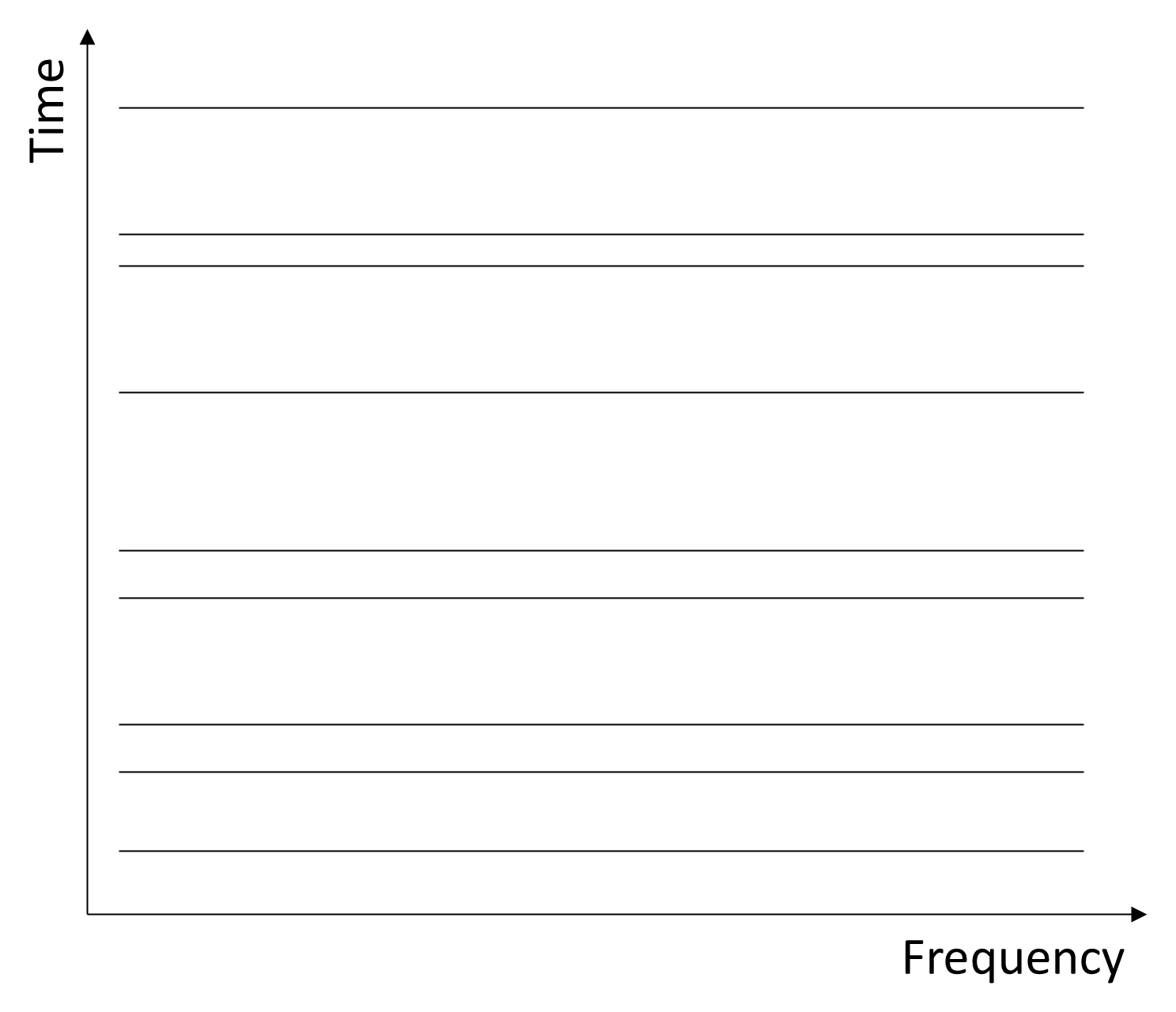
Time hopping should not be confused with TDMA. In TDMA, users are assigned deterministic time slots in a repeating frame. In time hopping, transmission instants are selected pseudo-randomly according to a spreading sequence. If multiple users employ distinct time-hopping sequences within the same frame, their pulses will generally not coincide. When pulses do overlap, a collision occurs and the affected pulse energy is corrupted. Provided that pulse overlap probability is low and suitable coding is used, reliable communication can still be achieved.
Like FH, time hopping provides a probabilistic form of multiple access. It does not guarantee orthogonality, but instead relies on low collision probability across a large time–frequency space. Because each pulse occupies an extremely wide bandwidth for a very short duration, the average transmitted power can be very low while still achieving acceptable signal energy per pulse.
Time hopping offers several advantages. Transmitter and receiver structures can be relatively simple, particularly in impulse-radio implementations. No continuous carrier synthesis or frequency coordination is required, and the very low power spectral density reduces detectability and limits interference at distant receivers. These properties make time-hopping systems attractive for short-range, low-power, and covert communication applications.
However, the large instantaneous bandwidth of each pulse can create regulatory and coexistence challenges. Even though average power is low, the wide spectral occupancy requires careful spectral shaping and compliance with emission masks. Potential interference with nearby communication and navigation systems must be managed through strict power limits and spectrum allocation rules. As a result, regulatory frameworks in most countries restrict time-hopping or UWB transmissions to specific frequency bands and power levels.
Time-hopping spread spectrum therefore represents a distinct approach to bandwidth expansion, complementing direct-sequence and FH methods. While less common in wide-area communication systems, it plays an important role in short-range, high-precision, and low-power wireless applications.
Back to reading