
8.3.7 Orthogonal Frequency Division Multiple Access (OFDMA)
Orthogonal frequency division multiple access (OFDMA) is a multicarrier extension of FDMA in which the available bandwidth is divided into a large number of closely spaced, mutually orthogonal subcarriers. Rather than assigning broad fixed frequency bands to users, OFDMA dynamically allocates subsets of subcarriers to different users in both time and frequency. The key distinction between classical FDMA and OFDMA is orthogonality.
In classical FDMA, guard bands are required because adjacent channels must be separated physically to prevent overlap. In OFDMA, subcarriers are mathematically constructed to be orthogonal over the symbol interval. Their spectra overlap in frequency, but the orthogonality condition ensures that, at the sampling instants defined by the Fourier transform, inter-carrier interference is ideally zero. Figure 8.7. illustrates the time–frequency characteristic of an OFDMA system, showing the subcarrier structure and time-slot assignment.
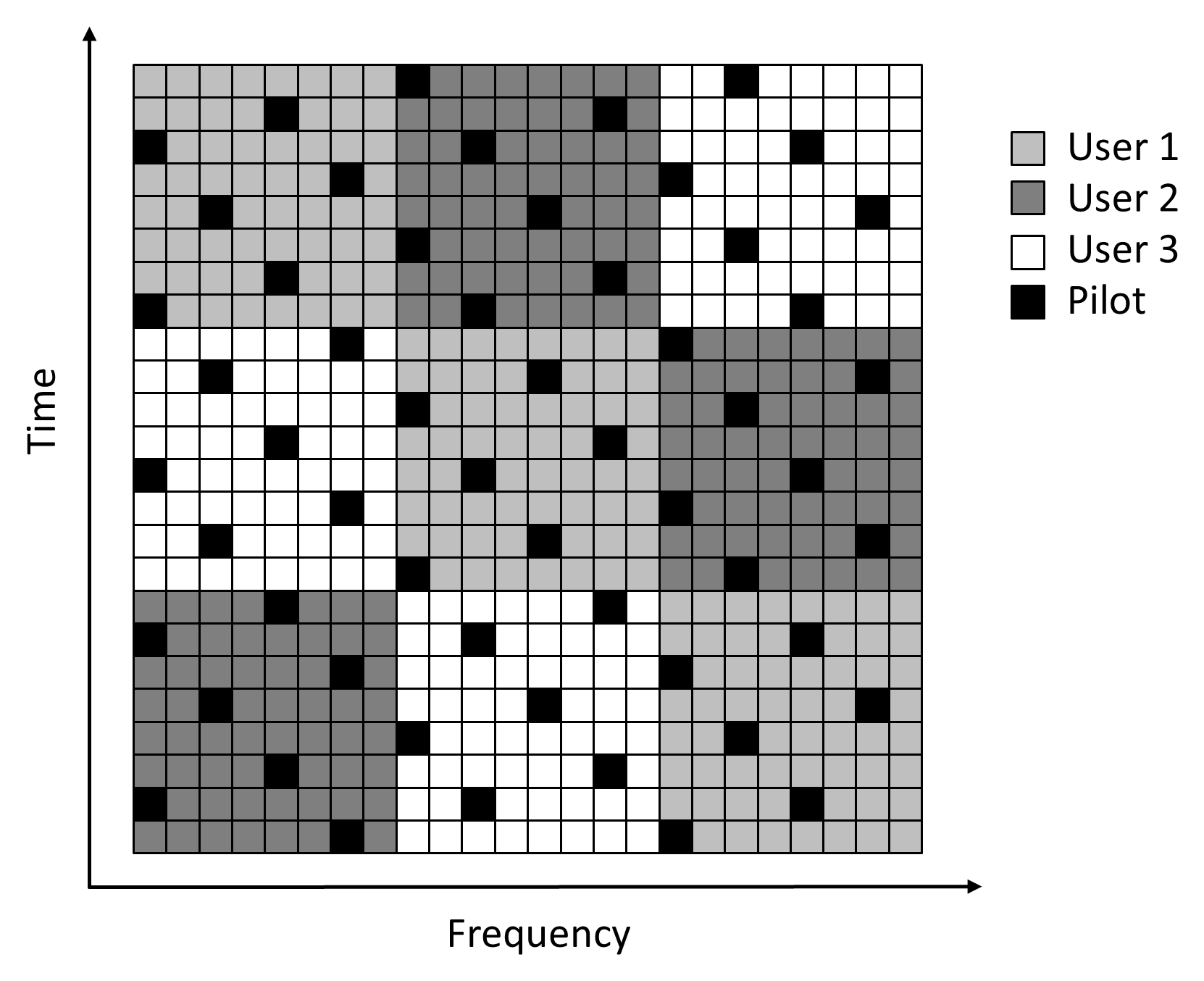
If the symbol duration is T, orthogonality is achieved when adjacent subcarriers are spaced at Δ𝑓=1/𝑇. This condition ensures that each subcarrier completes an integer number of cycles within the symbol interval, so its integral over other subcarriers is zero.
OFDMA systems typically employ inverse fast Fourier transform (IFFT) processing at the transmitter and fast Fourier transform (FFT) processing at the receiver to generate and recover the orthogonal subcarriers efficiently. Cyclic prefixes are inserted to preserve orthogonality in multipath channels by preventing inter-symbol interference, and dynamic scheduling mechanisms allocate subcarrier groups, often referred to as resource blocks, among users according to traffic demand and channel conditions.
Unlike classical FDMA, OFDMA allows fine-grained bandwidth allocation, supports adaptive modulation and coding on a per-subcarrier basis, and accommodates frequency-selective fading by assigning stronger subcarriers to users experiencing favorable channel conditions. These features enable high spectral efficiency and flexible resource management in broadband wireless systems.
OFDMA is widely used in modern broadband systems, including wireless LANs, 4G LTE, 5G New Radio (NR), and contemporary broadband satellite architectures. Where classical FDMA assigns static frequency slices, OFDMA creates a two-dimensional resource grid in time and frequency, enabling highly flexible and efficient resource scheduling.
OFDMA has the following advantages:
- High spectral efficiency: Orthogonal overlapping subcarriers eliminate the need for guard bands between users.
- Fine-grained allocation: Subcarriers may be grouped and assigned dynamically according to traffic demand.
- Robustness to multipath: Long symbol durations reduce inter-symbol interference in frequency-selective channels.
- Adaptive modulation capability: Different subcarriers can use different modulation and coding schemes depending on channel quality.
- Scalability: Suitable for large numbers of users with heterogeneous data-rate requirements.
Despite these advantages OFDMA has a number of limitations:
- High peak-to-average power ratio (PAPR): The superposition of many subcarriers produces large amplitude variations, requiring highly linear power amplifiers.
- Sensitivity to frequency and timing errors: Loss of orthogonality introduces inter-carrier interference.
- Increased signal-processing complexity: FFT/IFFT operations and dynamic scheduling demand significant digital processing capability.
- Linear amplifier requirement: As in classical FDMA, nonlinear distortion degrades performance, though the effect manifests as inter-carrier interference rather than traditional intermodulation products.