
8.3 FREQUENCY-DIVISION MULTIPLE ACCESS (FDMA)
Frequency-division multiple access (FDMA) is the most direct implementation of deterministic separation. Each user is assigned a distinct portion of the available spectrum and may transmit continuously within that allocated band. Provided that frequency allocations do not overlap and that transmitters remain within their assigned spectral limits, users do not interfere with one another.
FDMA is historically the earliest practical multiple-access technique and remains widely used in broadcasting, fixed wireless systems, satellite communications, trunked radio, and legacy cellular systems. Its conceptual simplicity makes it a useful starting point for understanding deterministic resource partitioning.
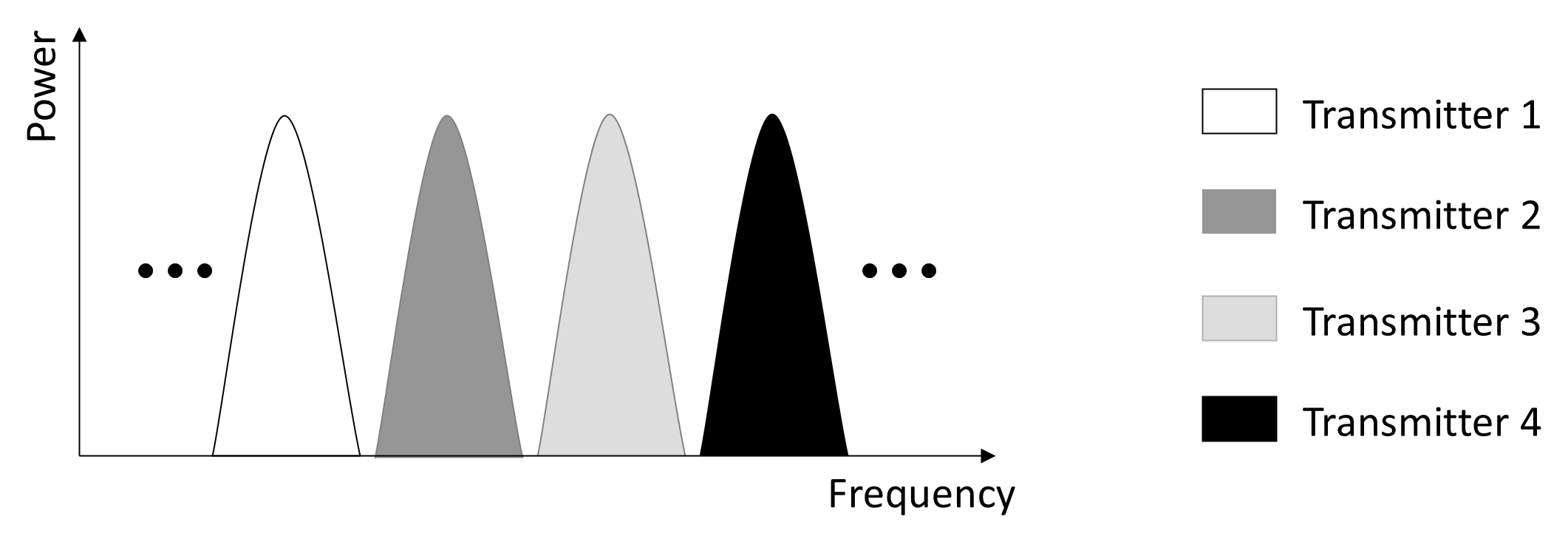
The fundamental idea of FDMA is separation in the frequency domain. As illustrated in Figure 8.2, the total available channel bandwidth is divided into a set of non-overlapping frequency intervals, each assigned to a different transmitter. All users may transmit simultaneously because each occupies a distinct spectral region.
This principle may be visualized in the time–frequency plane, as in Figure 8.3. Each transmitter occupies a continuous horizontal band (frequency extent) over time. Because no two users overlap in frequency, they may operate concurrently without mutual interference.
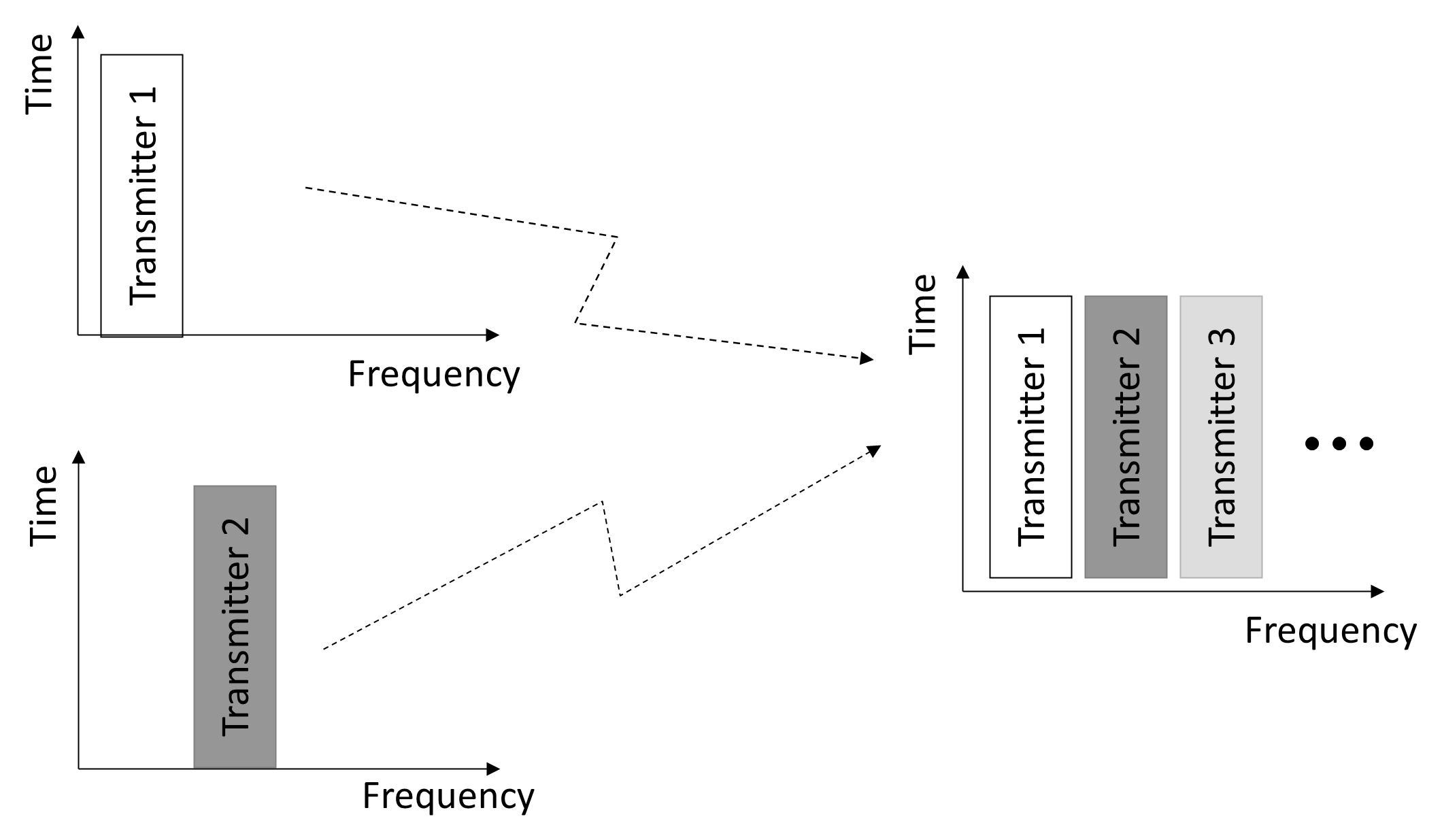
As long as transmitters remain spectrally confined within their assigned bands, orthogonality is achieved through physical separation in frequency. No time coordination among users is required, and synchronization between transmitters is unnecessary beyond maintaining carrier stability within allocated limits. FDMA may be applied to both analog and digital signals.
Because users transmit simultaneously, the composite received signal is the linear superposition of all carriers. This leads to important practical consequences: the shared transmission medium or amplifier must accommodate the total composite power without excessive distortion. The effects of nonlinearity and intermodulation are therefore central considerations in FDMA system design where there is a shared resource such as a transponder or a base station and are examined in Section 8.3.3.
Back to reading