
8.3.2 Adjacent-Channel Interference And Guard Bands
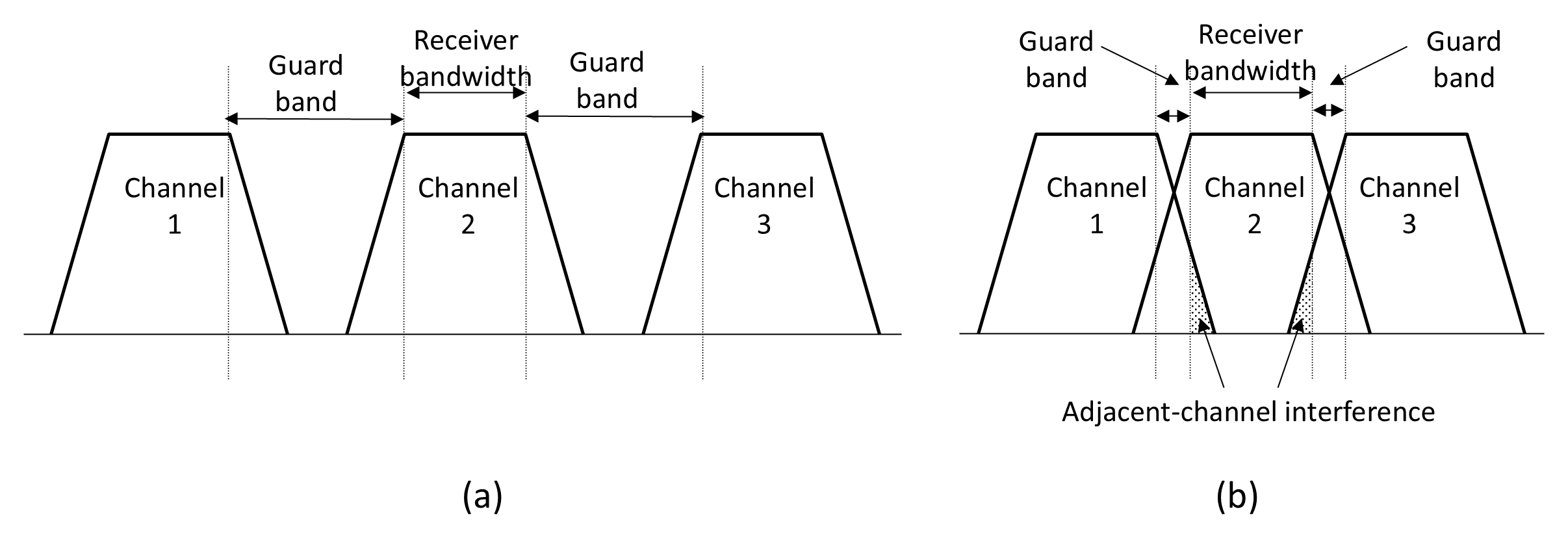
Ideal band-limited signals do not exist in practice. Real modulation schemes produce spectra with finite roll-off rather than abrupt cut-offs. Similarly, practical filters exhibit non-ideal attenuation characteristics. As a result, energy from one channel may leak into adjacent frequency bands, which is known as adjacent-channel interference (ACI).
To mitigate ACI, FDMA systems typically introduce guard bands — unused frequency intervals inserted between neighboring channels. Guard bands reduce spectral efficiency but increase isolation and tolerance to frequency error.
The required guard band depends on the modulation format and its spectral occupancy, the spectral purity of the transmitter, the selectivity of the receiver filters, the acceptable signal-to-interference ratio, and the frequency stability of the oscillators. These factors collectively determine how much separation is necessary to ensure adequate adjacent-channel isolation under practical operating conditions.
As illustrated in Figure 8.4(a), if channels are widely spaced with generous guard bands, adjacent-channel interference becomes negligible, but overall bandwidth utilization is poor. As illustrated in Figure 8.4(b), if channels are tightly packed to maximize spectral efficiency, filtering must be sharper and frequency control more precise. The system designer must therefore balance spectral efficiency, implementation complexity, and interference tolerance.
In digital systems using spectrally efficient modulation with controlled roll-off filtering, guard bands can be reduced significantly compared with legacy analog systems. However, aggressive spectral packing increases vulnerability to frequency offset and nonlinear distortion.
Adjacent-channel interference is fundamentally a linear filtering limitation. A more severe impairment arises when multiple carriers pass through nonlinear amplification stages such as in a transponder, producing intermodulation products that may fall directly within occupied channels. This effect is examined in the next section.
Back to reading