
8.8 SPREAD-SPECTRUM AND HOPPING TECHNIQUES
The deterministic techniques discussed earlier partition channel resources in frequency, time, code, or space to separate users. Spread-spectrum techniques take a different perspective. Rather than minimizing bandwidth to achieve spectral efficiency, spread-spectrum deliberately expands signal bandwidth beyond the minimum required for data transmission. This bandwidth expansion provides resilience against interference, jamming, and interception, and may also support multiple access.
In spread-spectrum systems, the transmitted signal occupies a bandwidth significantly larger than the information bandwidth. The spreading process distributes signal energy across this wider spectrum so that the power spectral density is reduced. At the receiver, knowledge of the spreading sequence allows the signal to be compressed back to its original bandwidth, while interference that is not similarly spread remains dispersed.
Although spread-spectrum methods can be used to implement multiple access, as in CDMA, they are not limited to that purpose. Their broader role includes improving robustness to narrowband interference, mitigating multipath effects, and reducing the likelihood of interception by unintended receivers.
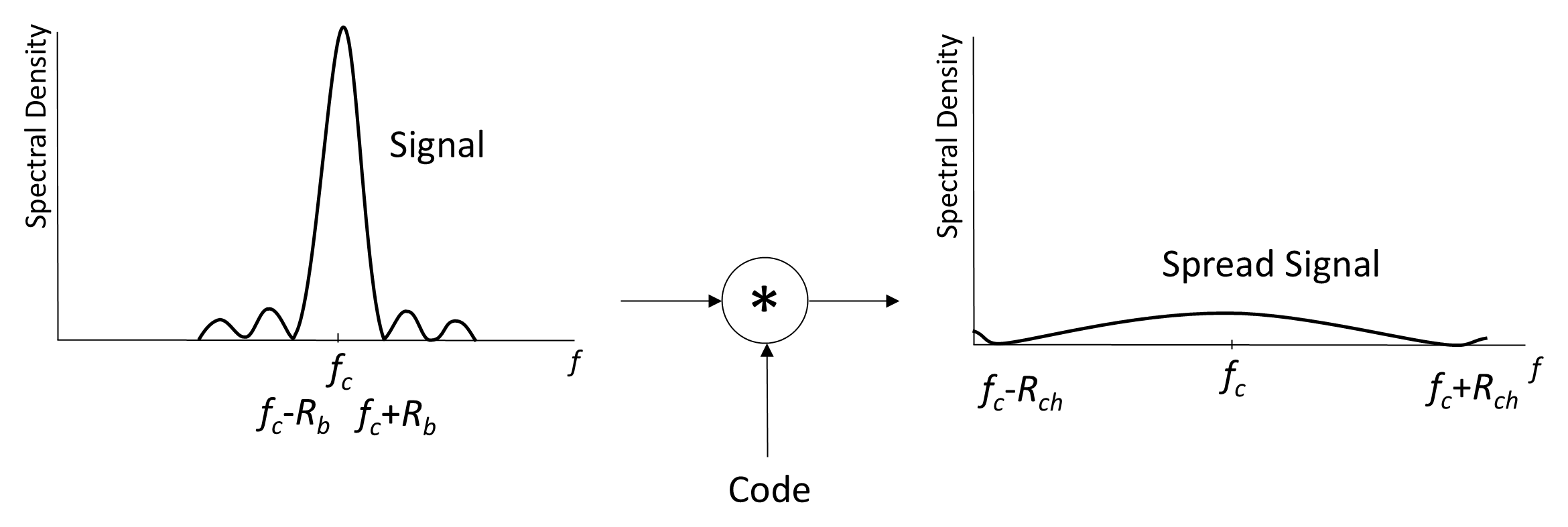
The defining characteristic of spread-spectrum signaling is bandwidth expansion through deterministic modulation by a spreading sequence, as illustrated in Figure 8.17. If the original data rate is Rb and the minimum required bandwidth is on the order of Rb, then after spreading the occupied bandwidth becomes
The ratio Gp=W/Rb is again referred to as the processing gain.
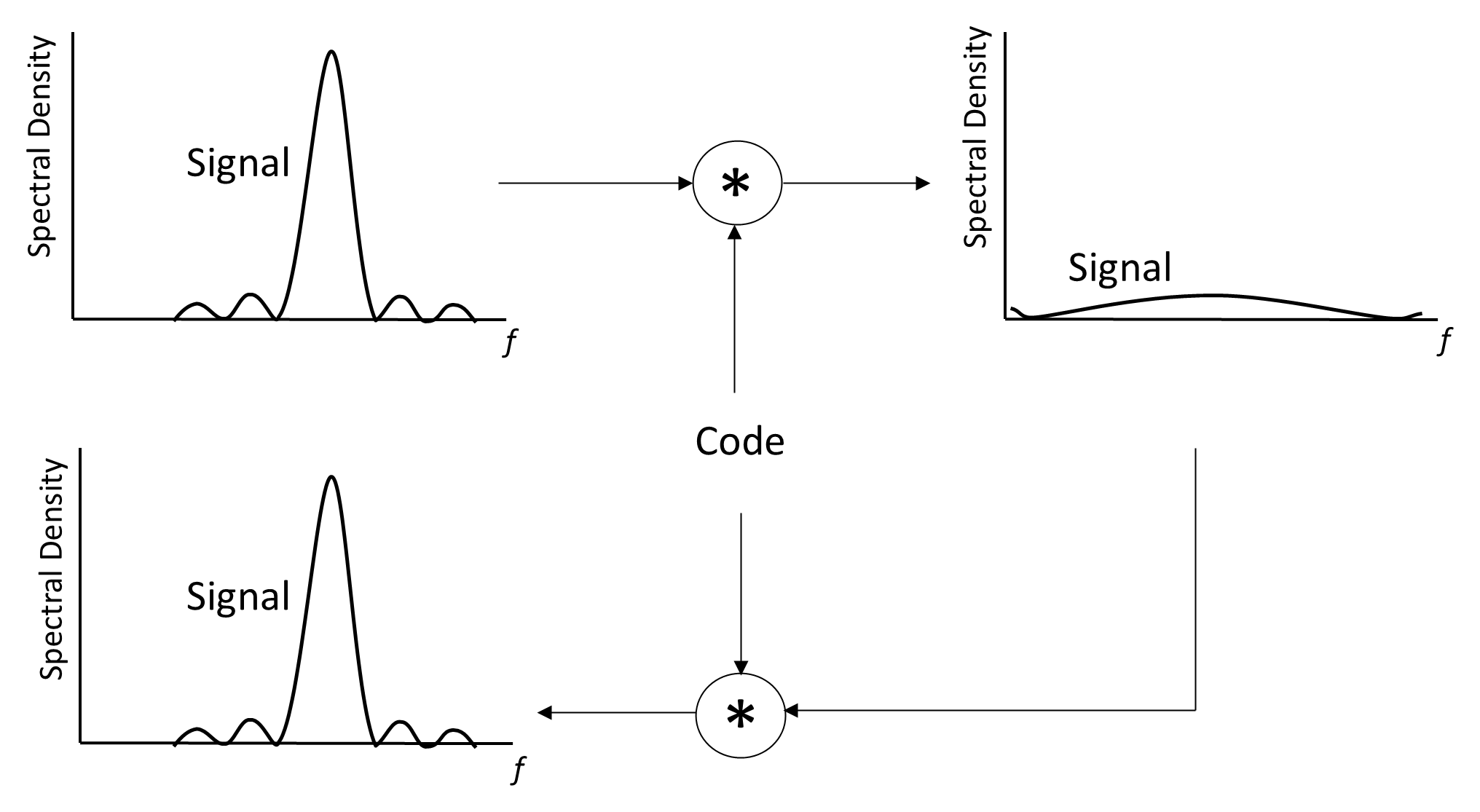
As illustrated in Figure 8.18, the spread signal is de-spread at the receiver through the application of the same code.
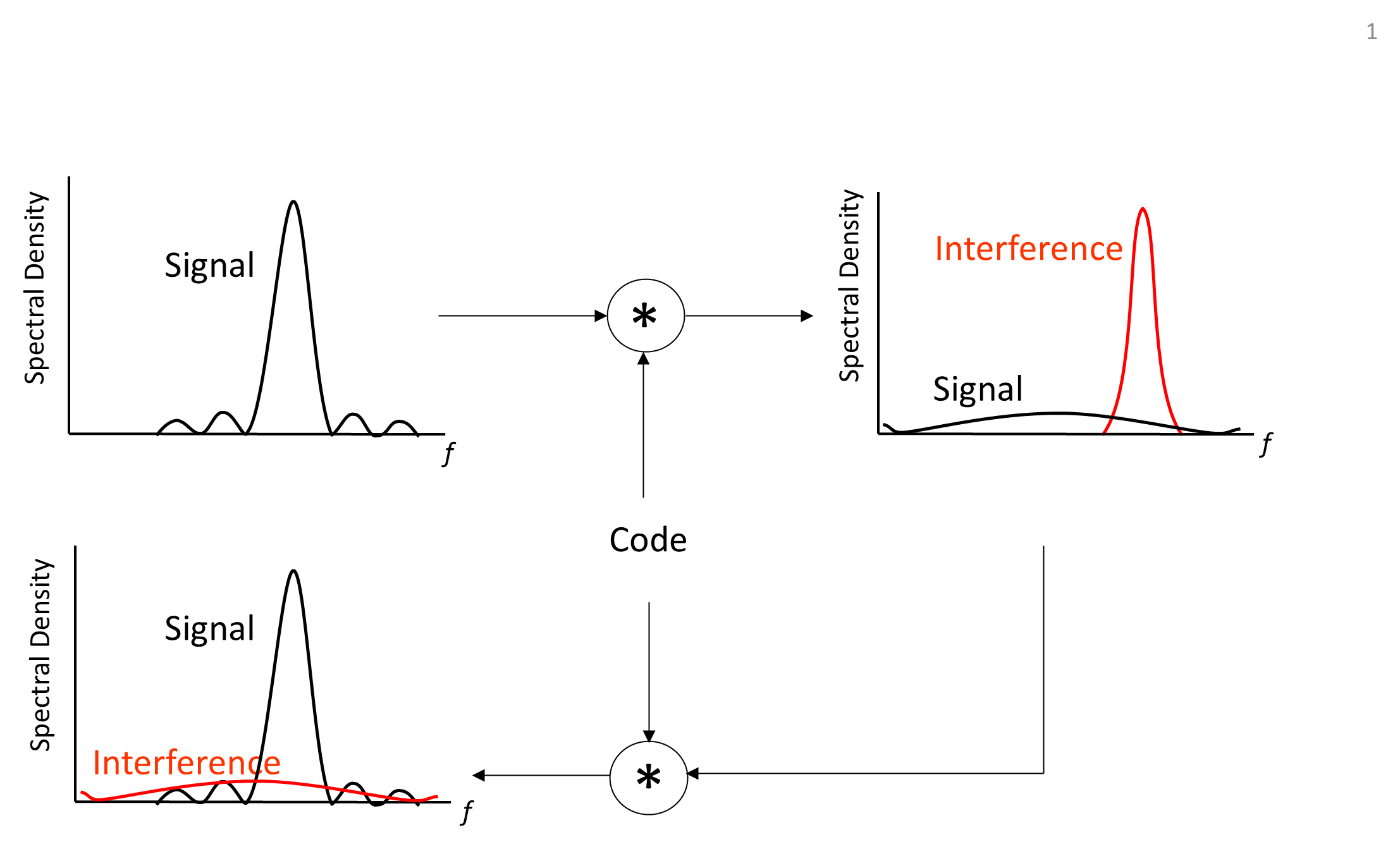
In the context of spread-spectrum signaling, processing gain represents the factor by which interference or jamming power is reduced after de-spreading. To illustrate the principle, consider a narrowband interference source occupying a small portion of the spread spectrum as illustrated in Figure 8.19. At the receiver, correlation with the spreading sequence compresses the desired signal back to its narrow bandwidth, while the interference remains wideband. As a result, the interference power within the recovered signal bandwidth is reduced approximately by the processing gain.
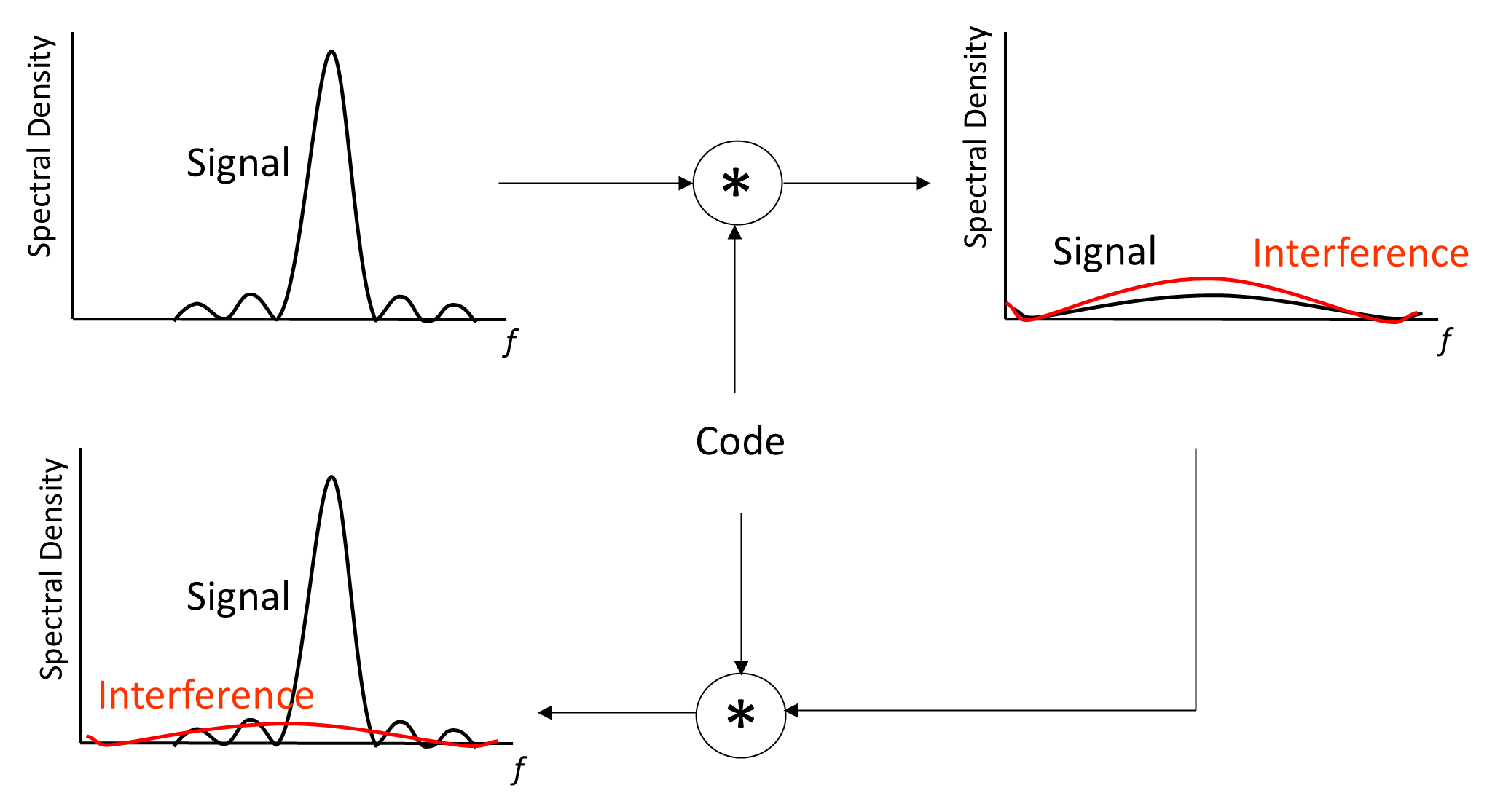
Similarly, if there is wideband interference in the channel as illustrated in Figure 8.20, it too will be spread at the receiver as the wanted narrowband signal is de-spread—again resulting in process gain. Figure 8.20 also illustrates why CDMA is not only a useful mechanism for ignoring interference but also useful as a multiple access technique since all other spread users appear as interference at the receiver which will then apply the appropriate code to de-spread the wanted signal.
Spread-spectrum signaling therefore converts bandwidth into robustness. By intentionally occupying a wide spectral region, the system becomes less sensitive to localized interference or spectral nulls.
Several distinct methods exist for implementing spread-spectrum signaling. The most common are direct-sequence spreading, frequency hopping, and, less commonly, time hopping. Each approach uses a pseudorandom sequence to control some aspect of the transmitted waveform, thereby distributing signal energy over a wider spectral region.
We now examine these methods in turn.
Back to reading