
8.3.3 Nonlinearity And Intermodulation
When multiple carriers are transmitted simultaneously through a shared amplifier or nonlinear device, the output spectrum is no longer simply the linear superposition of the input signals. Instead, additional frequency components are generated due to nonlinear distortion. These unwanted components are known as intermodulation products.
Consider input tones at frequencies f1, f2, f3, … fN. In a nonlinear system, new frequency components may appear at frequencies of the form:
where m1, m2, m3, … mN are integers (positive, negative, or zero).
The order of intermodulation order, denoted IMO, is defined as:
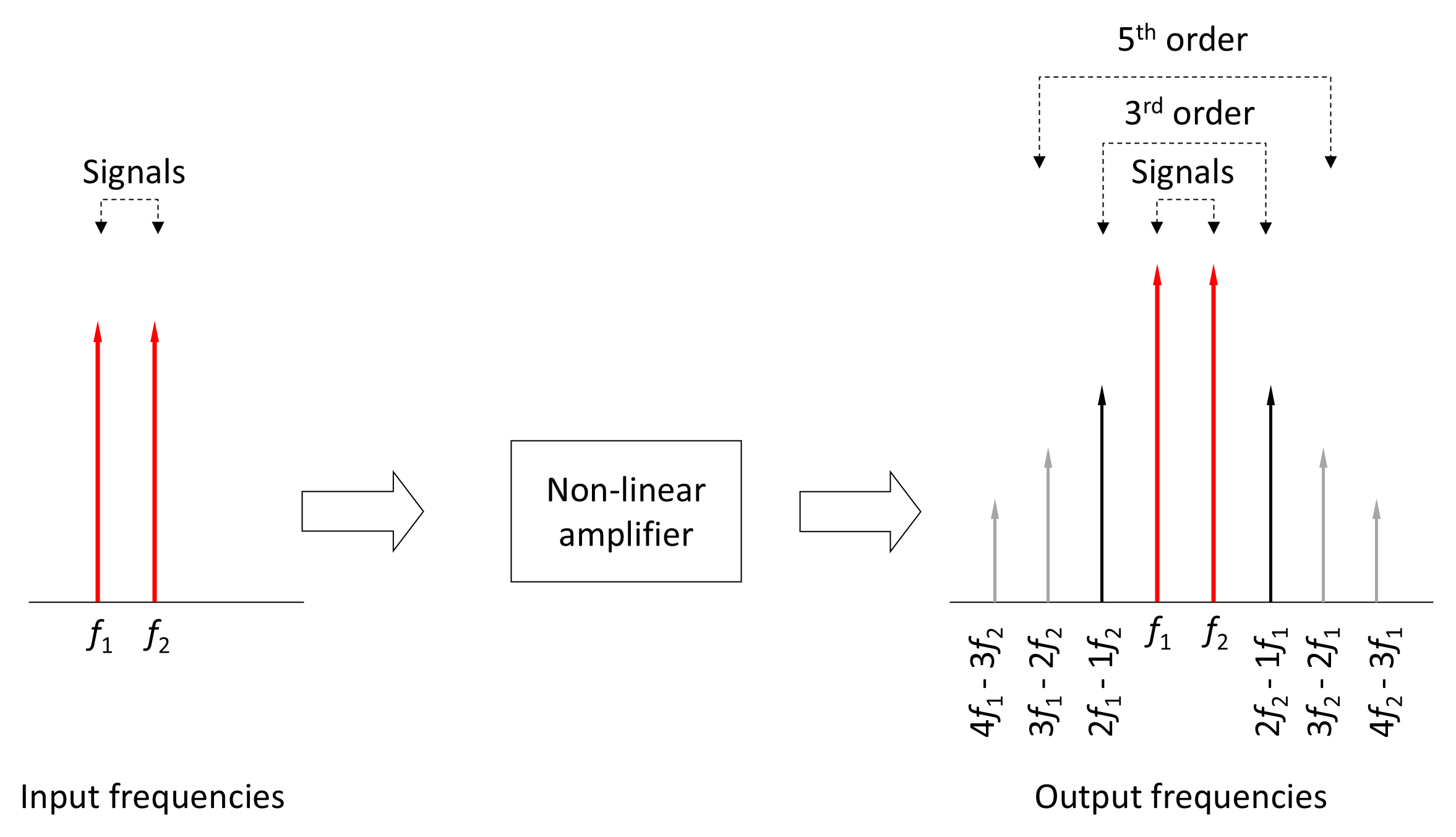
Lower-order products generally have higher amplitude than higher-order products. In practice, odd-order products—particularly third-order—are the most critical because they are difficult to filter since they tend to fall close to the original carrier frequencies and may even fall directly within adjacent allocated channels. Fifth- and higher-order products also occur but typically with reduced amplitude. Figure 8.5 shows the intermodulation spectrum for two tones and , and highlights the 3rd, 5th, and 7th order terms.
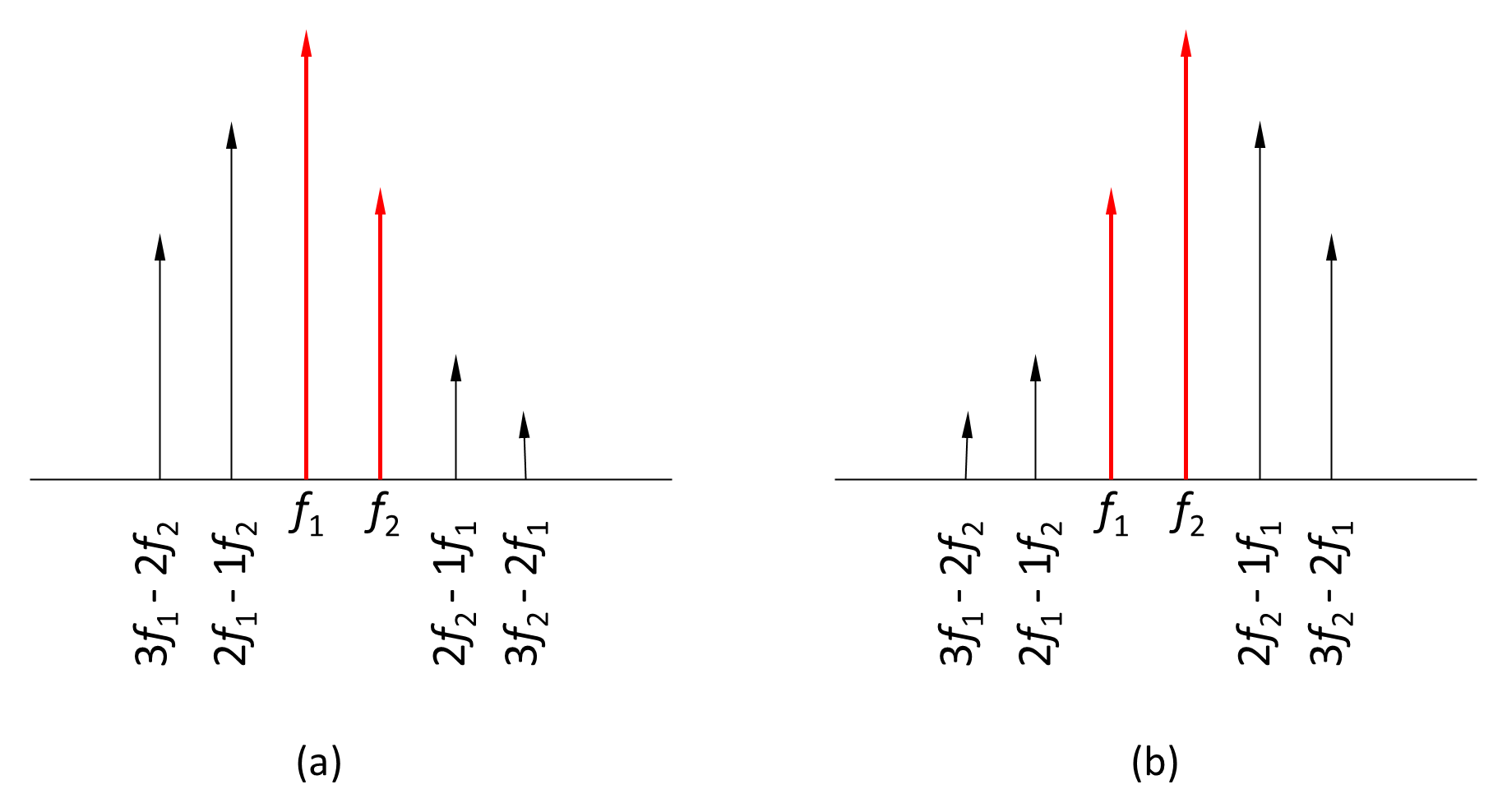
When input tones have unequal amplitudes as illustrated in Figure 8.6, the stronger tone can dominate the nonlinear interaction. In such cases, intermodulation products associated with the stronger carrier may significantly degrade weaker channels, particularly when power levels are poorly balanced among users.
Intermodulation is not confined to satellite systems; it occurs in terrestrial broadcast transmitters, cable distribution amplifiers, microwave relays, and cellular base stations whenever multiple carriers are amplified together. Thus, intermodulation is a fundamental physical constraint of FDMA and multi-carrier systems in general.
Mitigation techniques include increasing frequency spacing so that intermodulation products fall outside occupied bands, employing highly linear amplifier designs, applying digital pre-distortion or feed-forward linearization techniques, maintaining strict power balance among carriers, and operating with sufficient output backoff to suppress nonlinear distortion. These measures reduce the amplitude and impact of intermodulation products, though they often introduce trade-offs in spectral efficiency, implementation complexity, or power efficiency as examined in the next section.
Back to reading