
8.7 RANDOM AND CONTENTION-BASED MULTIPLE ACCESS TECHNIQUES
The deterministic techniques discussed in Section 8.2 prevent collisions by allocating frequency bands, time slots, codes, or spatial resources in advance. In many practical systems, however, traffic is intermittent and unpredictable. Under such conditions, permanently reserving channel resources for each user may lead to poor utilization.
Random or contention-based multiple access techniques take a different approach. Rather than scheduling transmissions explicitly, users transmit when they have data and rely on statistical behavior and collision resolution mechanisms to share the channel. Collisions are therefore not prevented but managed.
In contention-based systems, orthogonality is not guaranteed. Instead, performance is described probabilistically in terms of offered load, throughput, delay, and collision probability. These methods are particularly well suited to bursty traffic, where the channel would otherwise remain idle for significant periods.
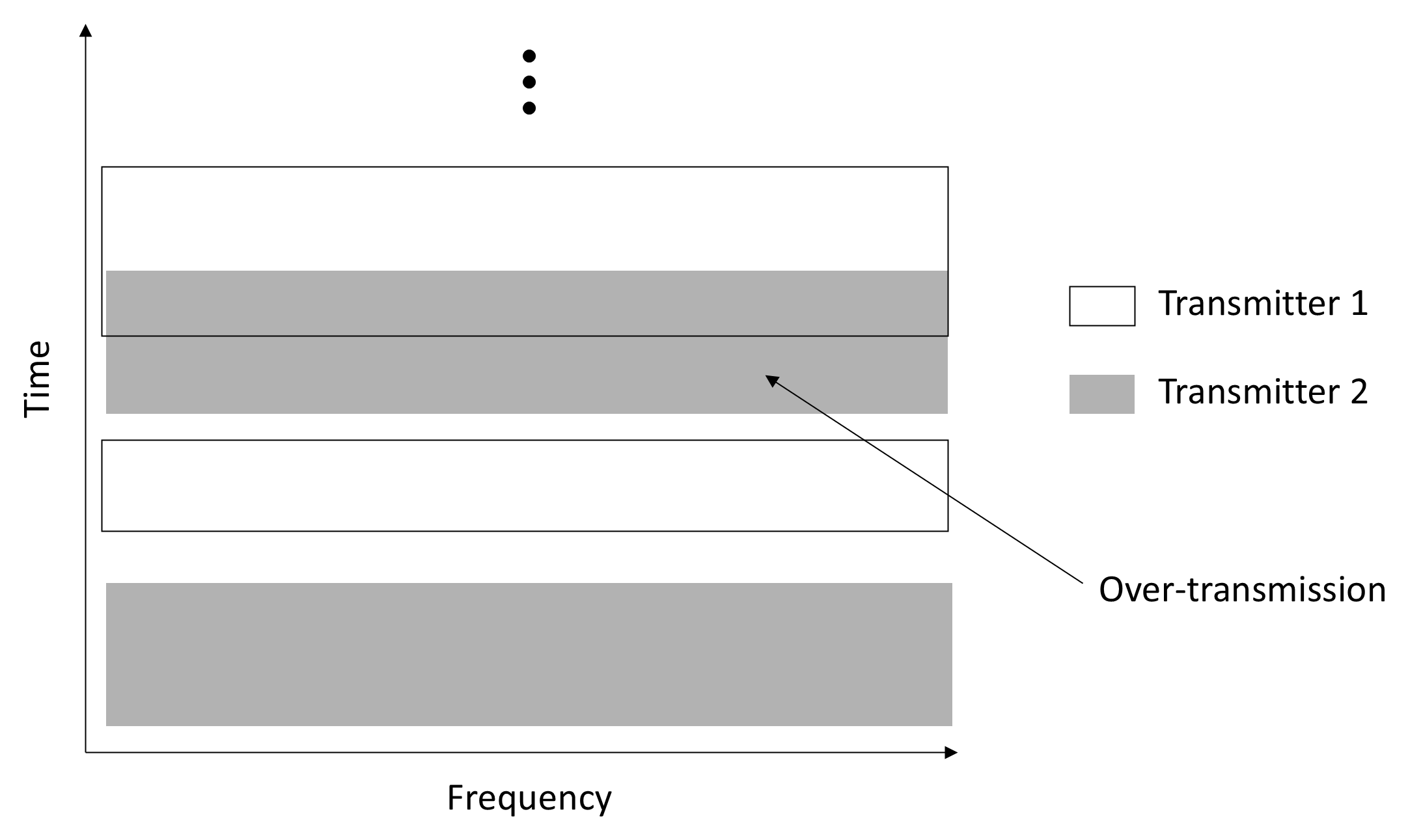
In a contention-based system, each user transmits independently according to its own traffic demands. As illustrated in Figure 8.16, if two or more users transmit simultaneously, their signals collide and the affected transmissions must be retransmitted. Successful operation therefore depends on limiting the probability of collision and resolving collisions efficiently when they occur.
To analyze such systems, it is useful to define two quantities:
- Offered load G, representing the average number of transmission attempts per packet time.
- Throughput S, representing the average number of successfully transmitted packets per packet time.
Throughput is always less than or equal to offered load because some transmission attempts are lost due to collisions. The relationship between S and G characterizes system efficiency.
If offered load is very low, collisions are rare and most transmission attempts succeed. In this regime, throughput increases approximately linearly with offered load. As offered load increases, collisions become more frequent, and throughput grows more slowly. Beyond a certain point, additional transmission attempts primarily increase collision probability rather than successful delivery, and throughput may even decline.
This fundamental trade-off distinguishes contention-based systems from deterministic ones. In deterministic multiple access, capacity is bounded by predefined resource partitions. In contention-based systems, capacity emerges from the statistical balance between traffic intensity and collision probability.
The simplest and historically most influential contention-based method is ALOHA, which is examined next.
Back to reading