
8.8.2 Frequency-Hopping Spread Spectrum (FHSS)
In FHSS, bandwidth expansion is achieved not by continuously spreading the signal across a wide band, but by rapidly changing the carrier frequency according to a pseudorandom sequence. At any given instant, the transmitted signal occupies only a relatively narrow frequency band. Over time, however, it visits many frequencies within a much larger allocated spectrum.
A frequency-hopping system defines a set of allowable carrier frequencies, often called the hop set. A pseudorandom sequence determines the order in which these frequencies are used. The transmitter and receiver share knowledge of the hopping sequence and remain synchronized so that the receiver tunes to the same frequency at the appropriate time.
Figure 8.21 illustrates the time–frequency characteristics of a single frequency-hopping transmitter. At any given instant, the transmitter occupies one frequency from its hop set; over time, it steps through different channels according to the hop sequence. Some channels may be used more than once during a given interval, while others may not be used at all.
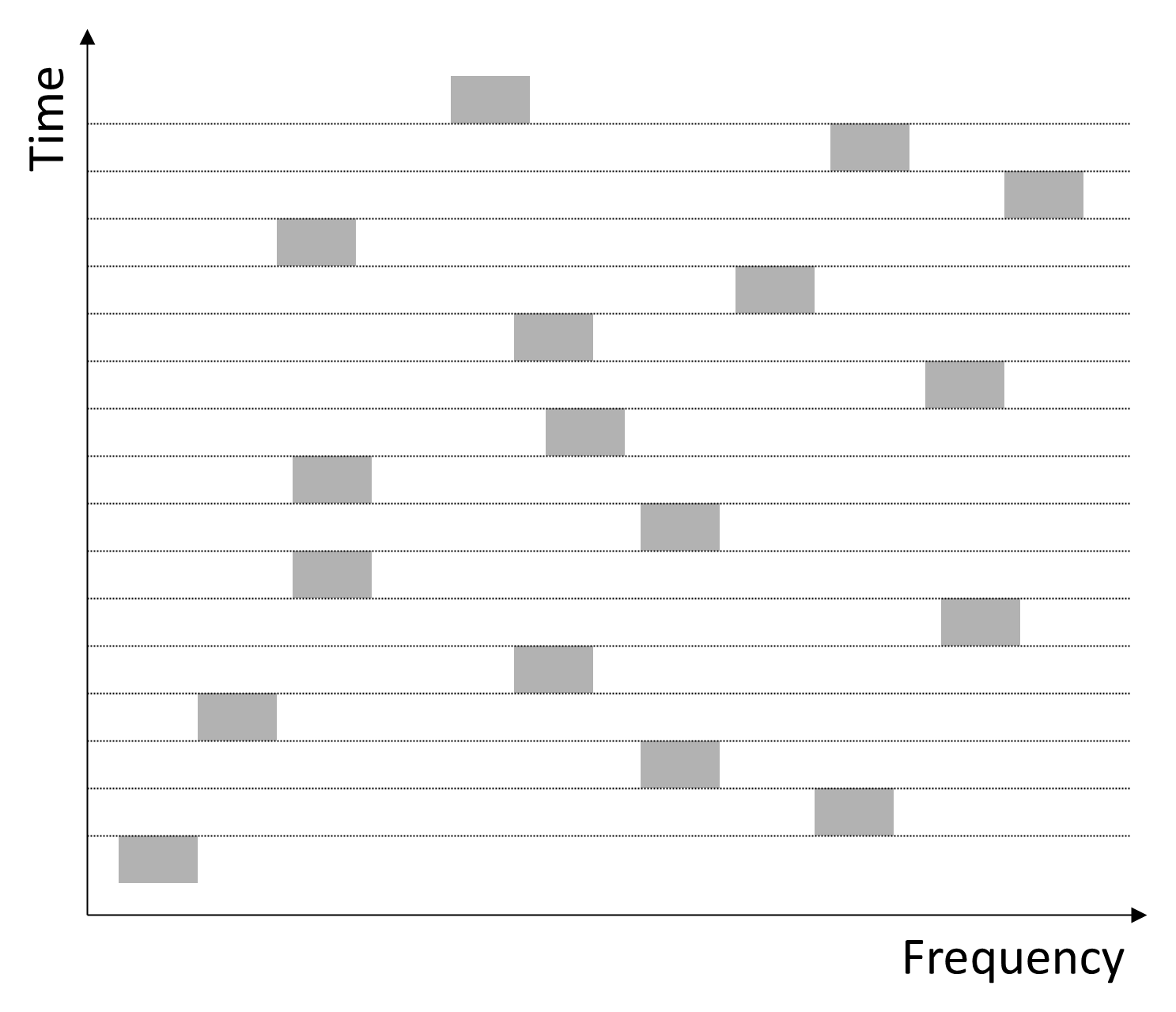
Figure 8.22 shows two independent frequency-hopping transmitters using the same hop set but different hop sequences. Because their sequences are uncorrelated, they operate without interference for most hops. Occasionally, their transmissions coincide on the same frequency—a hop collision—causing mutual interference and loss of the affected bursts.
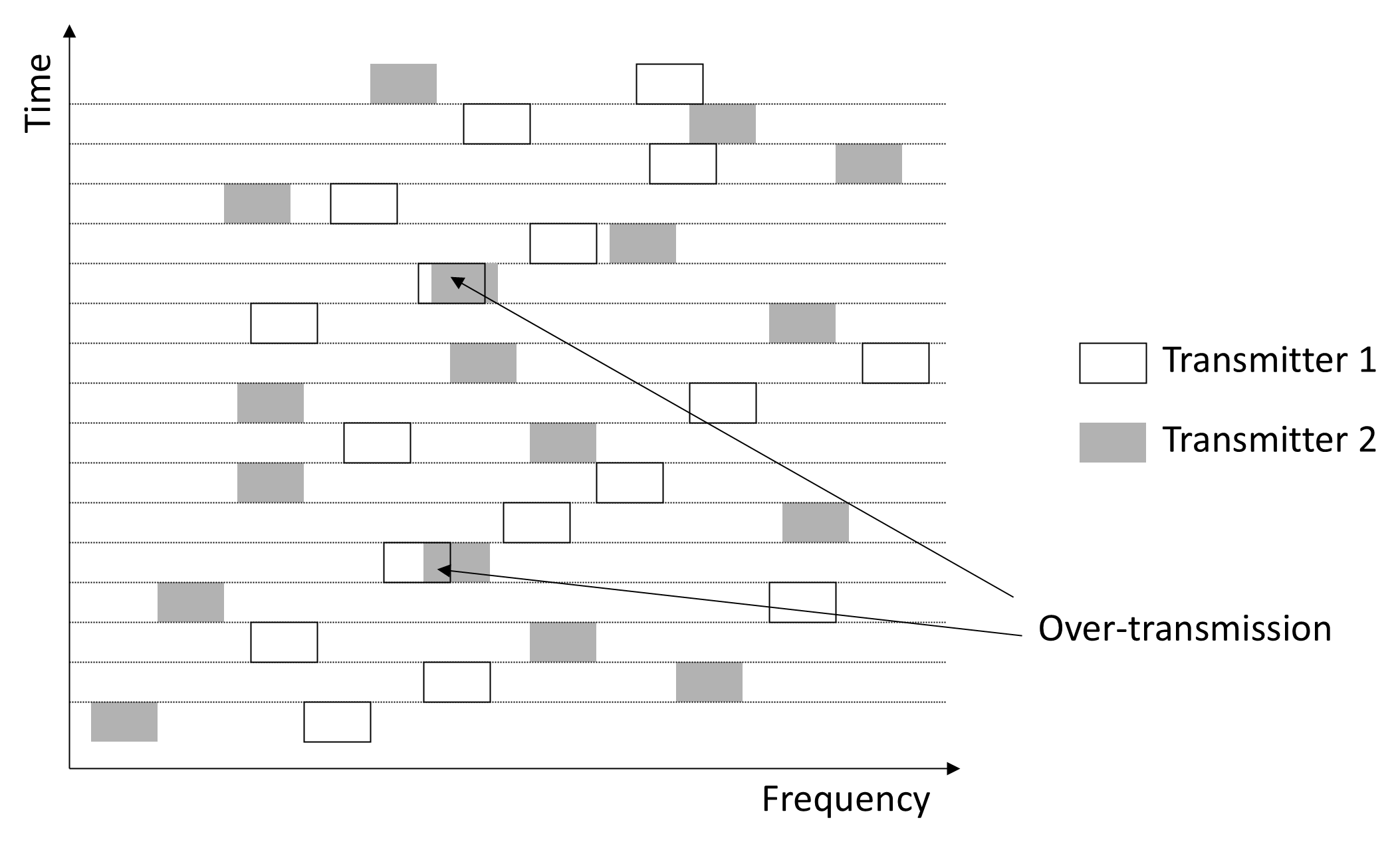
When a hop collision occurs, the overlapping bursts are typically corrupted and must be discarded. For speech communication, such losses are often imperceptible because the human auditory system can tolerate missing segments; intelligibility can often be maintained even when a substantial fraction of short bursts are lost, particularly when error concealment techniques are employed. For digital data, however, the consequences are more severe. Data systems that use FH incorporate FEC and ARQ protocols to recover lost information. To maintain acceptable throughput, the probability of hop collisions must be kept very low.
The duration spent on each frequency is known as the dwell time, typically ranging from tens of microseconds to tens of milliseconds, corresponding to hop rates from tens of kilohertz down to tens of hertz. Depending on the relationship between dwell time and symbol duration, frequency hopping is commonly categorized as slow or fast hopping. In slow frequency hopping, multiple data symbols are transmitted during each dwell interval before the carrier frequency changes. In fast frequency hopping, the carrier may change several times within the duration of a single data symbol.
Because available spectrum is finite, it is rarely possible to assign non-overlapping hop sets to every user. As a result, two or more frequency-hopping transmitters may share some common channels, and these channels may also coincide with those used by fixed-frequency (non-hopping) systems. This overlap increases the likelihood of transient interference events. The principal advantage of FH is resilience to interference and jamming. If a narrowband interferer occupies part of the spectrum, it affects only those hops that coincide with its frequency. Because the signal rapidly moves to other frequencies, the overall impact on the transmitted data can be limited. Error-correction coding and interleaving are often used in conjunction with hopping to distribute errors caused by occasional corrupted hops.
Unlike direct-sequence spreading, FH does not reduce instantaneous power spectral density; at any moment, the signal appears as a conventional narrowband transmission. However, over time, its spectral occupancy is distributed across the full hop set. As a result, long-term interference or interception requires monitoring a wide frequency range.
When multiple users employ distinct hopping sequences within the same hop set, the technique can support multiple access. Collisions occur when two users hop to the same frequency at the same time. If the hop set is large and sequences are well chosen, the probability of persistent collision is low. In this sense, FH provides a probabilistic form of code-based separation in the frequency domain.
FH systems require synchronization in both time and frequency. The receiver must follow the hopping pattern precisely, and acquisition involves determining both carrier frequency and hopping phase. Although synchronization requirements differ from those of DSSS, they remain central to reliable operation.
While direct-sequence spreading distributes energy continuously over a wide bandwidth, frequency hopping distributes energy sequentially across frequencies. Both approaches achieve bandwidth expansion and interference resilience, but through different mechanisms.
8.8.2.1 Applications Of Frequency Hopping
FH is employed in a wide range of civilian and military systems:
- Wireless LANs and personal networks: Although the original IEEE 802.11-1997 standard included a FHSS physical layer that hopped rapidly across the 2.4 GHz ISM band, this mode is now largely obsolete and seldom implemented in modern Wi-Fi equipment. Its hopping mechanism was intended to reduce narrowband interference and support coexistence among multiple WLANs, but in practice these benefits were limited and not guaranteed in dense or mixed-technology 2.4 GHz environments. By contrast, modern Bluetooth BR/EDR continues to employ fast (and, in later versions, adaptive) frequency hopping across the 2.4 GHz ISM band to mitigate interference and enable large numbers of devices to coexist.
- Cellular systems: GSM supports an optional slow frequency hopping (SFH) mode, in which the carrier changes at the frame rate to provide interference averaging and frequency diversity. This mechanism can reduce the impact of co-channel interference and frequency-selective multipath fading, although the performance gain depends on deployment conditions, mobility, and operator configuration.
- Military and secure communications: FH is a cornerstone spread-spectrum technique widely employed to improve resistance to jamming and to achieve low probability of intercept and detection (LPI/LPD). By rapidly changing the carrier frequency according to a pseudo-random hopping pattern shared only by authorized participants, frequency hopping signals appear noise-like to unintended receivers and are extremely difficult to detect, track, or predict. UHF tactical voice/data systems such as HAVE QUICK and HAVE QUICK II use time-synchronized pseudo-random hop sequences (based on word-of-day and time-of-day keys) to provide anti-jamming protection and to reduce vulnerability to intercept.
- Satellite communications: FH is also used in a number of satellite communication systems—primarily military but with some civilian implementations—for anti-jamming, interference avoidance, and spectral hardening. Military examples include UHF Follow-On (UFO), Mobile User Objective System (MUOS) legacy UHF channels, NATO SATCOM systems, and the protected EHF/AEHF family which incorporates fast-hopping and adaptive frequency spreading techniques as part of its LPI/LPD architecture. Some modern commercial systems also use hopping-like techniques, including FH channel access in DVB-RCS2 return links and pseudo-random fast carrier hopping in certain low-Earth-orbit constellations for interference avoidance and load balancing. In these systems, pseudo-random or algorithmically coordinated hop patterns distribute energy over wide bandwidths, reducing spectral predictability and improving robustness against both intentional and unintentional interference.
FH provides an effective balance between multiple access, interference suppression, and signal security. By spreading transmissions over a wide frequency range and coordinating hop patterns, FH systems achieve robustness in contested or congested spectrum environments. Although less spectrally efficient than TDMA or CDMA under heavy load, their resilience to interference and low detectability make them invaluable in tactical, mobile, and short-range wireless applications.
8.8.2.2 Code Synchronization In FH Systems
The principles of synchronization in FHSS systems parallel those in direct-sequence architectures, but the synchronization objective differs. In direct-sequence systems, the receiver must align its locally generated spreading sequence at the chip level. In FH systems, the receiver must align its hopping pattern in both time and frequency so that it tunes to the correct carrier at precisely the correct instant.
During the acquisition phase, sometimes referred to as coarse synchronization, the receiver establishes alignment between its internally generated hop sequence and the incoming signal to within a small fraction of a hop interval. Once this alignment is achieved, a tracking process, or fine synchronization, maintains coherence and compensates for oscillator drift, Doppler shift, and propagation delay variations.
Accurate synchronization is critical because even small timing errors can cause the receiver to tune to the wrong frequency during a hop transition, resulting in temporary loss of signal. The tracking loop therefore operates continuously to minimize timing and phase offsets. Depending on system design, synchronization may employ delay-locked loops, phase-locked loops, or digital timing recovery algorithms to ensure that hop transitions remain coordinated within tight temporal tolerances.
In secure or interference-prone environments, the acquisition subsystem must also be robust and rapid. Acquisition should occur quickly because interference during acquisition can disable the communication link, and the hop-sequence generator must be sufficiently long and programmable to prevent prediction or compromise.
Matched-filter and serial-search acquisition techniques are commonly employed in frequency-hopping systems. Matched-filter approaches provide rapid synchronization when the search space is limited, while serial-search methods offer flexibility for long or reprogrammable sequences. Modern implementations often combine coarse parallel detection with fine serial refinement to balance acquisition speed and robustness.
These synchronization mechanisms are fundamental to reliable operation in frequency-hopping systems, regardless of whether they are used for interference mitigation, multiple access, or secure communications.
8.8.2.3 Advantages And Disadvantages Of FHMA
FHMA offers several important advantages. Because the carrier frequency changes rapidly according to a pseudorandom sequence, it is difficult for a narrowband interferer or jammer to concentrate energy on a single channel. Interference affects only those hops that coincide in frequency and time, and error-control coding can often recover the resulting losses. FH also enables multiple users to share the same spectral band, provided that distinct hop sequences are used and the probability of persistent collision is kept low. In addition, hopping provides frequency diversity, which reduces the impact of narrowband fading and improves reliability in multipath environments. When hop sequences are known only to authorized participants, the signal exhibits low probability of intercept and detection, enhancing communication security.
Despite these advantages, FH systems introduce several challenges. Precise synchronization between transmitter and receiver is essential; loss of hop alignment immediately disrupts communication. Throughput efficiency may degrade under heavy load because collisions and retransmissions consume channel time. Implementation complexity is also higher than in fixed-frequency systems, as agile frequency synthesizers and rapid control circuitry are required. Finally, spatial or code-based orthogonality is not perfect, and collisions remain possible even when users employ distinct hopping sequences.
FH therefore represents a trade-off between spectral efficiency and robustness. While it may be less efficient than tightly scheduled time-division or code-division systems under heavy traffic, its resilience to interference and adaptability in congested spectrum environments make it valuable in many practical applications.
Back to reading