
8.5 CODE-DIVISION MULTIPLE ACCESS (CDMA)
Where FDMA separates users in frequency and TDMA separates users in time, as illustrated in Figure 8.10, CDMA separates users in signal space such that multiple transmitters can occupy the same frequency band at the same time, yet their signals remain distinguishable at the receiver through the use of distinct spreading codes.
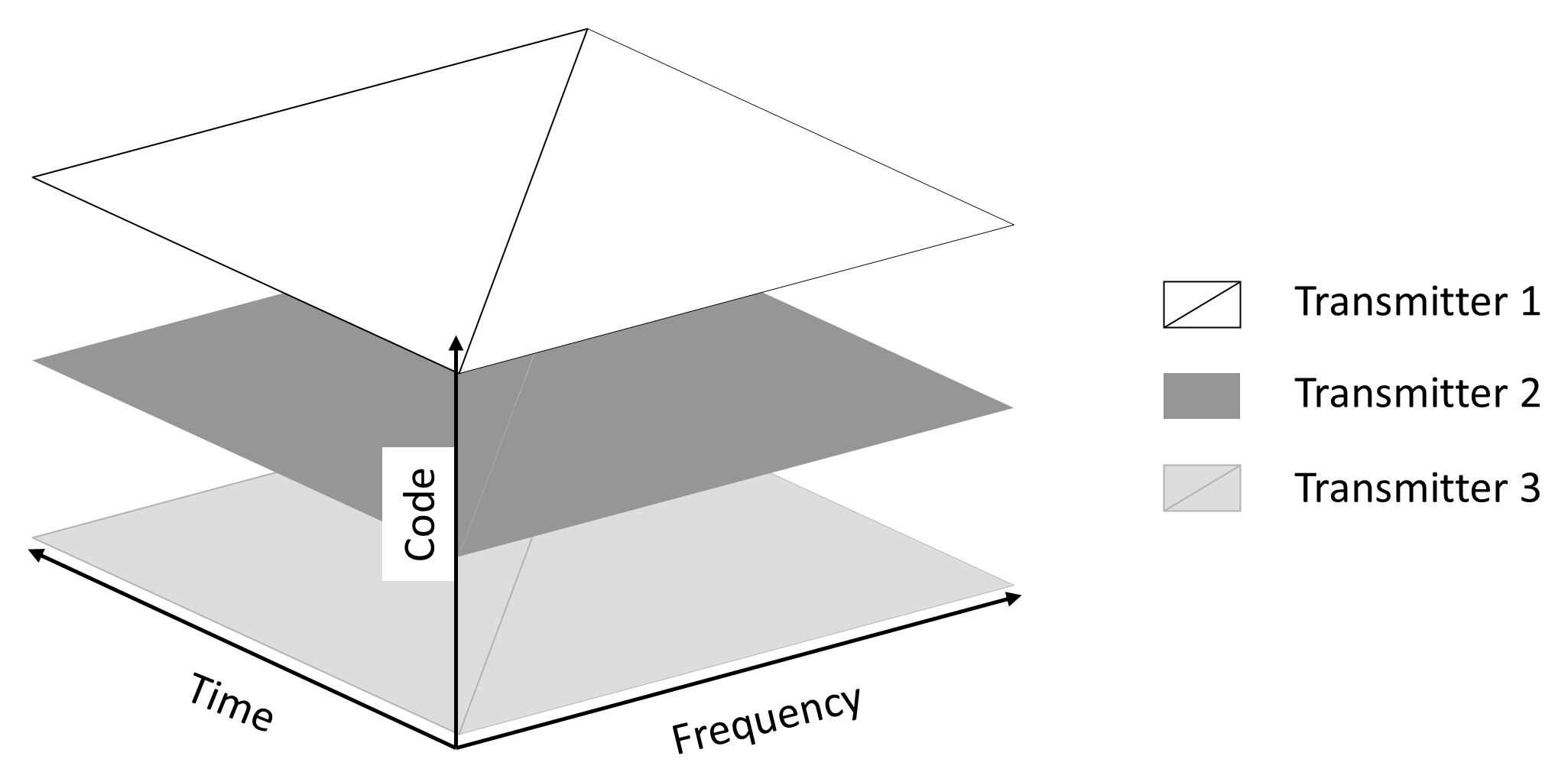
Unlike frequency or time separation, CDMA does not prevent physical overlap in the channel. Instead, it relies on controlled correlation properties so that each receiver can extract the desired signal while treating others as interference. For this reason, CDMA represents a fundamentally different form of deterministic multiple access: orthogonality is achieved mathematically rather than through physical partitioning.
Back to reading