
8.5.1 Fundamental Principle
The essential idea of CDMA is to spread each user’s signal over a bandwidth much larger than the minimum required to transmit its information. Each user applies a unique spreading sequence, typically a high-rate binary sequence known to both transmitter and receiver, to its data stream. The resulting waveform occupies a wide frequency band and resembles noise in its spectral characteristics. Figure 8.11 illustrates the application of a pseudo-random (PR) code at the transmitter to increase the data rate (spread the signal) at the transmitter and at the receiver to decrease the data rate (de-spread the signal)
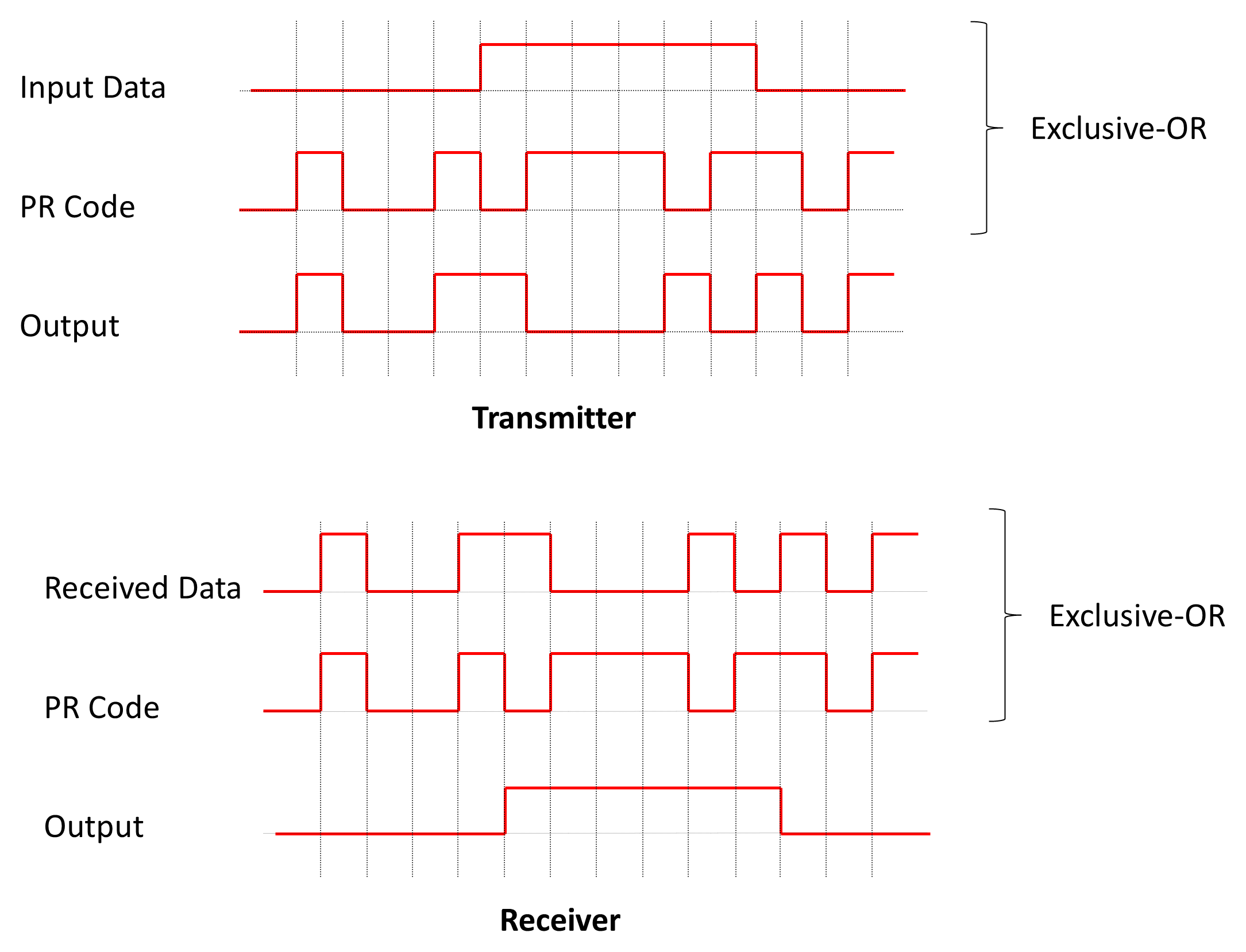
Let the original user bit rate be Rb. After spreading by a sequence with chip rate Rc, the transmitted bandwidth expands approximately in proportion to the chip rate. The ratio:
where W is the spread bandwidth, is known as the processing gain. Processing gain represents the factor by which the signal bandwidth is increased and, equivalently, the factor by which interference can be suppressed after de-spreading.
At the receiver, the desired user’s spreading code is generated locally and applied to the received composite signal. Because the spreading code matches only one user’s sequence, that user’s signal collapses back to its original bandwidth, while other users’ signals—having uncorrelated codes—remain spread and appear as low-level noise.
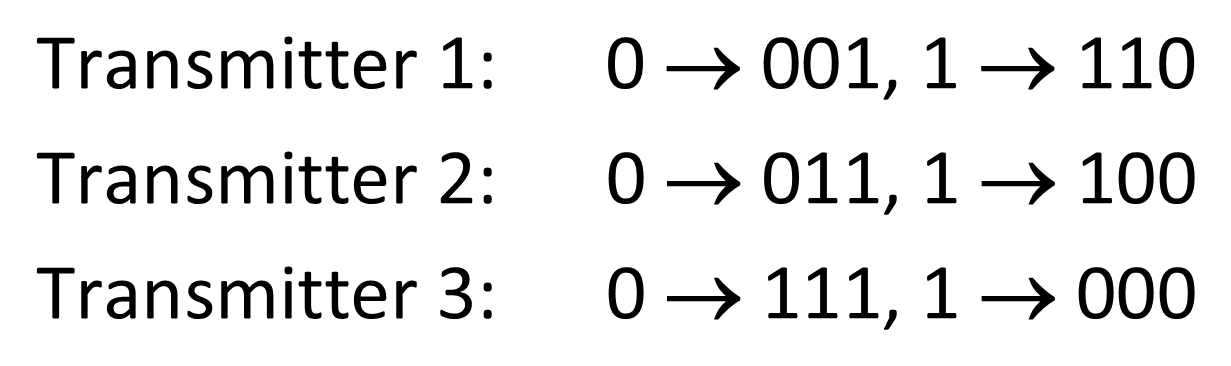
The basic operation of CDMA can be shown by a simple example involving three transmitters, each assigned a unique spreading sequence of length three (a spreading gain of 3). Each data bit is expanded to three chips before transmission. The mappings are illustrated in Figure 8.12, where the chip pattern representing a binary “0” is the logical complement of that representing a binary “1”.
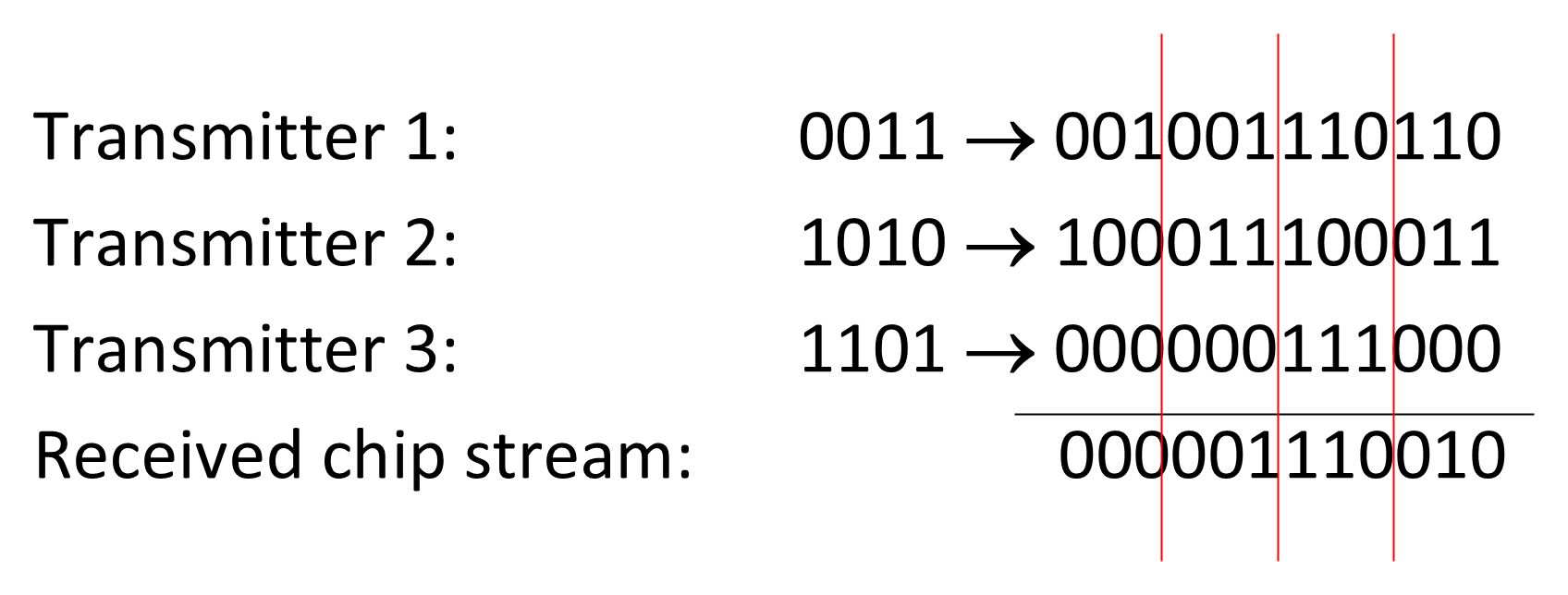
Using the mappings of Figure 8.12, each transmitter converts a four-bit data sequence into twelve chips, as shown in Figure 8.13. For example, Transmitter 1 maps bit “0” to the chip sequence 001 and bit”1” to 110. All three transmitters transmit their chip sequences simultaneously and in perfect time alignment.
If the signals from the three transmitters are exactly synchronized at the receiver, the received chip stream roughly corresponds to the effect of a majority vote between the three signals: the value of each received chip is equal to the most common chip value transmitted by the three transmitters. In this example, the received chip stream is 000001110010.
At the receiver, de-spreading is accomplished by correlation: the received chip stream is multiplied (e.g., exclusive-OR in binary logic) by the spreading code corresponding to the desired transmitter. For Receiver 1, the exclusive-OR of code 001 with each three-chip group of the received stream is computed, as illustrated in Figure 8.14.
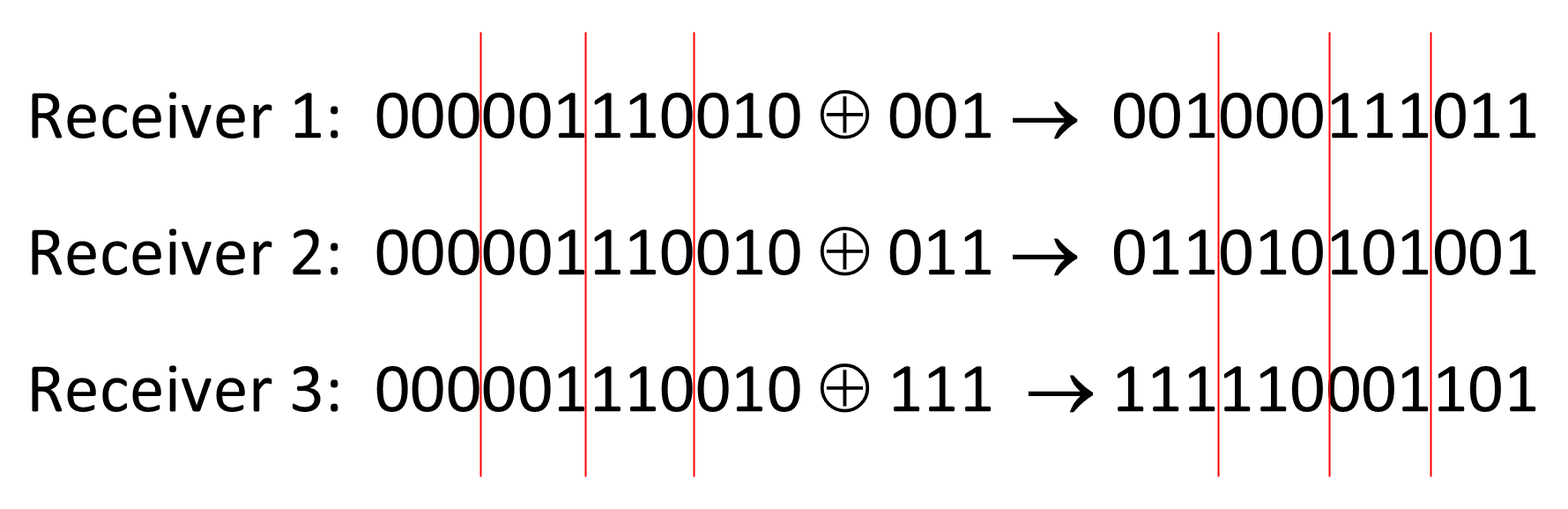
The decision process then examines each group of three de-spread chips and assigns the data bit “0” if zeros predominate, or “1” if ones predominate. This majority (voting) operation is conceptually equivalent to integrating the correlated waveform over the bit period. In the noise-free case, each receiver correctly reconstructs the bit stream of its own transmitter, as shown in Figure 8.15.
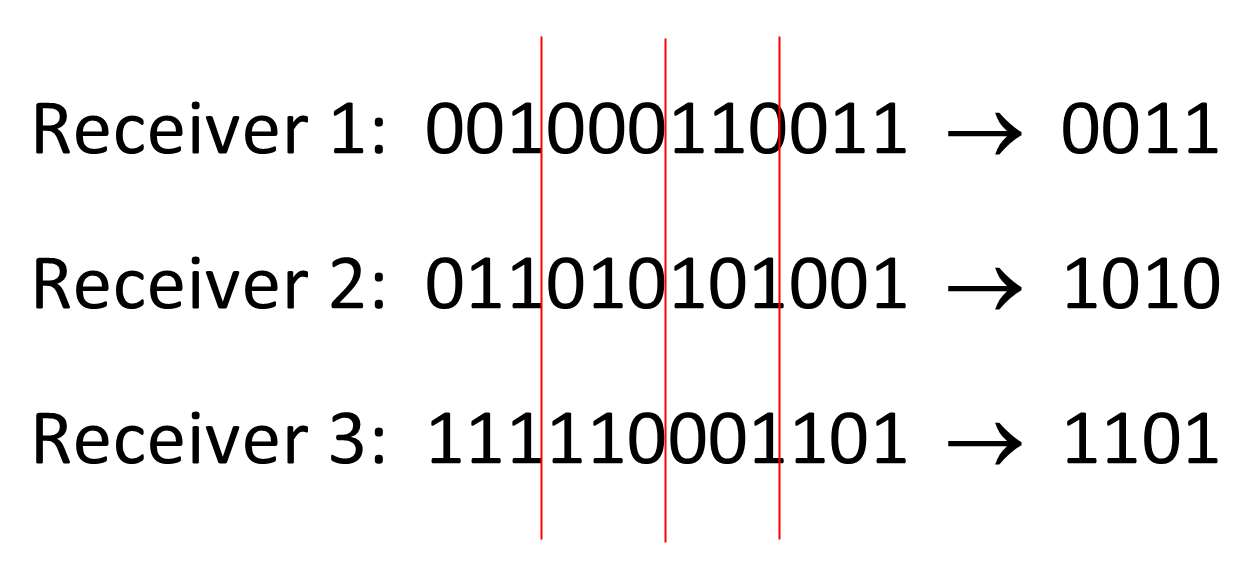
In ideal conditions, if spreading sequences are perfectly orthogonal and synchronized, users can be separated without mutual interference even though they share identical time and frequency resources. In practice, orthogonality is imperfect, and residual multiuser interference limits system capacity.
This distinction is critical: FDMA and TDMA achieve separation by preventing overlap, whereas CDMA allows overlap but relies on correlation properties to recover individual signals. The channel therefore becomes interference-limited rather than bandwidth-limited, and system performance depends strongly on code design and power control.
Back to reading